

Call/Whatsapp Anytime
+91 931 243 9444
+91 965 470 9935

Send Email
contact@sas-foundation.in

Visit Office
RZ-54/5A, Rajnagar Part 2,
Palam Colony, New Delhi 110077
+91 931 243 9444
+91 965 470 9935
contact@sas-foundation.in
RZ-54/5A, Rajnagar Part 2,
Palam Colony, New Delhi 110077
In today’s hyper-connected world, cybersecurity is no longer a niche technical domain—it is a fundamental life skill. With increasing digital dependence, every individual, especially the youth, must be equipped not just to use technology, but to use it responsibly and securely.
At SAS Foundation, this belief drives our Educational Initiatives, and the first session of the Cybersecurity Awareness Internship 2026–27 marked a strong and purposeful beginning towards that mission.

🚀 Setting the Foundation: Program Introduction
The internship commenced with an overview of the program, designed as a 10-session journey to build cybersecurity awareness among students. The session introduced the trainer, Kartik Singh, a cybersecurity professional at Tata Consultancy Services (TCS), who brings practical expertise in secure application development and offensive security.
Right from the outset, the focus was clear—this is not just another course. It is a mindset transformation initiative aimed at shaping digitally responsible citizens.
🧠 Understanding Cybersecurity: Beyond Definitions
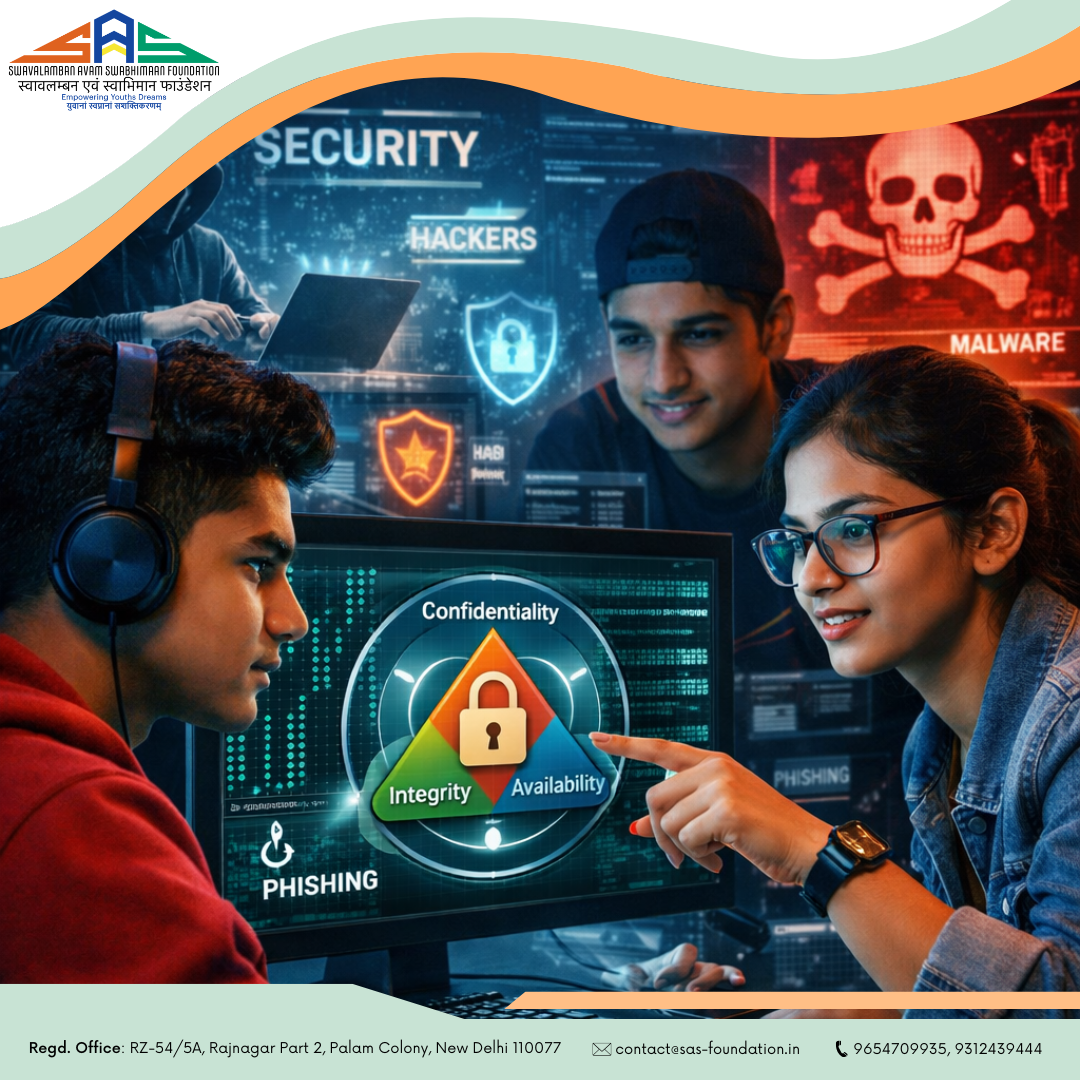
Cybersecurity was introduced not merely as a concept, but as a critical necessity in today’s digital ecosystem. At the heart of this understanding lies the CIA Triad:
These three pillars form the backbone of all cybersecurity practices and were explained through real-world analogies, making them relatable and easy to grasp for students.
⚠️ Exploring Cyber Threats: Awareness is the First Defense
The session provided a comprehensive overview of common cyber threats that individuals encounter daily. Students were introduced to various forms of malware, including:
Understanding these threats is crucial because awareness is the first line of defense. When individuals recognize how attacks work, they are better prepared to prevent them.
🕵️ Cyber Crime & Hacker Mindset: Thinking Like an Attacker
One of the most engaging parts of the session was understanding how cyber crimes are classified and how hackers operate. Cyber crimes were categorized based on their targets:
Students were also introduced to different types of hackers, categorized by intent—from ethical hackers who strengthen security to malicious actors who exploit vulnerabilities.
A key highlight was the discussion on social engineering, especially phishing—where attackers manipulate human psychology rather than technology. This reinforced an important insight:
👉 Humans are often the weakest link in cybersecurity.
🌐 Responsible Digital Citizenship: A Call to Action
The session emphasized the importance of reporting cyber crimes through platforms like the National Cyber Crime Reporting Portal, encouraging students to be proactive participants in maintaining digital safety.
More importantly, it instilled a sense of responsibility—cybersecurity is not someone else’s job. It is everyone’s responsibility.
💡 Key Takeaway: Cybersecurity is a Life Skill
What truly stood out from the session was a powerful realization:
Cybersecurity is not just a technical subject—it is a life skill in the digital age.
From protecting personal data to safeguarding digital identities, cybersecurity awareness empowers individuals to navigate the digital world with confidence and caution.
🌱 Building the Future: One Aware Individual at a Time
At SAS Foundation, our vision is to empower youth with knowledge that is practical, relevant, and future-ready. Through initiatives like the Cybersecurity Awareness Internship, we aim to create a generation that is not only digitally skilled but also digitally responsible.
Because the future will not just belong to those who use technology—
👉 It will belong to those who understand, secure, and protect it.
🤝 Join the Movement
Are we doing enough to prepare our youth for the evolving risks of the digital world?
We invite students, educators, and institutions to join hands with us in this mission of building a safer and more secure digital ecosystem. Together, we can empower the next generation with the awareness and skills they truly need.