SAS Foundation Assistant
Palam, New Delhi · Education · Health · Environment
Answers are AI-generated and may be inaccurate — for official confirmation, contact SAS Foundation directly.

+91 931 243 9444
+91 965 470 9935

contact@sas-foundation.in

RZ-54/5A, Rajnagar Part 2,
Palam Colony, New Delhi 110077
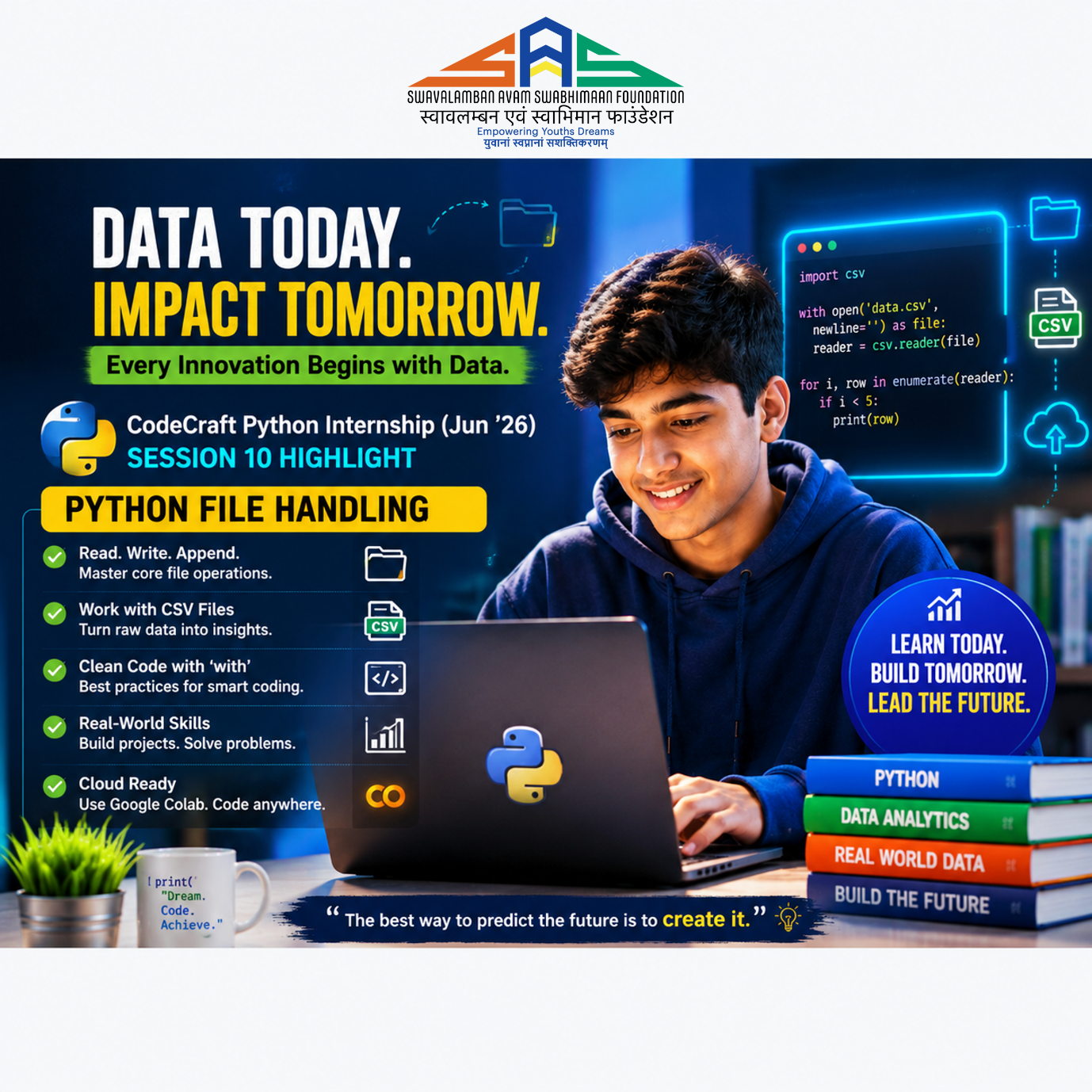
CodeCraft Python Internship (Jun ’26) | Session 10 – Python File Handling & Real-World Data Processing
“Data is often called the new oil. But unlike oil, data creates value only when it is collected, stored, managed, and understood.”
This philosophy formed the foundation of the 10th and final session of the CodeCraft Python Internship (Jun ’26) conducted by Swavalamban Avam Swabhimaan Foundation (SAS Foundation).
Over the past several weeks, participants learned the language of Python—from writing their very first program to mastering variables, conditional statements, loops, functions, collections, exception handling, and modular programming. But the concluding session introduced a concept that connects programming to nearly every modern digital innovation:
At first glance, reading or writing a file may appear to be another programming topic. In reality, it represents the moment when code begins interacting with the real world.
Because software is not valuable simply because it performs calculations.
Software becomes valuable when it remembers.
And remembering begins with file handling.

Every Digital Transformation Begins with Data
Imagine a hospital maintaining millions of patient records.
A bank processing thousands of financial transactions every minute.
An e-commerce company analyzing shopping behaviour.
A social media platform storing billions of posts.
A government delivering digital citizen services.
What powers all these systems?
Not just programming.
Persistent data.
Unlike variables that disappear once a program closes, files preserve information long after execution ends.
This simple distinction changes everything.
During the session, students explored how Python enables applications to store, retrieve, and update information using files—laying the groundwork for future careers in software engineering, artificial intelligence, cybersecurity, cloud computing, and data science.
From Temporary Memory to Lasting Knowledge
One of the most thought-provoking discussions during the session revolved around a simple comparison.
Variables are like writing on a whiteboard.
Once the board is erased, everything disappears.
Files, however, are like books in a library.
They preserve knowledge for future generations.
This analogy helped participants understand why file handling forms the backbone of almost every digital application they use every day.
Whether opening a photograph, saving a document, updating an online profile, or storing customer information, every modern application relies on file operations in one form or another.
Students began to appreciate that programming is not merely about creating algorithms.
It is about building systems that remember, evolve, and improve.
Understanding the Core Operations Behind Modern Applications
The session introduced learners to the three fundamental file operations every Python developer must understand.
Reading Files
Before software can make intelligent decisions, it must first access information.
Students learned how Python reads data stored inside text files and prepares it for processing.
From customer records to application logs, reading files is often the first step in any data-driven workflow.
Writing Files
The next step focused on creating and storing information.
Participants explored how Python writes data permanently into files, enabling applications to generate reports, maintain records, and preserve outputs.
They also learned an important principle:
Writing in default mode replaces existing content.
Understanding this behaviour prevents accidental data loss and encourages responsible programming practices.
Appending Information
Modern applications rarely replace all existing data.
Instead, they continue adding new information over time.
Students explored append mode, which enables applications to preserve historical information while continuously expanding datasets.
Whether maintaining attendance records, transaction logs, or system events, appending allows software to build history rather than overwrite it.
Building Reliable Software Through Error Handling
Professional software isn’t judged by how it performs when everything goes right.
It is judged by how gracefully it handles unexpected situations.
During the session, participants encountered one of the most common programming challenges:
FileNotFoundError
Instead of viewing this as an obstacle, students learned that robust developers anticipate such situations.
By combining file operations with try-except blocks, they discovered how applications can recover from errors, guide users effectively, and continue functioning without crashing.
This lesson extended beyond programming.
It reinforced an important life skill.
Preparation creates resilience.
Cleaner Code Creates Better Developers
Another important milestone came with the introduction of Python’s with statement.
Although beginners often manually open and close files, professional developers prefer the with statement because it automatically manages system resources.
Students realized that good programming is not only about producing correct output.
It is equally about writing code that is:
These qualities distinguish software engineers from programmers who simply write code.
Why CSV Files Matter in the Age of Artificial Intelligence
One of the most exciting parts of the session introduced students to CSV (Comma Separated Values) files.
While CSV files appear simple, they power countless real-world applications.
Businesses use CSV datasets to understand customer behaviour.
Hospitals manage healthcare information.
Schools maintain academic records.
Researchers analyze scientific data.
Machine learning engineers train intelligent algorithms using structured datasets.
Participants learned how Python’s built-in csv module simplifies data processing by automatically organizing rows into structured lists.
Instead of manually splitting text, Python provides elegant tools that dramatically improve productivity.
For many students, this was their first glimpse into the world of Data Analytics.
Learning Through Real-World Challenges
Education becomes meaningful when knowledge transforms into application.
To reinforce the session’s concepts, students received a practical assignment:
Read a CSV file and display the first five rows using Python’s csv module.
This seemingly simple exercise introduced learners to several professional programming practices simultaneously:
Rather than memorizing syntax, students began solving authentic problems.
Embracing Cloud-Based Development
Modern developers are no longer limited by their local computers.
Recognizing this reality, the session also introduced Google Colab as a cloud-based development environment.
Students discovered how cloud notebooks allow programmers to write code, upload datasets, and perform file operations without requiring complex local software installations.
This exposure prepares learners for industry practices where cloud computing increasingly powers software development, artificial intelligence research, and collaborative engineering.
Learning Python today means learning within the ecosystems that professionals use every day.
More Than Programming—Developing a Data Mindset
The final session demonstrated an important truth.
Programming languages change.
Technologies evolve.
Frameworks become obsolete.
But the ability to think logically about data remains timeless.
By understanding file handling, students began developing a mindset that values:
These competencies extend far beyond Python.
They form the foundation of successful careers across technology industries.
The End of an Internship. The Beginning of Possibilities.
As the CodeCraft Python Internship reached its conclusion, participants completed far more than ten technical sessions.
They completed a journey of transformation.
They learned how computers think.
How programs make decisions.
How data is organized.
How functions improve design.
How errors are managed.
And finally, how information is preserved for future use.
These lessons are not merely about becoming Python programmers.
They are about becoming innovators capable of solving tomorrow’s challenges.
SAS Foundation’s Commitment to Future-Ready Education
At Swavalamban Avam Swabhimaan Foundation (SAS Foundation), education is viewed as the foundation for self-reliance, innovation, and social transformation.
Through initiatives like the CodeCraft Python Internship, the Foundation equips young learners with practical digital skills, critical thinking abilities, and confidence to thrive in an increasingly technology-driven world.
By combining structured learning, hands-on assignments, mentorship, and real-world applications, SAS Foundation continues its mission of Empowering Youths’ Dreams and preparing the next generation to become creators—not just consumers—of technology.
The final session may have focused on file handling, but its larger lesson was far more profound:
The future belongs to those who know how to transform information into insight, ideas into innovation, and learning into lasting impact.
If you believe every young mind deserves the opportunity to build a brighter digital future, join SAS Foundation as a member, volunteer, mentor, or partner. Together, we can create opportunities, nurture talent, and empower the innovators who will shape tomorrow.