
Call/Whatsapp Anytime
+91 931 243 9444
+91 965 470 9935

Send Email
contact@sas-foundation.in

Visit Office
RZ-54/5A, Rajnagar Part 2,
Palam Colony, New Delhi 110077
+91 931 243 9444
+91 965 470 9935
contact@sas-foundation.in
RZ-54/5A, Rajnagar Part 2,
Palam Colony, New Delhi 110077
When Classrooms Become Catalysts for National Transformation
“The future will not belong to those who simply collect degrees. It will belong to those who connect knowledge with purpose and innovation with societal impact.”
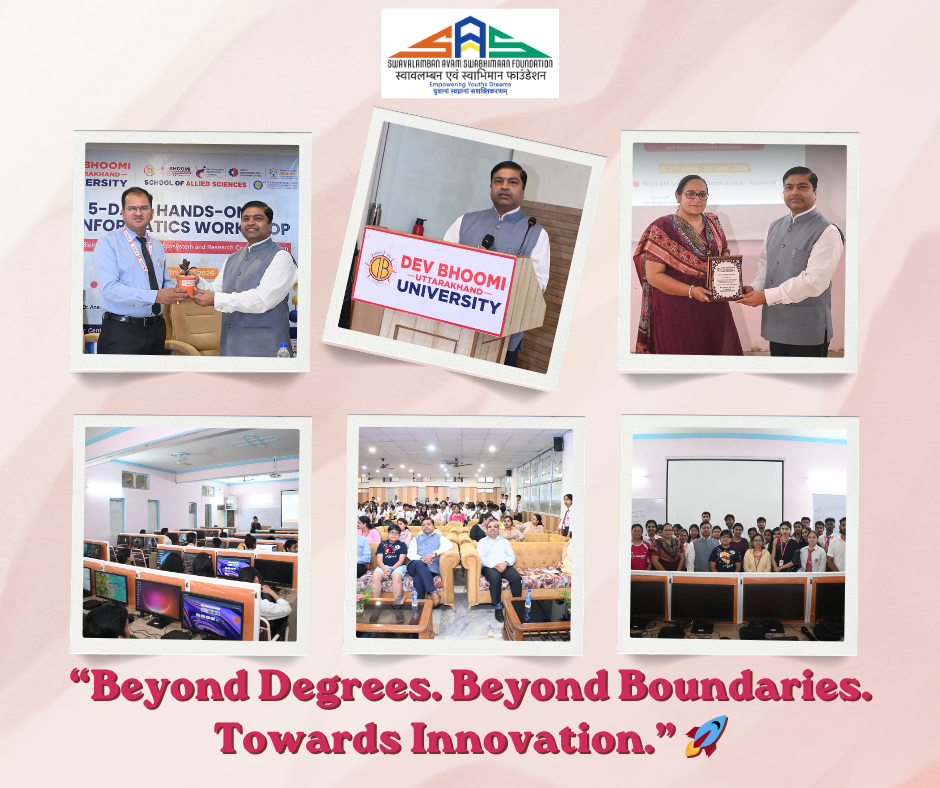
What began as an academic interaction at the Bioinformatics Workshop hosted by Dev Bhoomi Uttarakhand University soon evolved into a larger conversation about the future of education, innovation, Artificial Intelligence, and India’s journey towards self-reliance.
Dr. Nitin Saini addressed students, researchers, and academicians from DBUU and multiple participating colleges during the inaugural session of the workshop, setting the tone for a day focused not just on technology, but on responsibility, systems thinking, and meaningful innovation.
The interaction reflected a growing reality in today’s world — the challenges of the future will not be solved by isolated disciplines. They will be solved by interdisciplinary collaboration, ethical technology, and youth-driven innovation.

AI in Disease Surveillance: A New Era of One-Health Intelligence
One of the highlights of the workshop was Dr. Nitin Saini’s lecture on:
“AI for Disease Surveillance & One-Health Analytics”
The session explored how Artificial Intelligence is transforming the way societies approach disease surveillance, public health intelligence, and early warning systems.
Students showed immense curiosity while learning how:
The lecture emphasized an important global reality:
Disease surveillance is no longer just a healthcare issue — it is a systems challenge.
As pandemics, zoonotic diseases, climate risks, and global interconnectedness continue to reshape societies, the need for integrated and AI-enabled public health systems is becoming increasingly urgent.
The session also highlighted how India has the potential to become a global leader in digital public health infrastructure by combining:
The discussion resonated strongly with students who are eager to contribute to real-world impact beyond conventional academic pathways.
“Go A Little Beyond the Normal”
In a powerful extension of the day’s conversations, Dr. Ajay Kumar invited Dr. Nitin Saini to address the UG, PG, and Research Scholars of Aerospace Engineering.
What followed was not merely a technical interaction — it became a larger motivational dialogue on innovation, purpose, and nation-building.
During the interaction, students were encouraged to:
One message particularly resonated with the students:
“Innovation begins when you decide to go a little beyond the normal.”
Whether in Aerospace Engineering, Bioinformatics, AI, Healthcare, or Sustainability, the future belongs to individuals who are willing to:
The interaction strongly aligned with the national vision of:
Atmanirbhar Bharat — a self-reliant India driven by innovation, research, and youth leadership.
Why Interdisciplinary Innovation Matters More Than Ever
Later, during a meaningful discussion with Sh. Aman Bansal, the focus shifted toward one of the most important themes shaping the future of higher education:
Interdisciplinary Innovation
With 14 different schools operating under the DBUU ecosystem, the university represents a powerful model for collaborative learning and cross-domain problem-solving.
Today’s global challenges no longer fit neatly inside departmental boundaries.
The next breakthroughs will emerge where:
Institutions that encourage interdisciplinary collaboration will become the true engines of innovation in the coming decade.
The conversation also reinforced the idea that universities must evolve from being degree-distribution centers into:
Education Must Move Beyond Information Delivery
One of the strongest themes emerging from the workshop was the evolving role of education itself.
In a rapidly changing world driven by Artificial Intelligence, automation, and digital transformation, education can no longer focus only on information transfer.
Students today already have access to information.
What they truly need is:
The future workforce will not be defined merely by technical competence.
It will be defined by:
India’s Opportunity in the Age of AI & One-Health
India stands at a unique moment in history.
With:
India has the opportunity to become a global leader in:
But achieving this requires one critical shift:
Students and institutions must begin thinking beyond silos.
The future belongs to those who can integrate knowledge across domains and apply it responsibly for societal impact.
A Message to Students
As the workshop concluded, one idea remained central throughout the day:
Degrees may open doors, but innovation creates impact.
The world today does not need more passive learners.
It needs:
The future of India’s innovation ecosystem will be built by students who are willing to:
Because that “little beyond” is where transformation begins.
About SAS Foundation
SAS Foundation is a youth-focused NGO working across Education, Health, Environment, and Community Development with the vision of empowering youth dreams through impactful initiatives, awareness programs, innovation-driven engagements, and sustainable social transformation.