

SAS Foundation Assistant
Palam, New Delhi · Education · Health · Environment
Answers are AI-generated and may be inaccurate — for official confirmation, contact SAS Foundation directly.

+91 931 243 9444
+91 965 470 9935

contact@sas-foundation.in

RZ-54/5A, Rajnagar Part 2,
Palam Colony, New Delhi 110077
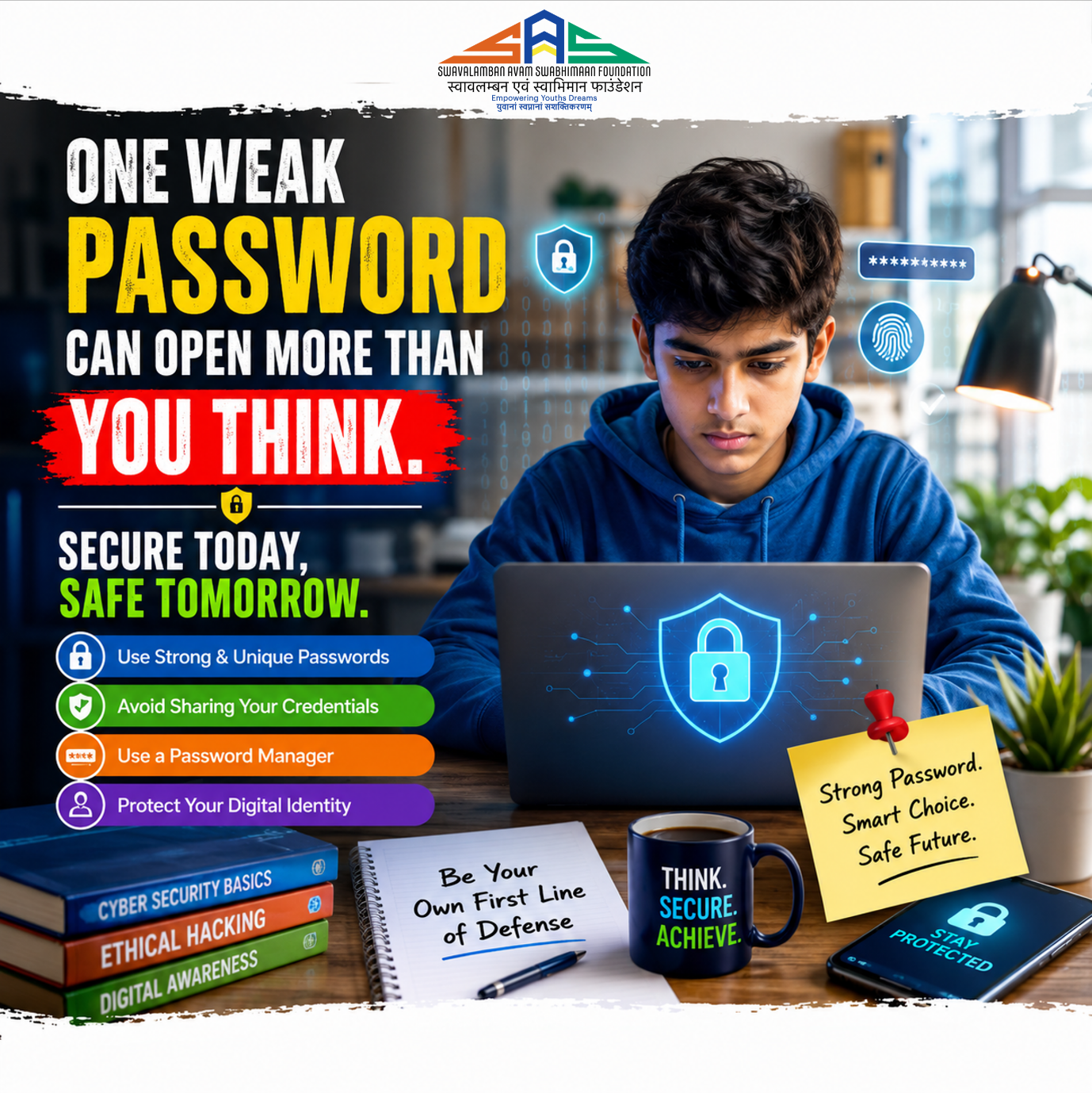
Cyber Guardians Internship (Jun ’26) | Session 5: Creating Strong Passwords & Using Password Managers
“The biggest cyber security risk isn’t sophisticated malware or advanced hackers—it is the simple password we thought nobody would guess.”
Every day, millions of people log into email accounts, social media platforms, banking applications, educational portals, cloud storage, and countless other digital services. Behind every login lies something incredibly valuable—our identity, personal information, memories, finances, and future opportunities.
Yet surprisingly, many people continue to protect all of this with passwords like 123456, password, their birthday, or their pet’s name.
The reality is both alarming and eye-opening: cyber criminals no longer need to “hack” sophisticated systems when weak passwords provide an easier path.
Recognizing this growing challenge, SAS Foundation dedicated Session 5 of the Cyber Guardians Internship (Jun ’26) to one of the most fundamental yet overlooked aspects of cyber security—building strong passwords and adopting smarter password management practices.
Rather than simply teaching technical concepts, the session empowered students to understand that cyber security begins with everyday decisions.

Why Passwords Matter More Than Ever
Our digital lives have expanded dramatically over the past decade.
Students today manage accounts across:
Every new account creates another doorway into our digital identity.
A weak password leaves that door unlocked.
A strong password turns it into a fortress.
One of the most important lessons from the session was that passwords are the first line of defense in cyber security. While organizations invest heavily in advanced security infrastructure, individual users often remain the weakest link because of poor password habits.
Cyber Criminals Don’t Guess—They Automate
Many people imagine hackers sitting behind computers manually trying different passwords.
Today’s cyber attacks rarely work that way.
Modern attackers use automated tools capable of testing millions of password combinations within minutes.
Students were introduced to common attack techniques, including:
Perhaps the most surprising concept for many participants was credential stuffing.
When one website experiences a data breach, attackers often obtain usernames and passwords. They then automatically test the same credentials across hundreds of other services, knowing that many users reuse identical passwords everywhere.
This means a single leaked password can compromise:
The lesson was simple but powerful:
Never reuse passwords across different platforms.
What Makes a Strong Password?
Creating strong passwords is no longer optional.
During the internship session, students learned that an effective password should:
✔ Be at least 12 characters long
✔ Include uppercase letters
✔ Include lowercase letters
✔ Include numbers
✔ Include special symbols
✔ Avoid personal information
✔ Be unique for every website
Longer passwords significantly increase the time required for automated cracking attempts, making unauthorized access dramatically more difficult.
However, complexity alone isn’t enough.
Passwords must also be memorable.
The Rise of Passphrases
One of the most practical concepts introduced during the session was the use of passphrases.
Instead of relying on short, difficult-to-remember passwords, students explored how meaningful phrases can create both stronger security and better usability.
For example, instead of choosing predictable passwords, users can develop unique phrases that are easy for them to remember but extremely difficult for attackers to guess.
This approach combines:
Passphrases represent a modern evolution in password security and are increasingly recommended by cyber security experts worldwide.
The Password Mistakes People Make Every Day
Many cyber incidents begin with surprisingly simple mistakes.
The session highlighted several practices that dramatically increase cyber risk, including:
Students quickly realized that convenience often comes at the expense of security.
Developing safer habits today prevents far greater problems tomorrow.
Password Managers: Smarter Security for the Digital Age
As students accumulate dozens—or even hundreds—of online accounts, remembering unique passwords becomes nearly impossible.
Rather than encouraging unsafe shortcuts, Session 5 introduced one of the most important tools in modern cyber security:
Password Managers
Participants explored how password managers help users:
The session included an introduction to well-known password management solutions such as:
Students also observed a live demonstration of Bitwarden, where they learned how to:
This practical demonstration helped transform password management from an abstract concept into an accessible daily habit.
Security Is About Habits, Not Fear
One of the strongest messages from the session was that cyber security should never be driven by fear.
Instead, it should be built on awareness.
Simple daily habits create enormous improvements in digital safety:
Cyber resilience grows through consistent practice rather than complicated technology.
Learning Through Practical Assignments
To reinforce classroom learning, participants were assigned an engaging activity:
Design a Password Strength Checker Flowchart.
Students were challenged to create a logical decision-making process that determines whether a password meets recommended security standards.
The assignment encouraged learners to apply critical thinking while reinforcing concepts such as:
This hands-on approach transforms theoretical understanding into practical problem-solving skills.
Preparing India’s Youth for a Secure Digital Future
As India accelerates toward becoming a digitally empowered society through expanding internet access, digital public infrastructure, online education, AI adoption, and digital financial services, cyber awareness becomes an essential life skill.
Future-ready citizens require more than technical knowledge.
They need:
Cyber security education should begin early, empowering students to become informed digital citizens capable of protecting themselves, their families, and their communities.
About the Cyber Guardians Internship
The Cyber Guardians Internship (Jun ’26) is an educational initiative by SAS Foundation designed to equip students with practical cyber security awareness and responsible digital citizenship skills.
The internship covers essential topics including:
Each session combines expert guidance, real-world examples, practical demonstrations, quizzes, and assignments to create an engaging learning experience.
Join the Movement for a Safer Digital Future
Every secure password created today is a step toward a safer digital tomorrow.
At SAS Foundation, we believe that empowering young minds with cyber awareness is not merely about protecting devices—it is about protecting dreams, opportunities, identities, and futures.
By investing in cyber education today, we are nurturing a generation that is confident, responsible, and resilient in an increasingly connected world.
If you believe every student deserves access to future-ready digital education, become a member of SAS Foundation, volunteer with us, partner with our initiatives, or support our educational programs. Together, we can build a digitally aware and cyber-secure India—one learner at a time.