SAS Foundation Assistant
Palam, New Delhi · Education · Health · Environment
Answers are AI-generated and may be inaccurate — for official confirmation, contact SAS Foundation directly.

+91 931 243 9444
+91 965 470 9935

contact@sas-foundation.in

RZ-54/5A, Rajnagar Part 2,
Palam Colony, New Delhi 110077
A small collection box. A few discarded chargers and cables. A group of curious students. And a much bigger lesson about environmental responsibility.
Sometimes, meaningful environmental change does not begin with a massive campaign. It begins with something as simple as giving people the right place to act.
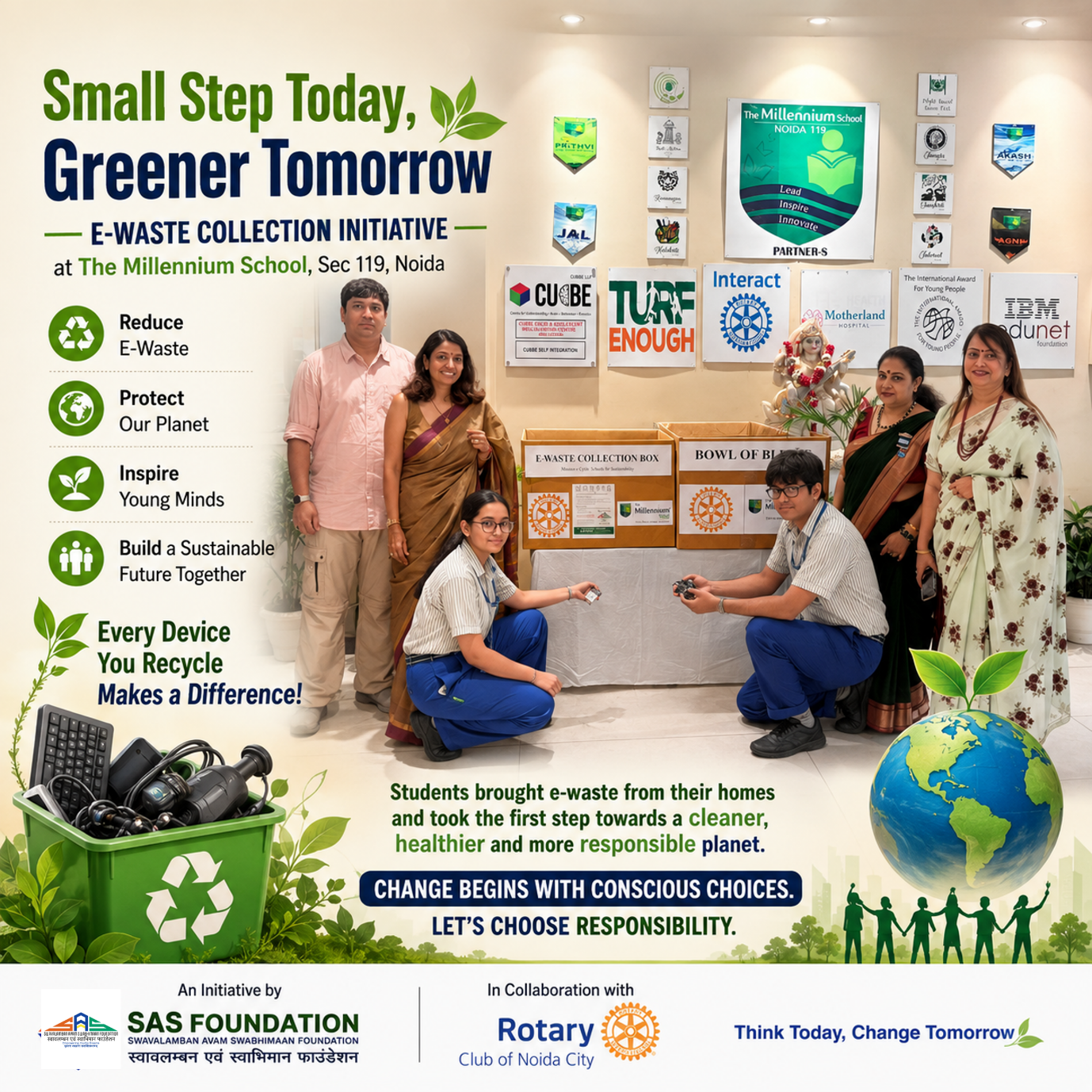
That is the thinking behind the E-Waste Awareness & Collection Initiative by SAS Foundation, in collaboration with Rotary Club of Noida City, which recently reached The Millennium School, Sector 119, Noida.
The installation of an e-waste collection box at the school may appear to be a small intervention. But its real significance lies beyond the box itself.
It is about changing a habit.
It is about helping a young student understand that the old charger lying unused at home is not simply “garbage”. It is electronic waste that deserves responsible handling.
And most importantly, it is about transforming environmental awareness from something students hear about into something they can practise.
From Awareness to Action
Environmental education often faces one fundamental challenge: awareness does not automatically lead to action.
A student may know that plastic pollution is harmful. They may understand that trees are important. They may have heard about climate change and sustainability.
But what happens when they have an old mobile phone, charger, cable, earphone or electronic accessory at home?
Where should it go?
That question is where meaningful environmental education begins.
Through the school-based e-waste collection initiative, SAS Foundation and Rotary Club of Noida City are creating a simple bridge between knowledge and behaviour.
The collection box provides students and teachers with a visible, accessible mechanism to practise responsible e-waste disposal.
The message is simple:
Don’t throw it away. Dispose of it responsibly.
A Box That Started a Conversation
At The Millennium School, Sector 119, Noida, the initiative received an encouraging response from the school and its staff.
The appreciation expressed by the school reflects an important reality: educational institutions are not merely places where academic knowledge is delivered. They are powerful environments for shaping attitudes, habits and values.
The real moment of impact, however, came when students began bringing e-waste from their homes and placing it into the collection box.
That action may have taken only a few seconds.
But behind it was a chain of decisions.
A student noticed an unused electronic item at home.
They remembered the initiative.
They chose not to discard it casually.
They brought it to school.
And they placed it into a designated collection point.
That is how environmental consciousness develops—not always through grand gestures, but through repeated, everyday choices.
Why E-Waste Education Matters
Electronic devices have become inseparable from modern life.
Mobile phones, laptops, tablets, chargers, earphones, keyboards, routers and countless other electronic products make our lives more connected and convenient.
But every device eventually reaches the end of its useful life.
The challenge is what happens next.
When electronic waste is improperly discarded, valuable recoverable materials may be lost and environmental risks can increase. Responsible collection and recycling therefore form an important part of building a more sustainable relationship with technology.
For young people in particular, e-waste presents an opportunity to connect two seemingly different worlds:
technology and environmental responsibility.
Today’s students are among the most digitally connected generations. They understand technology naturally. The next step is helping them understand the responsibility that comes with consuming technology.
Schools Can Become Sustainability Catalysts
A school can influence far more than the students sitting inside its classrooms.
When a child learns something meaningful at school, the lesson often travels home.
A student who learns about responsible e-waste disposal may ask their parents:
“What should we do with these old chargers?”
A teacher who participates in the initiative may encourage colleagues to adopt better disposal practices.
A school that establishes a collection mechanism can inspire its wider community.
This creates a multiplier effect.
The school becomes not merely a collection point, but a community sustainability catalyst.
That is why school-based environmental initiatives deserve greater attention.
They combine education with action and create an opportunity for young citizens to influence behaviour beyond the classroom.
From E-Waste Collection to Environmental Leadership
The ambition should not end with filling a collection box.
The larger objective is to nurture environmentally conscious young citizens.
A successful e-waste initiative should encourage students to ask broader questions:
Do I really need to replace this device?
Can an electronic product be repaired?
Can it be reused?
How should it be disposed of when it reaches the end of its life?
Where does my e-waste go after I throw it away?
These questions are the foundations of responsible consumption.
They move young people from being passive consumers to becoming informed environmental decision-makers.
Building a Culture of Responsible Consumption
Sustainability is not simply about planting trees or cleaning public spaces.
It is also about examining how we consume resources and what happens to products after we are finished using them.
This is where responsible e-waste management connects strongly with the principles of the circular economy.
Instead of viewing products as something that moves from “purchase” to “use” to “throw away”, society needs to think in terms of longer product lifecycles, repair, reuse, recovery and responsible recycling.
Students exposed to these ideas early can become tomorrow’s conscious consumers, innovators, entrepreneurs and policymakers.
That is a far more lasting impact than simply collecting a few kilograms of electronic waste.
A Partnership Built Around Young Minds
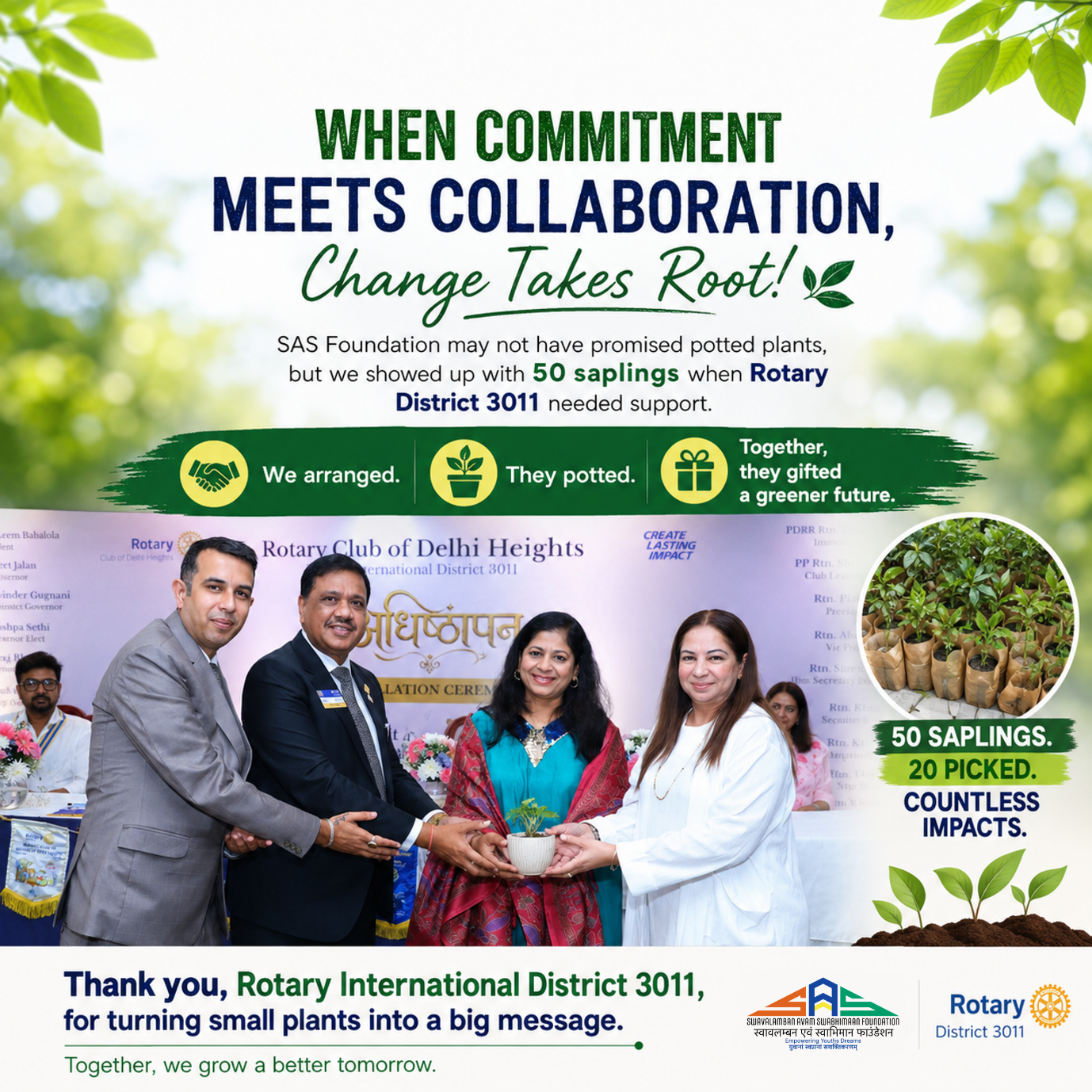
The initiative also demonstrates the power of collaboration.
SAS Foundation brings its environmental outreach experience and implementation framework.
Rotary Club of Noida City brings community engagement and its network of Interact Schools.
Schools provide the most important platform—the opportunity to engage directly with young minds.
Together, these stakeholders can create a model where awareness, infrastructure and action reinforce each other.
And the journey does not end with the installation of the collection box.
The initiative is designed to be supported by awareness and engagement activities that can help students understand the environmental implications of e-waste and responsible recycling.
The ultimate goal is behavioural change.
One School. One Box. Many Ripples.
The installation at The Millennium School is one step in a larger journey.
One collection box can encourage hundreds of students to think differently.
Those students can influence their families.
Families can change disposal habits.
Schools can inspire other institutions.
And institutions can collectively contribute to a stronger culture of environmental responsibility.
This is how seemingly small interventions create large social impact.
A box becomes a habit.
A habit becomes a mindset.
A mindset becomes a movement.
The Real Measure of Success
The success of an environmental initiative should not be measured only by kilograms collected.
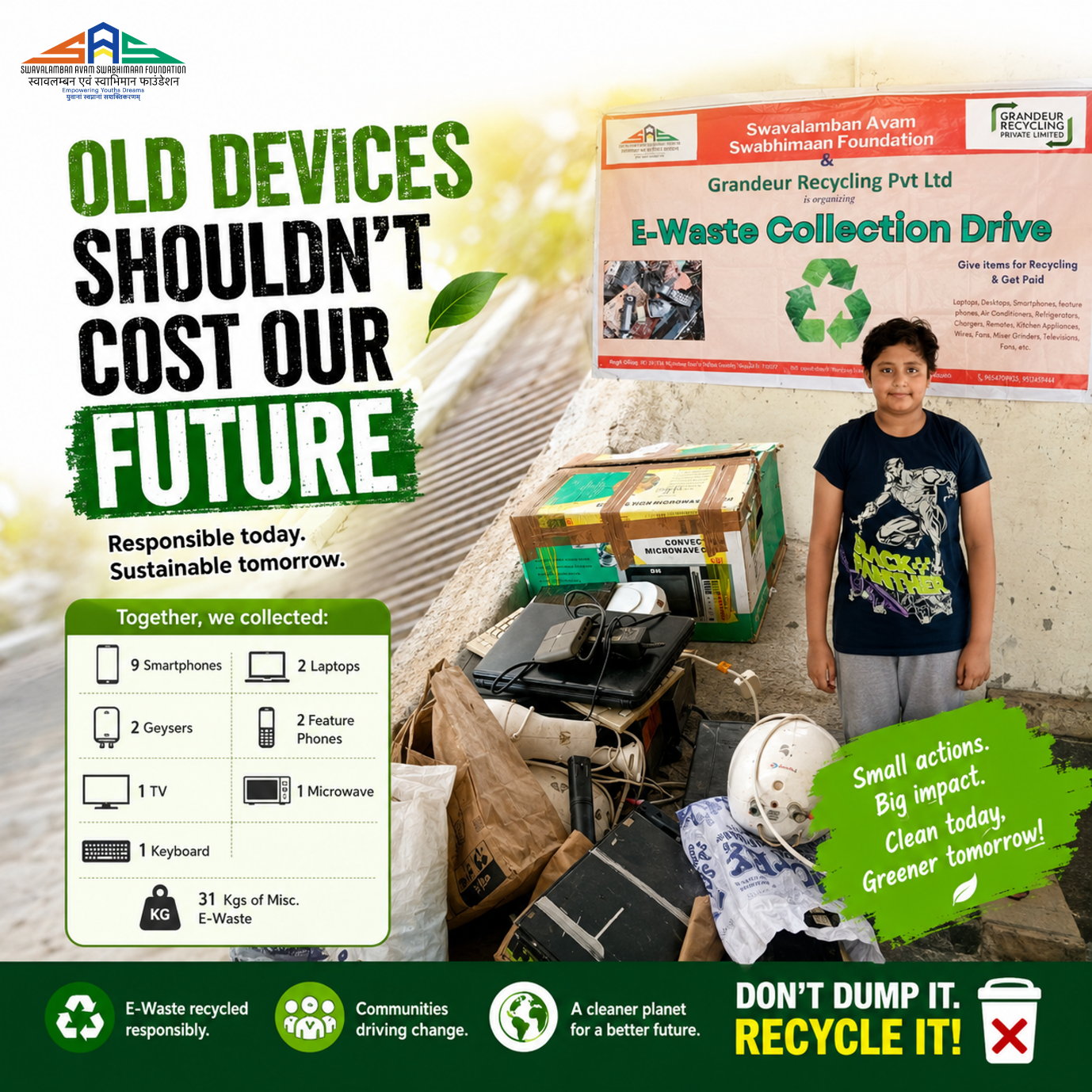
Kilograms matter. They help us quantify diversion and demonstrate tangible outcomes.
But there is another metric that is harder to measure—and potentially much more valuable:
How many minds changed?
How many students thought twice before throwing away an electronic item?
How many families started discussing responsible e-waste disposal?
How many teachers became environmental ambassadors?
How many young people began seeing sustainability as a personal responsibility rather than someone else’s job?
That is the impact that can continue long after the collection box is emptied.
A Call to Schools, Students and Communities
The experience at The Millennium School offers a simple lesson for every educational institution:
Environmental awareness becomes powerful when people are given an opportunity to act.
Schools can create sustainability corners.
Students can become environmental ambassadors.
Teachers can integrate responsible consumption into everyday learning.
Families can collect e-waste instead of casually discarding it.
Organisations can support structured recycling initiatives.
And communities can come together to make responsible disposal easier and more accessible.
At SAS Foundation, the belief is simple: empowering young people means empowering them not only to dream about a better future, but also to take responsibility for building it. Environmental conservation is an important part of that journey.
The next generation is watching us.
The question is not whether they will inherit the environmental consequences of today’s choices.
They will.
The question is:
What habits will we teach them before that happens?
The e-waste collection box at The Millennium School is a small but meaningful answer.
It tells every student who uses it:
Your choice matters.
Your action matters.
And protecting the planet begins with you.
Join the Movement
SAS Foundation invites schools, students, teachers, parents, corporates, community organisations and environmentally conscious citizens to join hands in building a culture of responsible e-waste management.
If your school or organisation would like to conduct an e-waste awareness session, establish a collection point, organise an e-waste collection drive, or collaborate on environmental initiatives, connect with SAS Foundation.
Do not just talk about sustainability. Create a system that makes sustainable action possible.
Join SAS Foundation as a member, volunteer, institutional partner or environmental champion—and help empower young minds to build a cleaner, greener and more responsible future.
Together, let us turn awareness into action.
Palam, New Delhi · Education · Health · Environment
Answers are AI-generated and may be inaccurate — for official confirmation, contact SAS Foundation directly.