SAS Foundation Assistant
Palam, New Delhi · Education · Health · Environment
Answers are AI-generated and may be inaccurate — for official confirmation, contact SAS Foundation directly.

+91 931 243 9444
+91 965 470 9935

contact@sas-foundation.in

RZ-54/5A, Rajnagar Part 2,
Palam Colony, New Delhi 110077
In today’s rapidly evolving society, true inclusion is measured not by passing intent, but by the absolute consistency of our actions. While global conversations around diversity and accessibility continue to grow, achieving meaningful impact requires sustained grassroots engagement, empathy-driven solutions, and long-term partnerships.
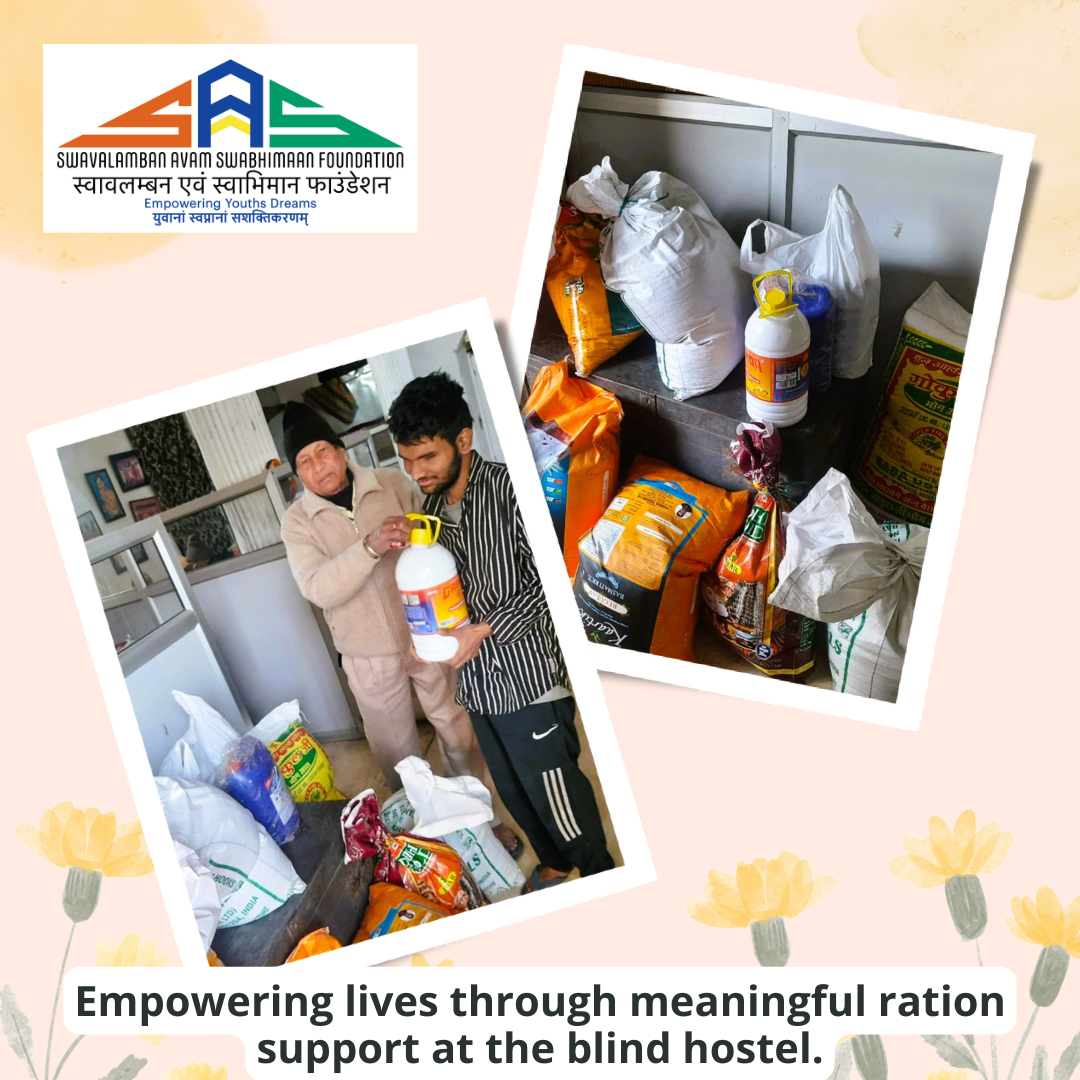
At the foundation, we believe that social responsibility does not conclude with a single handout. It begins with active listening, continues with structured action, and matures into an unyielding, lasting commitment. Guided by this philosophy, the SAS Foundation disability inclusion program recently sponsored a comprehensive donation of essential ration and grocery supplies for 40 young blind residents at the Rashtriya Blind Hostel & Training Center (RBHTC) in Delhi. These resilient students migrate from diverse villages and cities across India to the national capital with a powerful, singular aspiration—to pursue higher education, acquire professional skills, and build dignified, independent careers despite complex visual challenges.
For visually challenged students transitioning from small towns and rural areas into a massive metropolitan ecosystem like Delhi, daily life is layered with systemic friction. Beyond their immediate academic pressures, they routinely navigate critical challenges involving:
Daily Sustenance: Maintaining basic food security and stable nutrition.
Safe Living Standards: Finding hygienic, physically predictable residential spaces.
Personal Care Access: Securing consistent health, wellness, and self-care products.
Emotional Resilience: Managing isolation and stress in an unfamiliar environment.
Institutions like RBHTC play a vital role in bridging this gap by providing a protective residential and learning framework. However, these sanctuaries can only thrive long-term when civil society organizations step forward as dependable ecosystem partners rather than occasional, transactional donors.
Our association with RBHTC spans over three years. This journey has been defined by structural continuity, genuine compassion, and direct responsiveness to real needs on the ground.
+------------------------------------------------------------------------+
|                      SAS FOUNDATION SUSTAINED IMPACT                   |
+------------------------------------------------------------------------+
|  YEAR 1: Food Security  👉  YEAR 2: Infrastructure  👉  YEAR 3: Dignity|
+------------------------------------------------------------------------+
Over time, our SAS Foundation disability inclusion model has expanded far beyond basic food assistance to address multiple distinct dimensions of student well-being:
| Operational Support Area | Concrete Tangible Initiative Launched |
|---|---|
| Nutritional Security | Regular supply of bulk kitchen rations and grocery kits. |
| Seasonal Protection | Distribution of heavy insulating blankets during harsh Delhi winters. |
| Daily Hygiene Support | Provision of toothbrushes and personal care essentials to encourage self-care. |
| Educational Continuity | Distribution of tailored stationery supplies to prevent learning interruptions. |
| Sanitation Infrastructure | Total repair and structural renovation of hostel bathrooms for safety and dignity. |
Each programmatic choice is guided by a fundamental operational rule: True social inclusion must always preserve personal dignity, never foster long-term dependency.
True thought leadership in the social development sector requires shifting away from symbolic gestures. True disability inclusion is never about pity or sympathy—it is about systematically co-creating enabling environments where individuals possess the tools to thrive on their own terms.
When blind students are backed by reliable infrastructure, hygienic living conditions, emotional security, and consistent institutional support, their trajectory shifts completely. They transition smoothly from being passive beneficiaries into confident, self-reliant contributors to modern society.
Inclusive development ultimately strengthens the entire nation. It ensures that immense human talent is never lost due to adverse circumstances, and that individual potential is never limited by physical disability.
One-time interventions frequently offer nothing more than temporary relief. In contrast, long-term community partnerships establish a blueprint for sustainable social change. By remaining actively engaged with the RBHTC student body year after year, our team achieves critical development milestones:
Deep Trust: Building authentic, reliable relationships with both students and caretakers.
Agile Assessments: Evolving our support alongside the changing, real-world needs of the hostel.
Targeted Solutions: Deploying resources to solve practical everyday problems, avoiding wasteful generic charity.
Rhetoric-Free Action: Proving that social inclusion is an active, measurable metric rather than a mere corporate slogan.
This approach reflects our broader philosophy of community development—to walk shoulder-to-shoulder alongside communities, never just pass briefly through them.
As India makes strides toward becoming a more universally accessible nation, the collective responsibility shared by NGOs, corporate groups, and civic leaders grows increasingly vital. Accessibility, personal dignity, and equal opportunity must be intentionally woven into every single layer of social development.
The SAS Foundation remains entirely committed to supporting persons with disabilities, strengthening local community institutions, and promoting absolute equity through sustained grassroots engagement. Together, we can shape a future where unique ability is recognized long before disability, and where every citizen has an equal opportunity to learn, grow, and live with uncompromised self-respect.
Palam, New Delhi · Education · Health · Environment
Answers are AI-generated and may be inaccurate — for official confirmation, contact SAS Foundation directly.