

Call/Whatsapp Anytime
+91 931 243 9444
+91 965 470 9935

Send Email
contact@sas-foundation.in

Visit Office
RZ-54/5A, Rajnagar Part 2,
Palam Colony, New Delhi 110077
+91 931 243 9444
+91 965 470 9935
contact@sas-foundation.in
RZ-54/5A, Rajnagar Part 2,
Palam Colony, New Delhi 110077
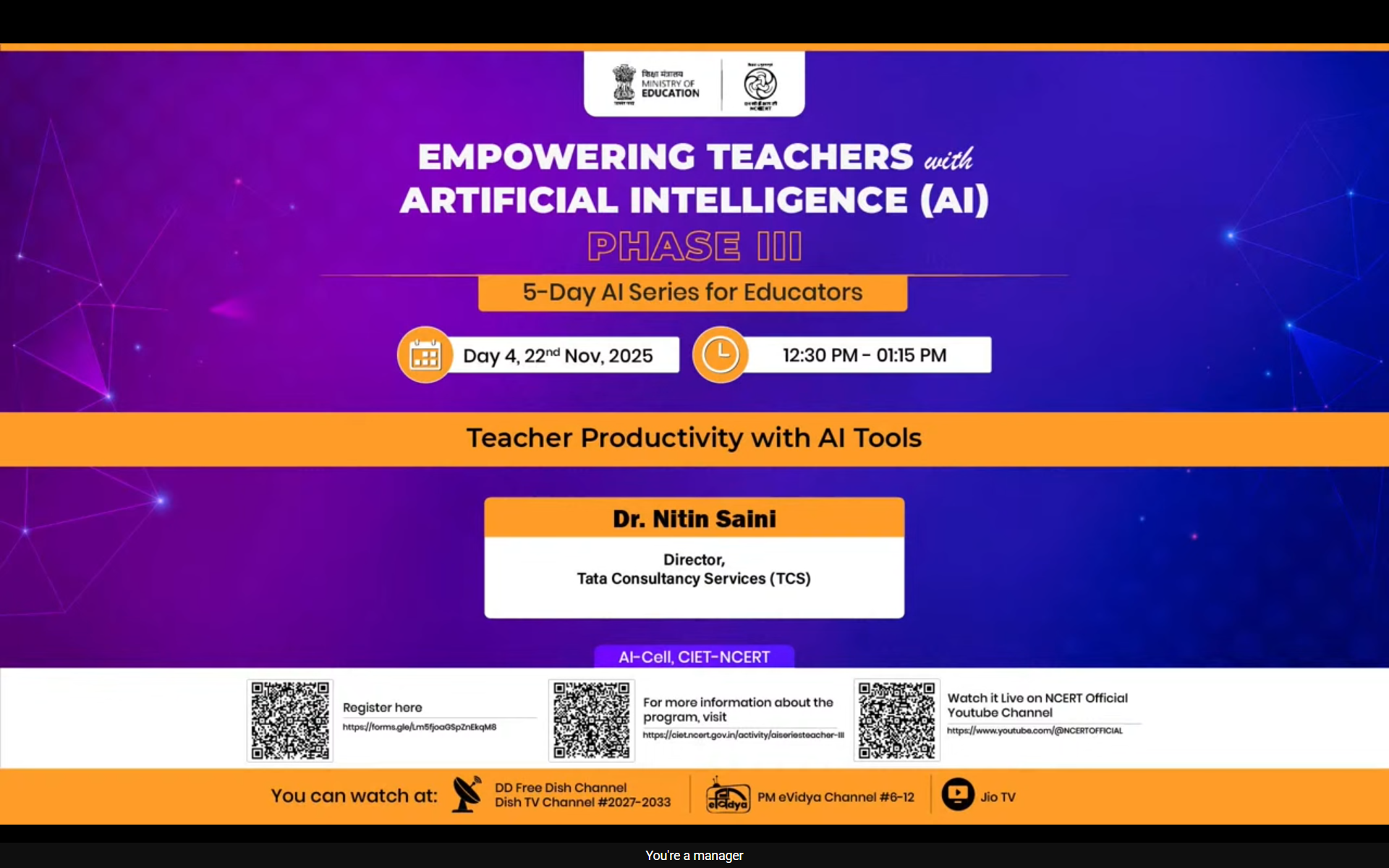
In an era where technology is rapidly reshaping every sector, education stands at the forefront of transformation. Artificial Intelligence (AI) is emerging as a powerful catalyst in redefining how knowledge is delivered, understood, and experienced. Recognizing this pivotal moment in education, NCERT invited Dr. Nitin Saini (Director – TCS and Managing Trustee of SAS Foundation) to deliver a national session titled “Empowering Teachers with Artificial Intelligence” for educators across India.
This insightful session explored how AI can enhance teacher productivity, enable personalized learning, and help educators focus on what truly matters—mentoring students and nurturing critical thinking. The session brought together teachers from across the country and emphasized the importance of adopting AI responsibly and effectively in classrooms.
📺 Watch the full session here:
https://www.youtube.com/watch?v=qzxBaECHUG8&t=1776s
The Changing Landscape of Education in the Age of AI
The global education ecosystem is undergoing a major transformation. With the rise of Generative AI tools, teachers and students now have access to resources that were unimaginable just a few years ago.
During the session, Dr. Nitin Saini highlighted a significant trend: a large percentage of students and educators are already using AI tools to explore concepts, generate explanations, and enhance learning experiences. These tools are increasingly being used alongside traditional textbooks to clarify doubts and deepen understanding.
However, the central question remains:
How can teachers leverage AI without losing the human essence of education?
The answer lies in viewing AI not as a replacement for teachers, but as a powerful assistant that amplifies their capabilities.
AI as a Teaching Assistant, Not a Replacement
One of the most important messages shared during the session was clear and reassuring:
Artificial Intelligence cannot replace teachers.
Education is fundamentally a human-centered process. Empathy, mentorship, cultural understanding, and the ability to inspire young minds are qualities that technology cannot replicate.
AI, however, excels at handling repetitive and time-consuming tasks, such as:
By automating such routine work, AI can free up valuable time for teachers, allowing them to focus more on student interaction, guidance, and meaningful engagement.
This shift enables teachers to become what they truly aspire to be—mentors, facilitators, and learning catalysts.
Enhancing Teacher Productivity with AI Tools
AI-powered platforms are increasingly supporting teachers in improving productivity and classroom effectiveness. Some key capabilities discussed during the session included:
1. Intelligent Lesson Planning
AI tools can generate structured lesson outlines, contextual examples, and visual aids tailored to different grade levels. For example, a teacher can ask an AI system to explain the water cycle for a class six student, and the tool can create simplified explanations, visuals, and activities suited to the learner’s level.
2. Automated Assessments and Feedback
AI can generate:
These tools can also assist in analyzing student responses and providing personalized feedback, helping teachers understand where students need additional support.
3. Classroom Analytics
Modern AI-enabled classroom tools can track attendance, engagement, and performance trends. These insights help teachers identify learning gaps and adjust teaching strategies accordingly.
4. Visual Learning and Content Creation
AI-based tools can convert textual explanations into diagrams, infographics, and presentations, making learning more engaging for visual learners.
Addressing India’s Multilingual Education Challenge
India’s diversity brings a unique challenge to classrooms—multiple languages and varied learning backgrounds.
AI is proving to be a powerful solution in this context. Through translation and speech technologies, AI can:
Government initiatives such as Bhashini are playing an important role in enabling language accessibility across the country.
Such innovations ensure that language is no longer a barrier to learning.
Real-World Case Studies: AI in Action
The session also highlighted several real-world implementations that demonstrate the transformative impact of AI in education.
AI Integration in Delhi Schools
A pilot initiative trained a group of teachers to use AI tools for lesson preparation and visual content creation. Once these educators demonstrated successful outcomes, the adoption spread rapidly among their peers—showcasing the power of peer-driven digital transformation.
AI Learning in Rural India
In rural regions such as Odisha, AI-powered learning platforms have been deployed with low-bandwidth models, enabling access even in areas with limited connectivity.
These initiatives have significantly improved student engagement and comprehension.
AI Tutors Improving Learning Outcomes
In some experimental deployments, AI-powered tutoring systems helped students understand complex subjects through contextual examples relevant to their environment. In certain cases, learning outcomes improved by nearly 30%.
These case studies demonstrate that AI can democratize quality education, especially in underserved regions.
Ethical Considerations and Responsible AI Use
While AI presents immense opportunities, it also brings important challenges that educators must address responsibly.
Dr. Saini emphasized three critical areas of concern:
Data Privacy
Teachers must ensure that student data is not shared irresponsibly with external AI systems. Privacy protection must remain a priority.
Bias and Accuracy
AI-generated content can sometimes include biases or inaccuracies. Therefore, teachers must always review and customize AI-generated material before using it in classrooms.
Digital Divide
Not all schools have access to reliable internet or digital infrastructure. AI initiatives must therefore be implemented thoughtfully to avoid widening the digital gap.
Responsible adoption ensures that technology remains a tool for empowerment rather than inequality.
Preparing Teachers for the AI-Enabled Future
For AI to truly transform education, teacher readiness is essential.
Educators must develop:
Just as digital literacy became essential in the last decade, AI literacy will become equally critical for educators in the coming years.
Professional development programs, workshops, and training initiatives will play a vital role in equipping teachers with these capabilities.
Aligning with India’s National Education Vision
The integration of AI in education aligns closely with the National Education Policy (NEP), which emphasizes innovation, technology integration, and experiential learning.
Government initiatives such as:
are paving the way for a technology-enabled education ecosystem in India.
By empowering teachers with AI tools, India is taking a significant step toward building a future-ready education system.
The Way Forward: Human Intelligence + Artificial Intelligence
The future of education will not be defined by technology alone.
Instead, it will be shaped by the collaboration between human intelligence and artificial intelligence.
Teachers bring:
AI brings:
Together, they can create a learning environment that is more personalized, more engaging, and more impactful than ever before.
SAS Foundation’s Commitment to Educational Innovation
At SAS Foundation, empowering youth through education remains a core mission. By actively participating in national conversations on technology and learning, the foundation continues to contribute to building a stronger and more inclusive education ecosystem.
Through educational initiatives, awareness programs, and capacity-building efforts, SAS Foundation strives to equip teachers and students with the tools and knowledge needed to thrive in the digital age.
The journey toward AI-enabled education has just begun—and collaboration between educators, institutions, and organizations will be key to shaping its success.
Join the Movement to Empower Young Minds
Education is evolving rapidly, and collective action is essential to ensure that no learner is left behind.
We invite educators, students, parents, and organizations to join hands with SAS Foundation in our mission to empower youth, strengthen education, and build a future-ready society.
Together, we can transform classrooms into spaces of innovation, creativity, and limitless learning.