

SAS Foundation Assistant
Palam, New Delhi · Education · Health · Environment
Answers are AI-generated and may be inaccurate — for official confirmation, contact SAS Foundation directly.

+91 931 243 9444
+91 965 470 9935

contact@sas-foundation.in

RZ-54/5A, Rajnagar Part 2,
Palam Colony, New Delhi 110077
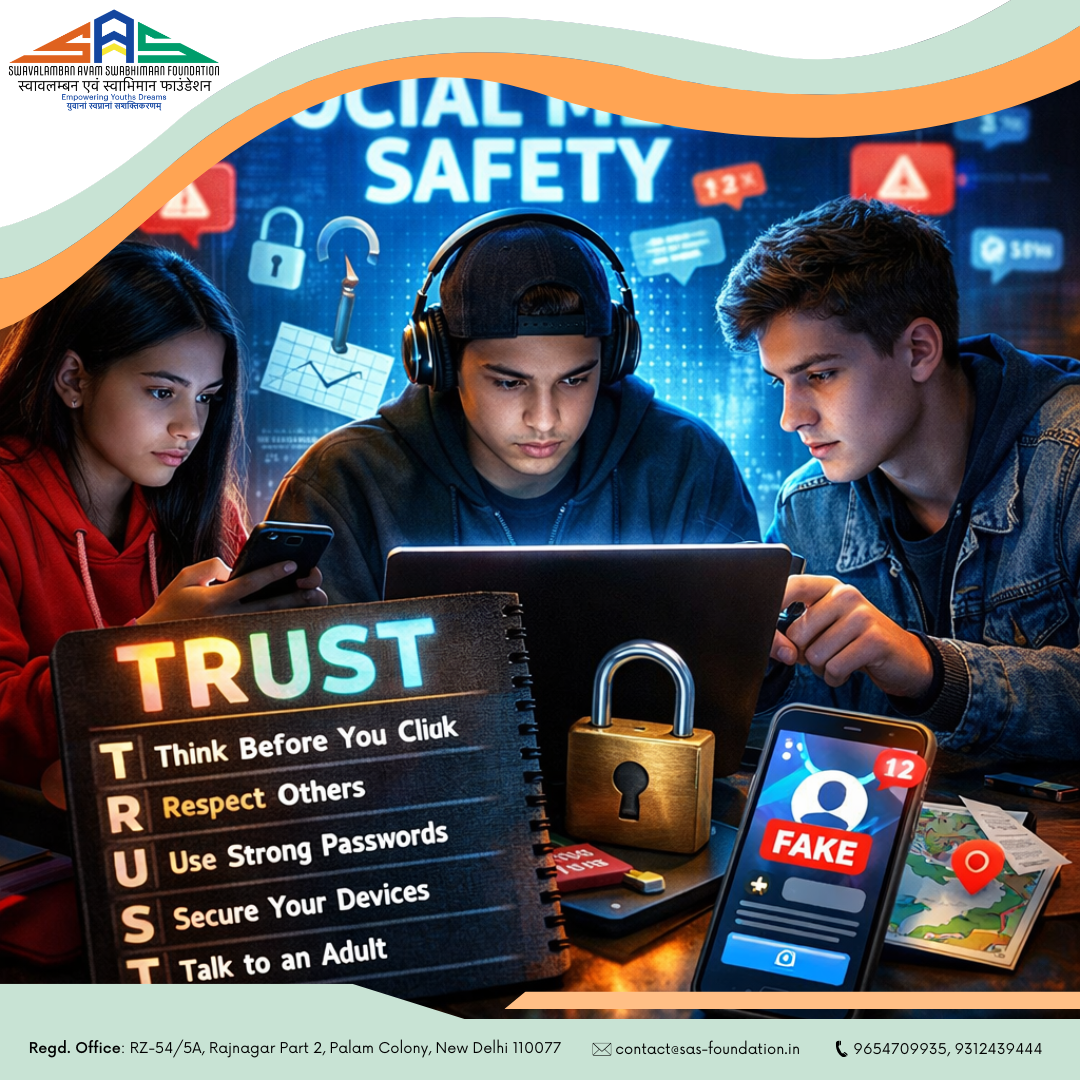
In today’s hyperconnected world, social media is not just a platform—it is a way of life. For young minds, it represents expression, connection, and opportunity. However, beneath its engaging interface lies a complex ecosystem of risks that often go unnoticed.
During Session 2 of the Cybersecurity Awareness Internship (2026–27) conducted on 5 April, SAS Foundation brought this reality into sharp focus through an insightful discussion on Social Networking Safety. The session was not just about awareness—it was about building a mindset.

The Hidden Side of Social Media
While platforms continue to evolve, one trend is becoming increasingly clear—digital exposure comes with long-term consequences.
Students explored how social media, while empowering, can also lead to:
A particularly important insight was the declining relevance of platforms like Facebook among teenagers, signaling how fast digital trends shift—and how quickly risks evolve with them.
The Real Danger: What You Don’t See
One of the most impactful discussions revolved around online messaging risks.
From fake profiles to catfishing, the session highlighted how cybercriminals exploit trust and curiosity. Students learned to identify red flags such as:
Equally concerning are seemingly harmless features like screenshots and live location sharing. Even “view once” content can be captured and misused, making digital interactions far more permanent than they appear.
TRUST: A Simple Framework for a Complex World
At the heart of the session was a powerful yet simple principle—the TRUST framework.
This framework reinforces a critical idea: cybersecurity is not just technical—it is behavioral. Every action online is a decision that carries consequences.
Cybersecurity Starts with You
A key takeaway from the session was that cybersecurity is not the responsibility of organizations alone—it begins with individuals.
Using strong, unique passwords, enabling two-factor authentication, and avoiding public Wi-Fi are not just best practices—they are essential habits. These small actions collectively create a strong defense against cyber threats like phishing and man-in-the-middle attacks.
Building Responsible Digital Citizens
At SAS Foundation, our approach goes beyond teaching concepts—we aim to shape responsible digital citizens.
The goal is not just to help students understand risks, but to empower them to make informed decisions in a digital-first world. Awareness, discipline, and critical thinking are the true tools of cybersecurity.
The Way Forward
As technology continues to advance, the line between the digital and physical worlds will only blur further. In such an environment, awareness becomes the first and most important layer of defense.
The question is no longer whether we should be online—it is how responsibly we choose to be online.
Let us not just raise a generation of users, but a generation that is digitally aware, secure, and empowered.
👉 Join SAS Foundation in building a safer digital future for our youth. Become a part of our mission and contribute to empowering young minds with the skills that truly matter.