

Call/Whatsapp Anytime
+91 931 243 9444
+91 965 470 9935

Send Email
contact@sas-foundation.in

Visit Office
RZ-54/5A, Rajnagar Part 2,
Palam Colony, New Delhi 110077
+91 931 243 9444
+91 965 470 9935
contact@sas-foundation.in
RZ-54/5A, Rajnagar Part 2,
Palam Colony, New Delhi 110077
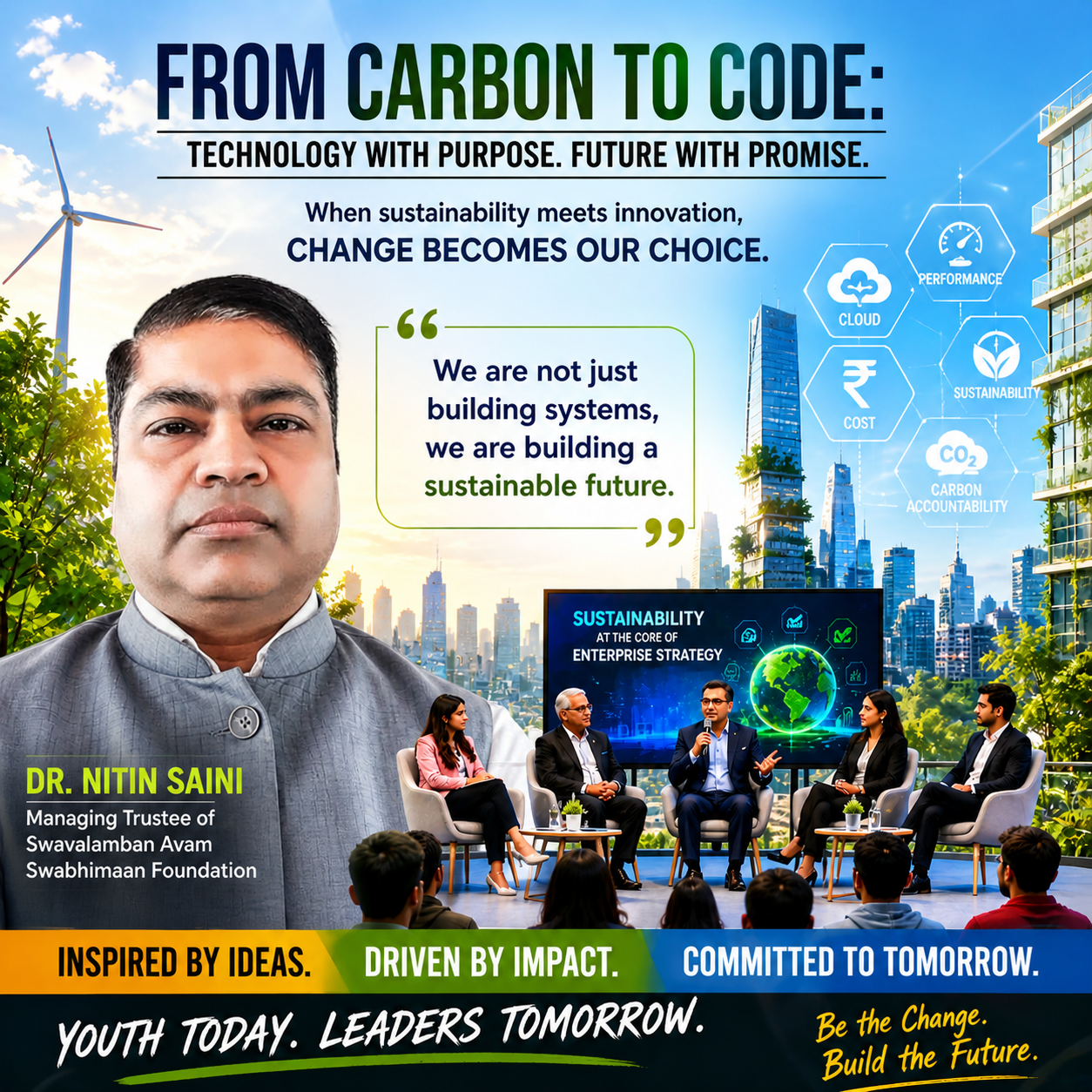
In a world driven by rapid digital transformation, a fundamental question is emerging—are we building technology for scale alone, or for sustainability as well?
At a recent industry panel discussion, Dr. Nitin Saini, Managing Trustee of Swavalamban Avam Swabhimaan Foundation, shared a compelling vision of how sustainability is no longer an optional consideration but a core design principle shaping the future of cloud, infrastructure, and enterprise strategy.

The Shift: From Speed to Responsibility
For years, organizations focused on speed, scalability, and performance. However, the paradigm is evolving. Today’s enterprises are increasingly asking:
The answer is clear—they must coexist.
Cloud computing is no longer just about flexibility and cost optimization. It is now about carbon-aware computing, where decisions such as data center selection, workload distribution, and architecture design are influenced by environmental impact.
The New Enterprise Equation: Cost + Performance + Carbon
One of the most powerful insights from the discussion was the emergence of a new decision-making framework:
Cost per transaction + Performance per transaction + Carbon per transaction
This triad is redefining enterprise priorities.
While trade-offs still exist, organizations are adopting advanced strategies such as:
These approaches are helping businesses achieve efficiency at scale while reducing their carbon footprint.
From ESG Commitments to Real Execution
Over the past decade, ESG (Environmental, Social, Governance) goals have moved from aspirational statements to measurable targets. However, the real transformation lies in execution.
Organizations are now:
This transition marks a significant shift—from intent to impact.
As Dr. Saini emphasized during the discussion, “Every digital decision today carries a climate responsibility.”
Carbon Accountability: The New Business Imperative
Carbon is fast becoming a boardroom metric, influencing enterprise strategy at the highest levels.
With increasing focus on Scope 1, 2, and 3 emissions, organizations are:
This evolution is transforming CIOs and CTOs into custodians of both performance and planetary impact.
Frameworks Driving Scalable Sustainability
To operationalize sustainability at scale, enterprises are leveraging globally recognized frameworks such as:
Combined with strong governance models and digital innovation, these frameworks enable organizations to transition from isolated initiatives to enterprise-wide sustainability transformation.
A Defining Opportunity for Youth
For young minds stepping into the world of technology, this is a defining moment.
The future will not just demand coders or engineers—it will require responsible innovators who understand the intersection of technology, sustainability, and society.
At SAS Foundation, we strongly believe that empowering youth with this mindset is critical to building a better tomorrow. By integrating sustainability into education and digital skill-building initiatives, we are preparing the next generation to lead with purpose, responsibility, and vision.
Conclusion: Building the Future We Want to See
Sustainability is no longer a trade-off—it is a strategic advantage.
The organizations and individuals who embed sustainability into their thinking today will shape the world of tomorrow. The journey from carbon to code is not just about technology—it is about redefining progress itself.
Let us move forward with a shared vision—to build systems that are not only intelligent and scalable, but also ethical, inclusive, and sustainable.
Join the Movement
Be a part of this transformative journey. Support initiatives that empower youth, drive sustainable innovation, and create meaningful impact.
Together, we can build a future where technology serves humanity—and the planet—responsibly.