
SAS Foundation Assistant
Palam, New Delhi · Education · Health · Environment
Answers are AI-generated and may be inaccurate — for official confirmation, contact SAS Foundation directly.

+91 931 243 9444
+91 965 470 9935

contact@sas-foundation.in

RZ-54/5A, Rajnagar Part 2,
Palam Colony, New Delhi 110077
What if the true measure of a psychology student isn’t how many theories they memorize, but how many lives they learn to understand?
Mental health is no longer a niche conversation. Across the world, communities are recognizing that emotional wellbeing, resilience, and psychological awareness are essential to building healthier societies. Yet, there remains a significant gap between academic learning and real-world application. While classrooms provide theoretical foundations, communities offer the experiences that transform knowledge into purpose.
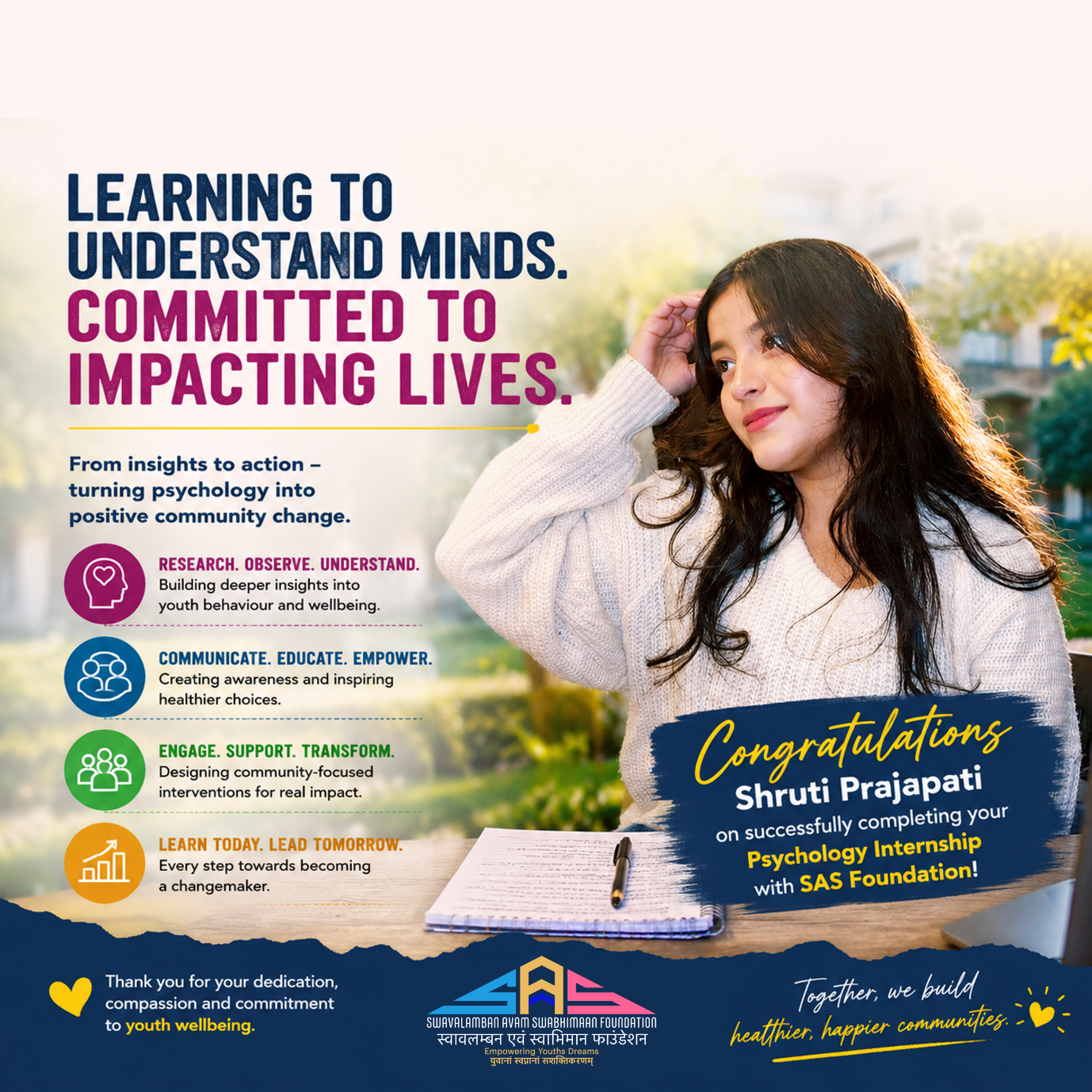
At Swavalamban Avam Swabhimaan Foundation (SAS Foundation), we believe that psychology is most powerful when it moves beyond textbooks and into people’s lives. This belief was reflected in the successful completion of the Community Mental Health, Youth Wellbeing & Applied Psychology Internship by Shruti Prajapati, a B.Sc. Clinical Psychology student from Amity University Haryana.
Her internship is a reminder that meaningful education is not only about earning academic credits—it is about cultivating empathy, responsibility, and the confidence to create positive social impact.
Psychology Beyond Clinical Practice
When people think of psychology, they often imagine counselling rooms, hospitals, or clinics. While these settings remain important, psychology has a much broader role in society.
Communities today face numerous challenges, including stress, anxiety, social isolation, digital addiction, peer pressure, behavioural issues among youth, and increasing mental health concerns. Addressing these challenges requires psychologists who understand not only individuals but also families, schools, workplaces, and communities.
Community psychology focuses on prevention, awareness, resilience, and empowerment. It encourages professionals to understand human behaviour within social contexts and design interventions that improve wellbeing before problems become crises.
This philosophy formed the foundation of Shruti’s internship at SAS Foundation.
Learning by Doing
Designed as an 80-hour structured internship, the programme was carefully developed to bridge the gap between academic concepts and practical community engagement.
Rather than limiting learning to observation alone, the internship encouraged active participation through research, behavioural analysis, psychoeducation, community intervention planning, and reflective practice.
Throughout four weeks, Shruti explored topics including:
Each assignment challenged her to move beyond theoretical understanding and examine how psychology can create measurable improvements in people’s daily lives.
From Observation to Understanding
One of the greatest strengths of psychology lies in observation—not merely watching behaviour but understanding the factors that shape it.
During the internship, behavioural observation became more than an academic exercise. It became an opportunity to appreciate how environmental influences, social relationships, communication patterns, and emotional experiences affect individual behaviour.
This process strengthened analytical thinking while reinforcing an essential lesson:
Every behaviour tells a story, and every story deserves understanding before judgment.
Such perspectives are increasingly valuable in today’s rapidly changing world.
Research with Purpose
Evidence-based practice remains at the heart of modern psychology.
Throughout the internship, research was not treated as an isolated academic requirement but as a practical tool for solving community problems.
Shruti examined scientific literature, explored behavioural theories, evaluated community-based mental health approaches, and translated academic evidence into accessible awareness materials suitable for the general public.
This ability—to convert research into action—is precisely what future psychologists need.
Communities benefit not only from scientific discoveries but from professionals who can communicate those discoveries in simple, meaningful ways.
Behaviour Change Starts with Communication
One of the most impactful aspects of the internship involved developing Behaviour Change Communication (BCC) strategies.
Changing behaviour rarely happens through instructions alone.
It happens through trust.
It happens through awareness.
It happens through consistent communication.
Whether encouraging stress management, promoting healthy coping mechanisms, supporting youth wellbeing, or improving community awareness, effective communication remains one of psychology’s most powerful interventions.
Learning how to design evidence-based awareness campaigns prepares future psychologists to become educators, advocates, and community leaders—not merely practitioners.
Reflection Creates Better Professionals
Technical knowledge is important.
Reflection makes it meaningful.
Throughout the internship, reflective journals encouraged Shruti to evaluate her learning journey, identify strengths, acknowledge challenges, and recognize areas for future development.
Reflection transforms experience into wisdom.
It builds emotional intelligence, professional ethics, and lifelong learning habits—qualities that every psychologist should cultivate.
By the conclusion of the programme, her reflections demonstrated growing confidence, improved analytical thinking, stronger communication skills, and a deeper appreciation for psychology’s role in creating positive social change.
The Future of Psychology is Community-Centred
The future demands psychologists who can work across multiple settings—not only clinics but also schools, NGOs, workplaces, communities, digital platforms, and public health programmes.
Mental health promotion is increasingly becoming everyone’s responsibility.
Future professionals must therefore develop competencies in:
Internships that provide exposure to these areas equip students to contribute meaningfully to society from the very beginning of their careers.
Building Changemakers Through Experiential Learning
At SAS Foundation, internships are designed around a simple philosophy:
Learning should create impact.
Whether working in education, health, environment, technology, entrepreneurship, or psychology, interns are encouraged to solve real problems, engage with communities, and develop practical skills that extend far beyond academic curricula.
Shruti’s internship reflects this philosophy beautifully.
Her successful completion of the programme demonstrates how structured mentorship, meaningful assignments, and reflective learning can transform students into socially responsible professionals.
The journey was not about completing tasks.
It was about discovering purpose.
A Message to Every Psychology Student
If you are studying psychology today, remember this:
Your greatest contribution may not be the diagnosis you make tomorrow.
It may be the young person you inspire today.
The community you educate.
The family you support.
The awareness you create.
The stigma you help eliminate.
The conversation you begin.
Psychology has the power to change lives—not only through therapy but also through prevention, education, advocacy, and community engagement.
Every internship, every project, every reflection, and every meaningful interaction adds another layer to becoming the psychologist the world truly needs.
Because the future of mental health will not be built by professionals who only understand theories.
It will be built by compassionate leaders who understand people.
At SAS Foundation, we remain committed to nurturing such changemakers by providing experiential learning opportunities that empower students to apply knowledge with empathy, integrity, and purpose. Together, we can build communities where mental wellbeing is understood, supported, and celebrated.
The classroom may introduce psychology, but communities teach its true meaning.

About SAS Foundation
Swavalamban Avam Swabhimaan Foundation (SAS Foundation) is a registered charitable trust dedicated to empowering communities through initiatives in Education, Health, Environment, and Community Development. Through internships, awareness programmes, research collaborations, and volunteer initiatives, SAS Foundation is committed to nurturing socially responsible leaders who create sustainable and meaningful impact.