
SAS Foundation Assistant
Palam, New Delhi · Education · Health · Environment
Answers are AI-generated and may be inaccurate — for official confirmation, contact SAS Foundation directly.

+91 931 243 9444
+91 965 470 9935

contact@sas-foundation.in

RZ-54/5A, Rajnagar Part 2,
Palam Colony, New Delhi 110077
When was the last time you visited a website and remembered how it made you feel?
Most people think websites are built with text, images, and buttons.
But the truth is—great websites are built with intention.
Every section placement influences attention. Every interaction shapes trust. Every visual decision determines whether someone stays, explores, acts—or leaves.
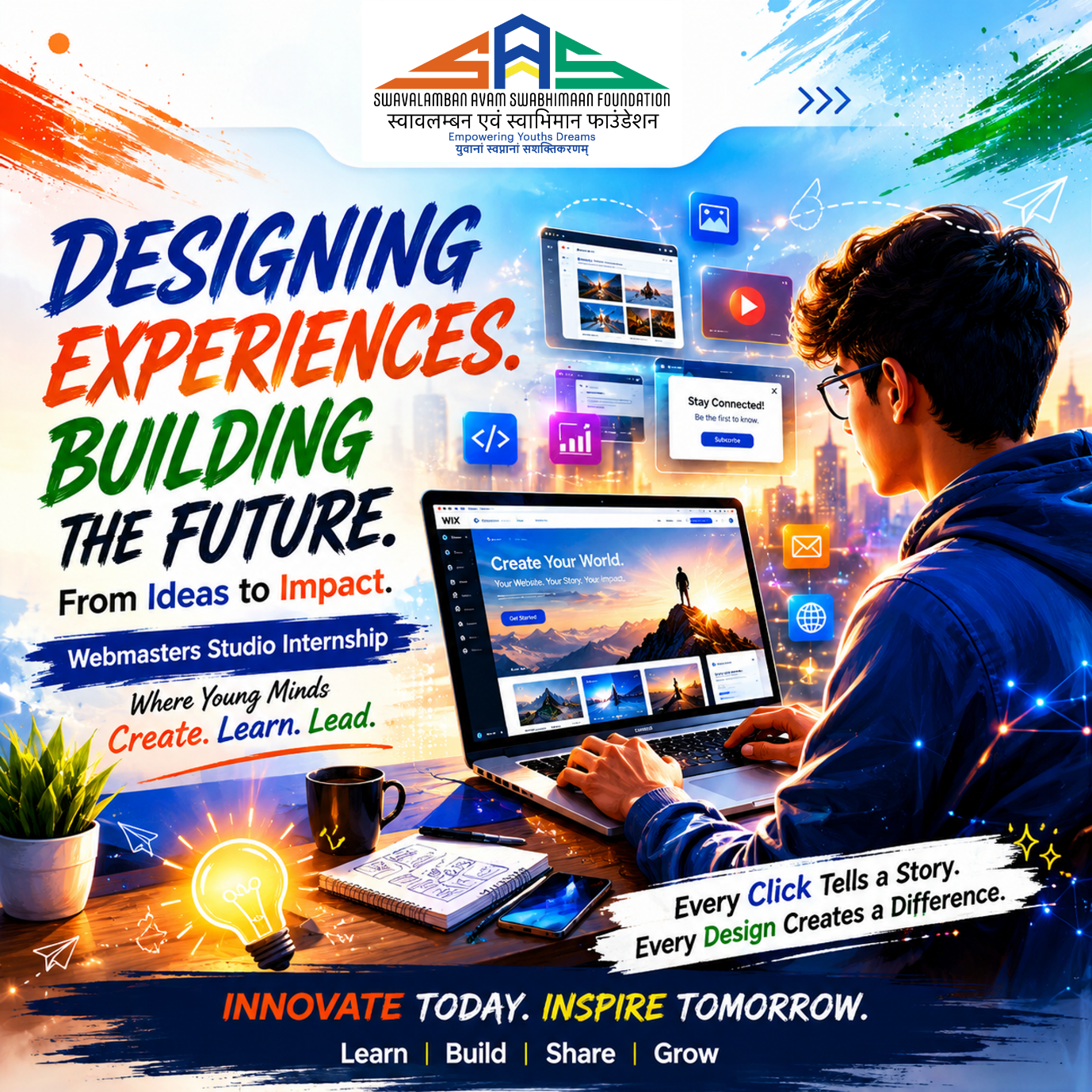
That realization became the heart of Session 3 of the Website Design, Development & Maintenance Internship – Webmasters Studio Internship (Jun ’26) conducted by Swavalamban Avam Swabhimaan Foundation (SAS Foundation).
This session moved beyond website creation and introduced participants to something more powerful:
Designing digital experiences that people remember.

The Shift from Building Pages to Building Experiences
Young learners often begin their website journey believing that development means arranging elements on a page.
However, modern websites require a deeper understanding.
Today’s websites must:
• Communicate instantly
• Guide visitors naturally
• Encourage interaction
• Build trust visually
• Deliver memorable experiences
Through this session, participants explored how design decisions shape user engagement and transform static websites into meaningful digital spaces.
The focus areas included:
✓ Grid Layout Configuration
✓ Media Gallery Management
✓ Interactive Button Design
✓ Pop-up Implementation
✓ User Experience Principles
Each concept introduced students to the mindset of modern digital creators.
Lesson One: Structure Creates Clarity — Understanding Grid Layouts
One of the most important concepts explored during the session was grid configuration.
At first glance, grids appear technical.
But grids represent something much larger.
They help creators organize information in a way that reduces confusion and improves understanding.
Participants learned how grid cells allow designers to:
• Organize content logically
• Create visual balance
• Position media effectively
• Improve readability
• Enhance navigation
Students also explored how rows and columns can be customized to support different storytelling objectives.
During discussions, an interesting insight emerged:
Not every visual element should behave like a navigation element.
Students discovered that creating meaningful interactions often requires combining visual blocks with intentional actions—such as using dedicated buttons and text elements for linking.
That distinction introduced learners to a fundamental principle of digital design:
Everything visible should have a purpose.
Why Media Is No Longer Optional
Digital audiences today expect websites to be visual, engaging, and interactive.
Static pages alone rarely capture attention.
That is why the session focused heavily on media gallery management and visual storytelling.
Participants explored how image galleries can elevate a website’s communication and improve engagement.
Students experimented with:
• Image galleries
• Media organization
• Visual comparisons
• Content presentation
• Dynamic layouts
More importantly, they discovered that galleries are not just containers for photos.
They are storytelling tools.
The session introduced multiple gallery formats including:
• Carousel experiences
• Slide-based displays
• Visual grid layouts
• Honeycomb presentations
Participants also learned that these experiences can integrate both images and videos to create richer visitor journeys.
The message was clear:
Content becomes more powerful when people can experience it visually.
Buttons: Small Elements That Drive Big Decisions
One of the most valuable insights from the session came from an everyday website element that people rarely notice—
the button.
Buttons are often viewed as simple navigation tools.
But in reality, they influence behavior.
Students learned how buttons can guide users toward:
• Exploring more content
• Visiting another page
• Opening resources
• Sending emails
• Taking action
By configuring buttons strategically, participants began understanding that websites are conversations—not presentations.
Every click is a decision.
Every decision is designed.
Pop-Ups: Interruptions or Opportunities?
Pop-ups often receive criticism.
Yet when designed thoughtfully, they become powerful engagement tools.
During the session, students explored how modern websites use pop-ups to:
• Highlight announcements
• Share updates
• Promote campaigns
• Encourage subscriptions
• Improve visitor interaction
Participants learned how behavior-based triggers can activate content at the right moment.
They also discovered that pop-ups can include multimedia to create more engaging experiences.
This shifted the conversation from:
“How do we attract visitors?”
to
“How do we create moments visitors care about?”
Learning to Think Like Designers
Perhaps the most meaningful outcome of this session was not technical.
It was cognitive.
Students began asking different questions.
Instead of asking:
“Where should I place this image?”
They started asking:
“How should visitors experience this section?”
Instead of:
“What should I add?”
They asked:
“What should people feel?”
This shift—from creation to intentional creation—is what defines future-ready digital talent.
The Assignment That Extends Learning Beyond the Session
Learning does not end when a session concludes.
Participants were challenged to apply advanced tools and strengthen their homepage experiences.
The assignment encouraged students to:
✓ Enhance website layouts
✓ Add media galleries
✓ Improve engagement
✓ Refine visual communication
By doing so, students move from passive learning into active creation.
Why Initiatives Like This Matter
Digital skills are becoming foundational—not optional.
Website creation develops capabilities that extend far beyond technology:
• Creative thinking
• Communication
• Problem solving
• User empathy
• Digital literacy
• Entrepreneurial mindset
When young learners gain opportunities to create, experiment, and publish, they become prepared to lead in a digital future.
At SAS Foundation, we believe empowering youth means helping them build—not just consume—the future.
And every website they create becomes one more step toward confidence, creativity, and self-reliance.
Join the Movement of Young Digital Creators
If you believe young minds should learn practical skills that prepare them for tomorrow—
join us.
Become a member.
Support initiatives that transform curiosity into capability and ideas into impact.
Because empowering youth dreams begins with creating opportunities to learn, build, and lead.
Visit:
www.sas-foundation.in
Together, let us create a generation that does not wait for the future—
but designs it.