

Call/Whatsapp Anytime
+91 931 243 9444
+91 965 470 9935

Send Email
contact@sas-foundation.in

Visit Office
RZ-54/5A, Rajnagar Part 2,
Palam Colony, New Delhi 110077
+91 931 243 9444
+91 965 470 9935
contact@sas-foundation.in
RZ-54/5A, Rajnagar Part 2,
Palam Colony, New Delhi 110077
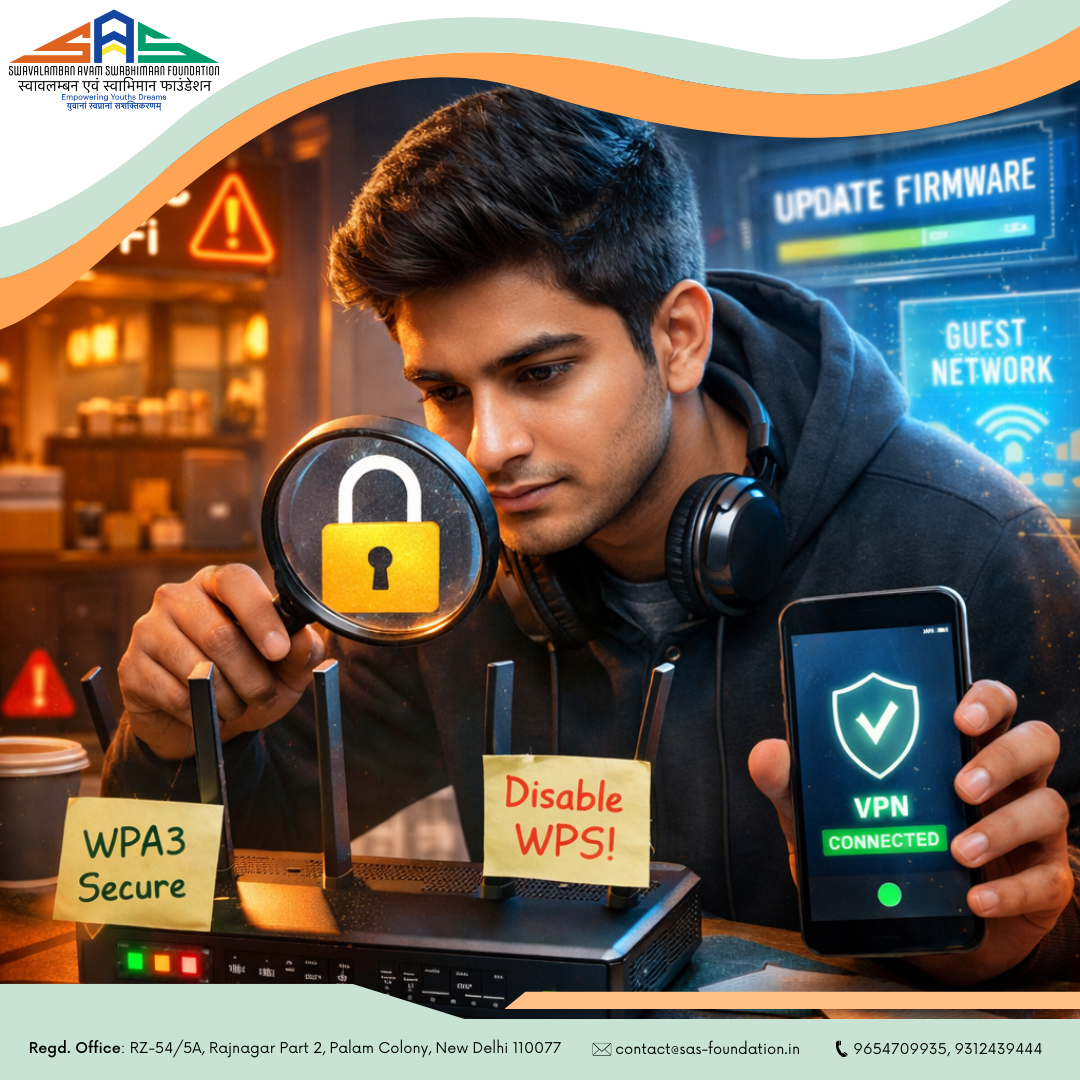
In today’s hyper-connected world, Wi-Fi is no longer a luxury—it is a necessity. From online learning to digital payments and social interactions, our daily lives are deeply dependent on seamless connectivity. However, what many overlook is a critical question: Is your Wi-Fi network truly secure, or just conveniently connected?
During Session 6 (Wi-Fi Security | 19-Apr) of the Cybersecurity Awareness Internship 2026–27 by SAS Foundation, students explored the hidden vulnerabilities that exist within everyday networks—and the findings were both eye-opening and urgent.

Understanding the Invisible Risks
Most home networks operate under a false sense of security. The session revealed that common issues such as weak passwords, outdated router firmware, and the continued use of obsolete protocols like WEP can expose entire networks to cyber threats.
Cyber attackers do not always rely on sophisticated techniques. Often, they exploit simple misconfigurations and negligence. A poorly secured Wi-Fi network can become an entry point for data theft, unauthorized access, and even identity compromise.
This reinforces a critical truth: Cybersecurity is not just about advanced tools—it begins with awareness and basic hygiene.
WPA3: The New Standard for Digital Protection
One of the key takeaways from the session was the importance of adopting WPA3 encryption, which represents the latest and most secure Wi-Fi protection standard.
Unlike older protocols, WPA3 offers stronger encryption, improved authentication mechanisms, and better resistance against brute-force attacks. For students and households alike, upgrading to WPA3 is no longer optional—it is a foundational step toward securing digital environments.
Public Wi-Fi: Convenience with Caution
Public Wi-Fi networks—found in cafes, airports, and public spaces—pose significant risks. These networks are often unsecured, making them prime targets for cybercriminals to intercept sensitive data.
The session emphasized two critical practices:
These simple precautions can significantly reduce exposure to man-in-the-middle attacks and data breaches.
Small Changes, Big Impact: Practical Security Measures
One of the most powerful insights from the session was how small configuration changes can prevent major vulnerabilities.
Students learned the importance of:
These actions may seem minor, but collectively they create a strong defense against common cyber threats.
Cybersecurity as a Life Skill
Perhaps the most significant outcome of this session was a shift in perspective. Cybersecurity is often perceived as a technical domain reserved for experts. However, in reality, it is a fundamental life skill in the digital age.
For students, understanding cybersecurity is as essential as learning communication or problem-solving. It empowers them to navigate the digital world responsibly, protect their data, and make informed decisions.
Building a Secure Digital Future
At SAS Foundation, our mission goes beyond education—we aim to empower youth with awareness, responsibility, and future-ready skills. Through initiatives like the Cybersecurity Awareness Internship, we are nurturing a generation that is not only digitally skilled but also digitally secure.
As technology continues to evolve, so do cyber threats. The need of the hour is not fear, but preparedness.
Because in the digital world, security is not an option—it is a responsibility.
Join the Movement
We invite students, educators, and communities to be part of this growing movement toward digital safety and awareness. Together, we can build a secure, informed, and resilient digital ecosystem.
👉 Stay aware. Stay secure. Stay empowered.