
SAS Foundation Assistant
Palam, New Delhi · Education · Health · Environment
Answers are AI-generated and may be inaccurate — for official confirmation, contact SAS Foundation directly.

+91 931 243 9444
+91 965 470 9935

contact@sas-foundation.in

RZ-54/5A, Rajnagar Part 2,
Palam Colony, New Delhi 110077
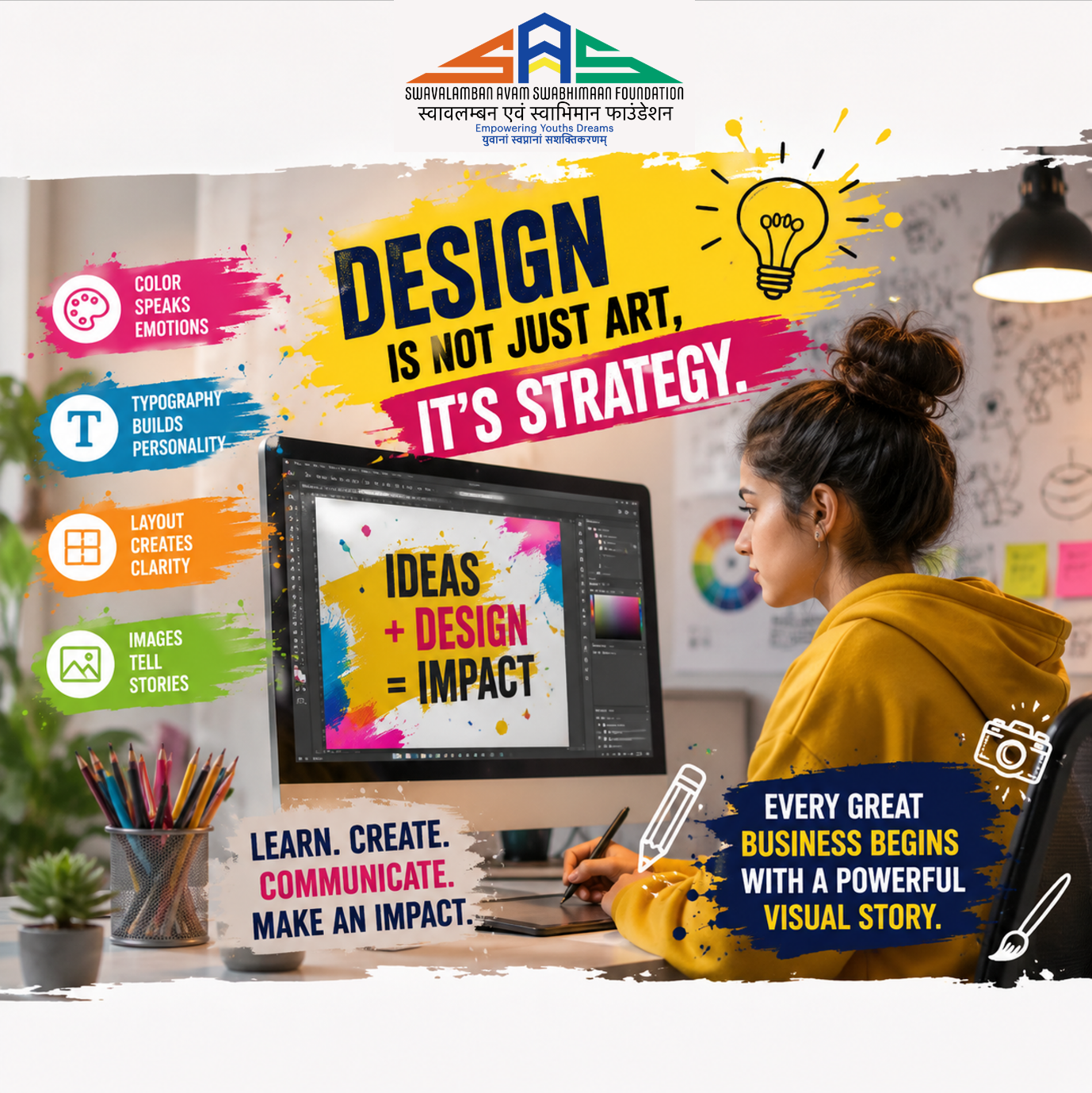
How Session 5 of the Creatorpreneurs Hub Internship (Jun ’26) Empowered Students to Transform Creativity into Powerful Visual Communication
Imagine walking past two posters promoting the same business.
One is cluttered with random fonts, blurry images, and confusing messages.
The other instantly captures your attention. Its colors evoke emotion, its layout guides your eyes naturally, and within seconds, you understand exactly what the business offers and what action you should take.
The difference is not artistic talent.
The difference is graphic design.
That was the central message of Session 5 of the Creatorpreneurs Hub Internship (Jun ’26) conducted by Swavalamban Avam Swabhimaan Foundation (SAS Foundation)—a session that challenged students to look beyond aesthetics and discover the strategic power of visual communication.
In today’s creator economy, where people scroll through thousands of posts every day, attention has become one of the world’s most valuable currencies. Businesses no longer compete only through products or services—they compete through stories, experiences, and memorable visual identities.
Teaching young minds how to communicate visually is no longer optional. It is an essential life skill.

Why Graphic Design Matters More Than Ever
Graphic design is often misunderstood as simply “making things look attractive.”
In reality, great design solves problems.
It simplifies complexity.
It builds trust.
It communicates emotions.
It influences decisions.
Whether it is a startup logo, a YouTube thumbnail, a social media campaign, an educational infographic, or a fundraising poster, every successful visual is built on deliberate choices rather than decoration.
During the session, students learned that every design silently answers important questions:
These are not artistic questions.
They are business questions.
Learning to Tell Stories Without Words
One of the most thought-provoking discussions of the session focused on a simple yet powerful idea:
Graphic design is storytelling without words.
Before someone reads a headline, they notice colors.
Before they understand a message, they observe shapes.
Before they trust a business, they evaluate its professionalism through visuals.
Every design element communicates something.
A carefully selected image creates emotional connection.
A balanced layout improves understanding.
Strong typography builds credibility.
Strategic use of white space improves readability.
Together, these elements create an experience that words alone cannot achieve.
The Four Building Blocks of Effective Graphic Design
Participants explored the four foundational components that appear in almost every successful design.
Images
Visuals create immediate emotional engagement.
Students learned the importance of selecting high-quality, relevant images that strengthen rather than distract from the intended message. Resources such as Pixabay, Pexels, Unsplash, and Flat Icons were introduced to encourage ethical use of free design assets.
Color
Color influences psychology.
Different colors communicate different emotions.
For example:
Rather than using too many colors, students were encouraged to maintain a consistent palette of two to four complementary colors to strengthen brand recognition.
Typography
Fonts are personalities.
A playful rounded font creates a completely different impression than a clean professional sans-serif typeface.
Participants learned to limit designs to two or three complementary fonts to maintain consistency while improving readability and professionalism.
Layout
Even excellent content can lose its impact if poorly organized.
Students explored how spacing, alignment, hierarchy, and positioning influence how viewers consume information.
A clean layout guides the viewer naturally from headline to supporting information and finally to the desired action.
Understanding the Principles Behind Every Great Design
Beyond individual design elements, students explored four timeless principles used by professional designers worldwide.
Balance
Balance creates stability.
Whether symmetrical or asymmetrical, balanced designs feel comfortable and visually satisfying.
Contrast
Contrast ensures important information stands out.
Large headlines, bold colors, and differences in size or shape naturally attract attention.
Without contrast, even valuable messages disappear into visual clutter.
Alignment
Alignment creates order.
Proper alignment connects visual elements and gives designs a polished, professional appearance.
Poor alignment immediately reduces credibility.
Repetition
Consistency strengthens identity.
Repeated use of colors, fonts, icons, and design styles helps audiences recognize and remember a brand across different platforms.
Professional Design Tools Made Accessible
The session also introduced students to beginner-friendly design platforms that empower anyone to create professional-quality graphics without advanced technical expertise.
Canva
Participants explored Canva’s intuitive drag-and-drop interface, ready-to-use templates, cloud storage, collaboration features, and multiple export formats including PDF, JPG, and MP4.
Its accessibility makes it one of the best tools for students, educators, entrepreneurs, and nonprofit organizations.
Adobe Express
Students were also introduced to Adobe Express, another beginner-friendly platform offering professionally designed templates and seamless integration with Adobe Creative Cloud for users seeking advanced creative workflows.
By learning these tools early, students gain practical skills that can support academics, internships, entrepreneurship, freelancing, and future careers.
Designing for Attention in the Digital Age
One of the most practical sections of the session focused on creating effective posters and promotional material.
Students learned that successful posters should include:
Participants were introduced to the 70/30 design rule, where approximately 70% of the design emphasizes visuals while the remaining 30% communicates essential information.
This simple principle helps prevent overcrowding while maintaining audience engagement.
The importance of readability was also emphasized, including recommended font sizes for headlines and supporting text to ensure visibility even from a distance.
Creating for Social Media
Designing for digital platforms requires a different mindset.
Students explored best practices for creating engaging social media graphics, including:
These practices help maximize visibility, engagement, and professionalism in today’s competitive digital landscape.
Learning by Doing: The Business Poster Challenge
Rather than ending with theory, the session concluded with a practical assignment.
Every participant was challenged to create a professional poster or banner for their own business idea.
Each design was required to include:
Assignments are to be submitted in PDF or JPG format for evaluation based on originality, engagement, clarity, visual effectiveness, and completeness.
This hands-on exercise encourages students to apply classroom learning to real-world entrepreneurial scenarios, reinforcing creativity, strategic thinking, and professional communication.
Beyond Design: Building Future-Ready Leaders
Graphic design is not merely a creative hobby.
It is a critical capability for entrepreneurs, educators, marketers, social innovators, and professionals across every industry.
Young people who understand how to communicate visually are better equipped to pitch ideas, build brands, raise awareness, attract customers, and inspire communities.
The Creatorpreneurs Hub Internship reflects SAS Foundation’s belief that education must extend beyond textbooks. Students need opportunities to develop creativity, digital literacy, communication, collaboration, and entrepreneurial thinking—skills that will define success in an increasingly digital world.
Every session is designed not only to teach tools but to cultivate confidence, innovation, and purpose.
Join the Movement to Empower Young Creators
At Swavalamban Avam Swabhimaan Foundation (SAS Foundation), we believe that every young mind deserves the opportunity to dream boldly, create confidently, and lead responsibly.
The Creatorpreneurs Hub Internship is helping students transform curiosity into creativity, creativity into communication, and communication into meaningful impact.
Whether you are a student eager to build future-ready skills, a parent seeking transformative learning opportunities, an educator passionate about innovation, or a professional looking to mentor the next generation, there is a place for you in this journey.
Become a member of SAS Foundation and join us in empowering youth to become creators, entrepreneurs, innovators, and changemakers who will shape the future through knowledge, creativity, and purpose.
Together, let’s empower today’s learners to become tomorrow’s leaders.