Over the past decade, quantum computing has largely been discussed in the context of research labs, physics departments, and highly specialized technical communities. For many leaders, it remained an abstract concept—powerful, promising, but distant.
That perception is changing rapidly.
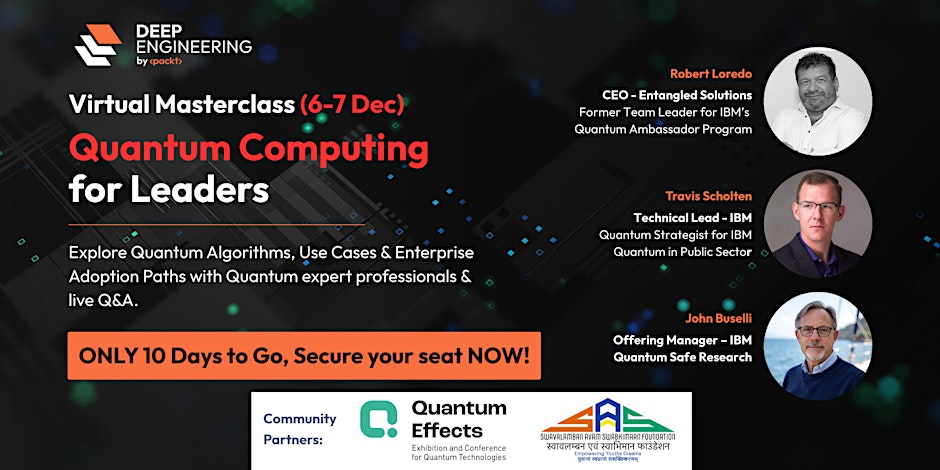
On 6–7 December, Quantum Computing for Leaders – A Strategic Masterclass was organized by Packt Publishing, with Swavalamban Avam Swabhimaan Foundation (SAS Foundation) serving as the Community Partner. The two-day program marked an important shift in how quantum computing is being framed—not as a niche technical discipline, but as a strategic leadership concern.
This blog reflects on the key themes and why this conversation matters now more than ever.
Quantum Computing Has Moved Beyond the Lab
One of the strongest takeaways from the masterclass was a shared realization:
quantum computing is no longer a future problem—it is a present planning requirement.
The sessions emphasized that while large-scale, fault-tolerant quantum computers are still evolving, the strategic implications of quantum are already impacting:
- Cybersecurity and cryptography
- National digital infrastructure
- Financial systems and risk modeling
- Scientific research and material discovery
- Long-term enterprise technology roadmaps
The question leaders must now ask is not when quantum will arrive, but how prepared their organizations are for its impact.
From Technology Curiosity to Leadership Responsibility
Unlike traditional technical workshops, the masterclass was deliberately designed for leaders rather than programmers. The focus remained on:
- Understanding where quantum computing delivers real value
- Identifying realistic use cases across industries
- Evaluating organizational readiness and risk exposure
- Planning for governance, compliance, and talent needs
- Preparing for the convergence of Quantum, AI, and Cybersecurity
This shift in framing is critical. Quantum computing is not just a faster computer—it represents a fundamentally different way of solving certain classes of problems. That difference carries strategic consequences that leaders cannot afford to ignore.
The Growing Urgency of Quantum-Safe Thinking
A particularly important thread throughout the discussions was the quantum threat to today’s cryptographic systems. As quantum capabilities mature, widely used encryption methods will become vulnerable, making early planning for quantum-safe approaches essential.
The message was clear:
organizations that delay preparation risk scrambling later—under regulatory pressure, security exposure, or competitive disadvantage.
Quantum readiness, therefore, is not only a technology roadmap—it is a risk management and governance imperative.
Why Community Partnerships Matter
SAS Foundation’s role as Community Partner reflects its broader mission of enabling future-ready awareness and learning across society. Working across four pillars—Education, Health, Environment, and Community Development—the foundation places strong emphasis on helping youth, professionals, and institutions understand emerging technologies before they become disruptive forces.
Collaborations such as this one with Packt Publishing help bridge an important gap:
the gap between cutting-edge innovation and accessible, leadership-oriented understanding.
Key Reflections for Leaders
Several insights consistently surfaced over the two days:
- Quantum readiness is a journey, not a switch
Organizations must start with awareness, assessment, and small steps rather than waiting for “perfect” maturity.
- Leadership literacy matters as much as technical expertise
Leaders do not need to code—but they must understand implications, timelines, and decisions.
- Early preparation creates long-term advantage
Those who plan early shape standards, talent pipelines, and governance models.
- Quantum will coexist with classical systems and AI
The future is hybrid, not replacement-driven.
Looking Ahead
The masterclass reinforced a fundamental truth:
the quantum era will reward preparedness, not reaction.
As emerging technologies increasingly shape economies, security frameworks, and societal systems, leadership readiness becomes the defining factor between those who lead transformation and those who struggle to keep up.
At SAS Foundation, we remain committed to supporting initiatives that promote informed dialogue, strategic thinking, and responsible adoption of future technologies.
Quantum computing is no longer a distant horizon.
It is a leadership conversation—one that must begin now.