CodeCraft Python Internship (Jun ’26) | Session 4 Reflection
What if growth was not about doing more—but doing better, repeatedly?
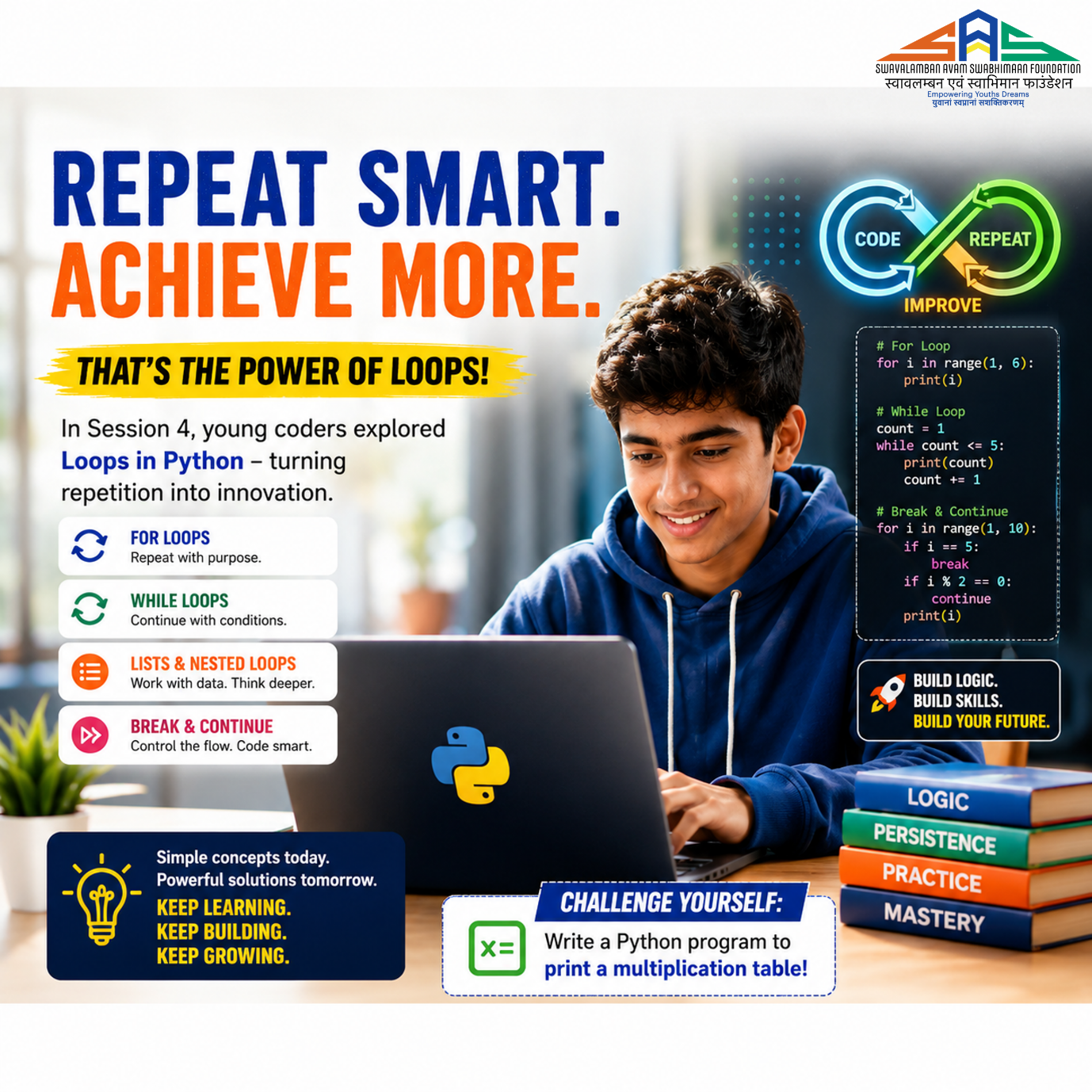
This question sat quietly beneath Session 4 of the CodeCraft Python Internship (Jun ’26), where participants explored one of programming’s most powerful concepts: Loops in Python.
At first glance, loops appear technical.
But beneath the syntax lies a much bigger lesson—efficiency.
Because every breakthrough in technology, every intelligent system, and every scalable solution is built on one principle:
Do not repeat effort. Repeat process.
And that principle does not just shape great software.
It shapes great careers, great learning habits, and great futures.
From Instructions to Automation: The Moment Programming Changes
Most beginners enter programming believing code means writing instructions.
Then something changes.
They discover loops.
And suddenly programming becomes less about writing more and more about thinking smarter.
In Session 4, participants learned that loops allow developers to automate repetitive actions and execute instructions efficiently without unnecessary duplication.
Instead of writing the same code multiple times, students learned how a single structured instruction can create hundreds of outcomes.
That realization changes how young learners approach problems.
The question becomes:
“How can I automate this?”
Not:
“How can I keep repeating this?”
That shift represents one of the earliest moments students begin thinking like engineers.
Understanding Control Before Understanding Scale
Before introducing loops, the session revisited control flow concepts including:
• if statements
• elif conditions
• else logic
Students reflected on a foundational truth:
Every loop depends on decisions.
Technology is not random.
Software continuously evaluates conditions and determines what should happen next.
Once participants understood conditional execution, they were ready to move into the next stage—controlled repetition.
And that is where loops transformed the conversation.
Why Loops Matter Beyond Programming
Rajat Mangat introduced loops not simply as coding constructs but as tools for intelligent automation.
Participants explored how loops help:
• Eliminate repetitive tasks
• Reduce code duplication
• Improve readability
• Increase execution efficiency
• Simplify debugging
• Improve maintainability
Students also discussed an important engineering principle:
When programs grow unnecessarily large because of repeated code, they become difficult to manage.
The same principle applies beyond software.
Complexity grows when repetition replaces systems.
Efficiency grows when systems replace repetition.
Learning the Language of Iteration
Participants explored the two foundational loop structures in Python.
The For Loop: Repeat with Purpose
Students learned that for loops are ideal when the number of iterations is already known.
Whether printing numbers, generating outputs, processing records, or performing repeated calculations, for loops provide predictability and structure.
They explored:
• Loop syntax
• Using the in keyword
• Working with range()
• Iterative execution flow
• Automating repeated outputs
The biggest realization?
Small instructions can produce large outcomes.
The While Loop: Continue Until Conditions Change
Next came the while loop.
Unlike the for loop, students discovered that while loops operate based on conditions.
Programs continue running until specific conditions become false.
This concept introduced learners to dynamic execution.
Students explored:
• Condition-driven repetition
• Increment logic
• Execution control
• Infinite loop prevention
One of the most important lessons emerged here:
Uncontrolled repetition creates inefficiency.
Controlled repetition creates progress.
That lesson applies equally to software and life.
When Practice Becomes Performance
During the session, students were encouraged to build capability progressively.
Instead of jumping directly into difficult challenges, participants were advised to:
Start simple.
Build consistency.
Increase complexity gradually.
This mindset reflects how high performers learn.
The strongest coders rarely begin with advanced systems.
They master fundamentals relentlessly.
This philosophy aligns deeply with SAS Foundation’s vision of empowering youth through sustainable skill development.
Because confidence is not built through shortcuts.
It is built through practice.
Organizing Data Through Lists
The session then expanded into Lists in Python, introducing students to one of the most practical tools for handling multiple values.
Participants explored:
• Creating lists
• Using square brackets
• Storing collections of information
• Accessing multiple values efficiently
This led to a major shift in understanding.
Students moved from storing individual variables to managing organized groups of information.
That transition mirrors real-world software systems where data rarely exists alone.
Traversing Lists: Teaching Computers to Explore
Once students understood lists, they explored traversal using loops.
Through examples like printing fruits from a list, learners discovered how loops move through collections systematically.
Rather than manually accessing values one by one, they learned to automate discovery.
This principle powers:
• Search systems
• Recommendation engines
• Data analytics
• Machine learning pipelines
• Automation platforms
A simple loop suddenly became a window into how large-scale digital systems operate.
Nested Loops: Understanding Layers of Complexity
Participants then advanced into nested loops.
This concept demonstrated how one loop can operate inside another.
Students learned that every iteration of the outer loop triggers a full execution cycle of the inner loop.
Though simple in appearance, nested loops introduced powerful thinking concepts:
• Structured execution
• Multi-dimensional logic
• Sequential processing
• Complexity management
For many participants, this became the first glimpse into how advanced systems process large datasets.
Knowing When to Stop—and When to Continue
The final segment introduced two important control keywords:
break
Stop execution immediately when conditions are met.
continue
Skip the current iteration and move forward.
Students quickly realized that intelligent systems are not defined by running forever.
They are defined by knowing:
When to continue.
When to adapt.
And when to stop.
These principles are equally valuable in technology, education, and leadership.
From Concepts to Creation: The Multiplication Table Challenge
The session concluded with a practical assignment:
Build a Python program that generates a multiplication table.
At first glance, the challenge seemed simple.
But behind the exercise were powerful learning outcomes.
Students needed to:
• Define inputs
• Apply loops
• Manage iteration
• Generate structured output
• Translate logic into execution
This was not merely homework.
It was an opportunity to experience creation.
And creation changes confidence.
Building More Than Coders
At SAS Foundation, educational initiatives are designed with a broader purpose.
Technology education is not only about preparing students for jobs.
It is about preparing them for possibility.
When young learners understand automation, structure, and computational thinking, they begin seeing challenges differently.
They become:
Creators instead of consumers.
Builders instead of observers.
Problem-solvers instead of passive users.
That transformation is where real empowerment begins.
The Future Will Reward Systems Thinkers
Tomorrow’s world will not reward the people who work endlessly.
It will reward those who build systems that work intelligently.
Loops may appear to be a programming concept.
But their lesson is universal:
Progress is rarely built through repetition alone.
Progress is built through purposeful repetition.
And every future innovator must learn the difference.
Join us as we continue empowering young minds through technology, education, and opportunity.
Become a member. Learn with us. Build with us. Grow with us.