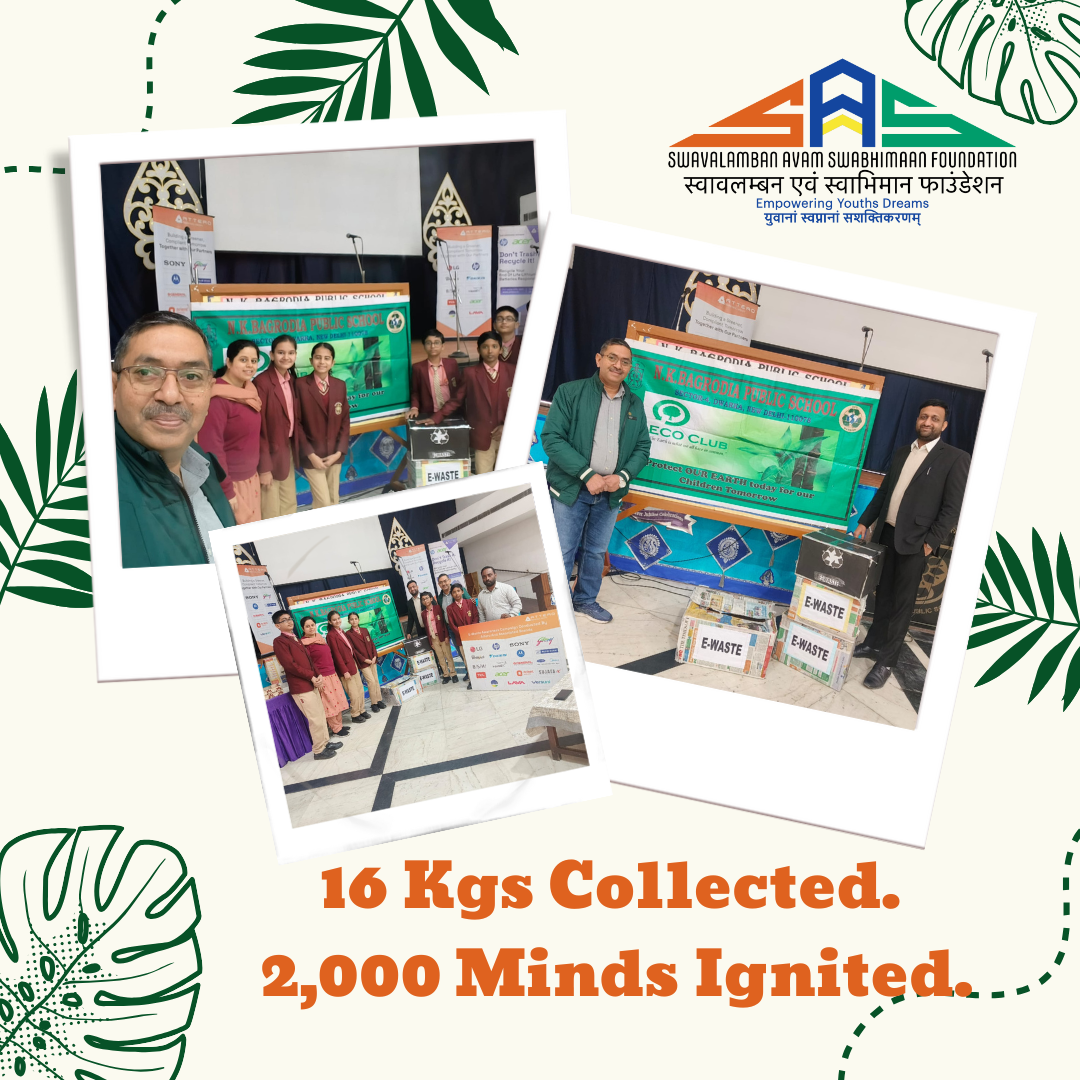
On 2nd February, the SAS Foundation, in close coordination with the Rotary Club of Delhi Govinda, successfully conducted a comprehensive E-Waste Awareness and Collection Drive at N. K. Bagrodia Global School, Sector-17, Phase-II, Dwarka. This initiative was far more than a basic disposal activity—it was a highly structured sustainability intervention explicitly designed to embed a deep sense of environmental responsibility within young minds.
Core campaigns like this form the baseline of our ongoing SAS Foundation environmental initiatives, proving that true climate resilience is achieved by combining classroom education with hands-on civic action.
Why E-Waste Awareness in Schools Matters
India currently ranks among the fastest-growing generators of consumer electronic waste globally. With accelerating digital penetration across schools and households, smartphones, batteries, laptops, and chargers are becoming completely indispensable—but so is the hazardous, mounting burden of electronic waste (e-waste).
Improper or informal disposal of e-waste leads to severe ecological degradation:
Addressing this modern urban challenge requires far more than physical infrastructure; it demands early environmental education and targeted behavioral modification. Modern schools act as incredibly powerful catalysts for building this long-term sustainability consciousness.
Student-Led Environmental Leadership in Action
What made this specific drive uniquely impactful was the phenomenal leadership displayed by the school’s Eco Club students. Rather than limiting their peer outreach to a standard, passive morning assembly session, these motivated students went classroom to classroom to educate their peers on critical concepts:
-
Hazard Identification: Explaining the severe environmental hazards of improper tech disposal.
-
Source Segregation: Teaching students how to separate dry, wet, and electronic waste items at home.
-
Circular Economy: Demonstrating how old electronic items can be stripped for parts to manufacture new tech.
-
Climate Resilience: Connecting small, daily individual actions to global climate preservation milestones.
Approximately 2,000 students were actively sensitized during this peer-to-peer exercise, beautifully turning abstract environmental awareness into a collective, shared social responsibility.
Tangible Impact: Scientific Recycling via Attero
The collaborative drive resulted in the direct collection of approximately 16 kilograms of hazardous e-waste straight from student households. The collection inventory consisted primarily of:
-
Spent household and smartphone batteries
-
Tangled charging cables and power bricks
-
Small, broken personal electronic appliances
-
Miscellaneous electronic accessories and discarded peripherals
The collected items were formally handed over to Attero, India’s leading authorized e-waste recycling company, to undergo fully certified, environmentally compliant scientific recycling. By ensuring responsible downstream processing, this initiative successfully prevented high-risk heavy metals from entering informal, unsafe urban waste streams and overflowing city landfills.
Multi-Stakeholder Collaboration: A Sustainable Model
The foundation strongly believes that systemic environmental challenges demand tightly integrated, collaborative solutions. This successful Dwarka drive stands as a brilliant model for cross-sector urban sustainability:
During the drive, the foundation’s strategic direction was represented on-ground by Gaurav Agarwal, while Arjunseamlessly managed the logistics handling on behalf of Attero.
Thought Leadership: Building a Circular Mindset in Youth
True environmental sustainability can never be achieved through top-down corporate policies alone; it must be driven organically by a shift in everyday culture. When young students understand resource extraction limits, lifecycle thinking, and the hidden environmental footprints of consumer tech, they inherently begin making better daily choices. They learn to extend device lifecycles, choose repair over replacement, and prioritize verified recycling over casual disposal.
Youth Sensitization (2,000 Students)+Compliant Recycling (Attero)=Measurable Carbon Reduction
All ongoing SAS Foundation environmental initiatives are mapped directly against international Sustainable Development Goals (SDGs), ESG-driven corporate awareness metrics, and circular economy frameworks. By integrating awareness, action, and clear corporate accountability, we aim to build a passionate vanguard of youth climate leaders who will naturally influence their families and wider communities.
The Road Ahead: From Awareness to a Movement
A single school collection drive is an excellent start, but it is not a complete solution to an electronic waste crisis. Consistent, scheduled interventions across thousands of schools, residential RWAs, and corporate institutions are required to create a massive, cumulative ecological impact.
Moving forward, the foundation is committed to scaling up these structured school modules, expanding collection box networks, and continuing to provide transparent data reporting across Delhi-NCR. Sustainability is never an isolated, one-time event—it is a continuous, lifelong commitment to safeguarding our planet.