
SAS Foundation Assistant
Palam, New Delhi · Education · Health · Environment
Answers are AI-generated and may be inaccurate — for official confirmation, contact SAS Foundation directly.

+91 931 243 9444
+91 965 470 9935

contact@sas-foundation.in

RZ-54/5A, Rajnagar Part 2,
Palam Colony, New Delhi 110077
Moving Beyond Traditional Education
In today’s rapidly evolving world, education must evolve beyond textbooks and examinations. The modern workforce demands individuals who can think critically, analyze information, solve complex problems, and make informed decisions. Academic knowledge alone is no longer sufficient to prepare students for the challenges of the future.
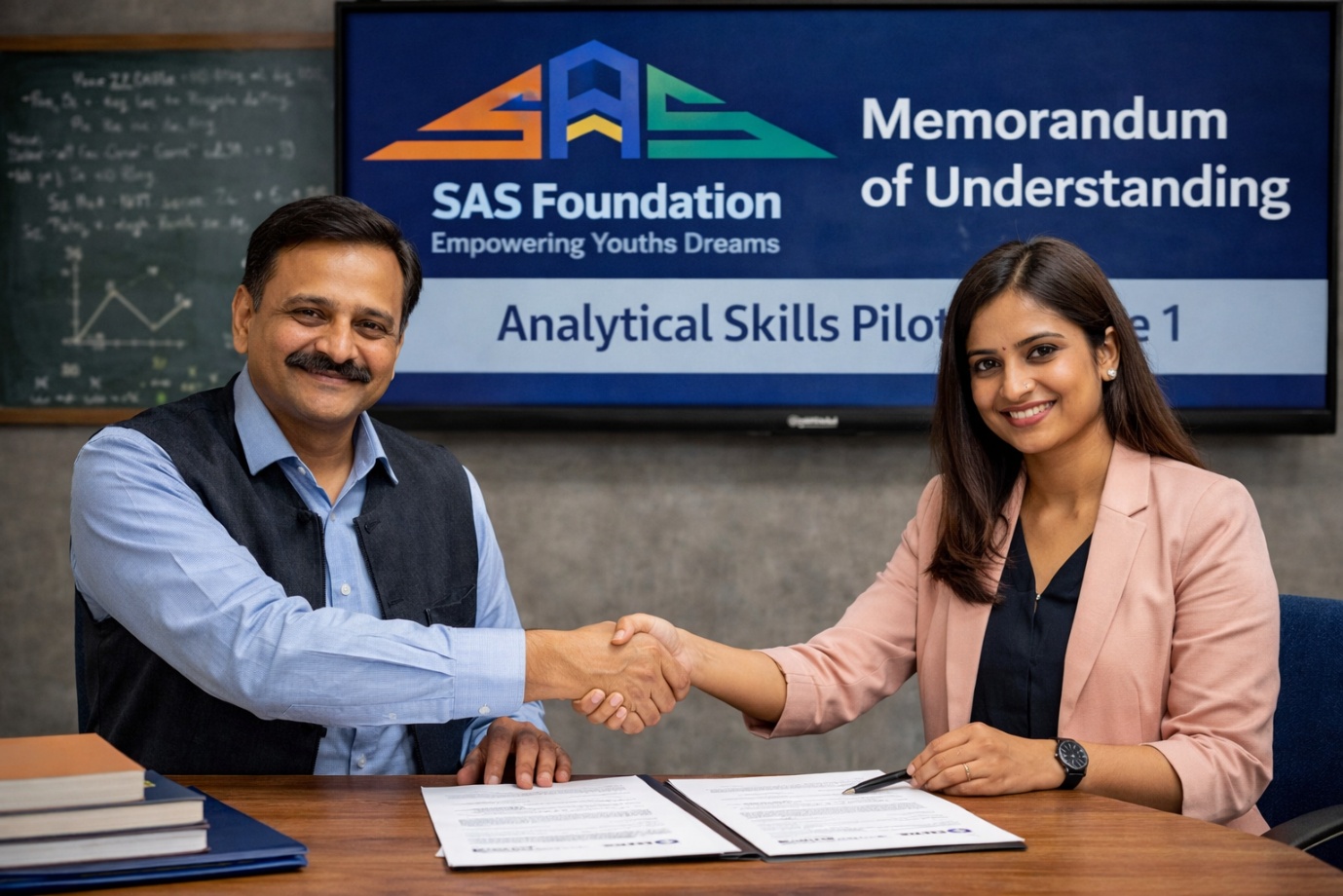
Recognizing this need, Swavalamban Avam Swabhimaan Foundation (SAS Foundation) has taken another meaningful step toward transforming youth education. The foundation has signed a Memorandum of Understanding (MoU) with Ms. Kristy Dhoundiyal from Indira Gandhi Delhi Technical University for Women to launch the “Analytical Skills Pilot – Phase 1.”
This initiative represents a significant milestone in SAS Foundation’s broader vision of empowering youth through practical, skill-oriented educational interventions that prepare students for real-world opportunities.
Through this pilot program, SAS Foundation aims to introduce students to structured analytical thinking, logical reasoning, and problem-solving frameworks, enabling them to build essential competencies required for academic success, career readiness, and life-long learning.
SAS Foundation’s Vision for Transformative Education
Since its inception, SAS Foundation has been committed to empowering youth dreams by creating opportunities that bridge the gap between education and real-world application.
While traditional educational systems often emphasize theoretical knowledge, SAS Foundation believes that students must also develop:
The Analytical Skills Pilot aligns strongly with the foundation’s Education pillar, which focuses on enabling young learners to gain the competencies necessary for success in a knowledge-driven economy.
By nurturing analytical and reasoning skills at an early stage, the foundation seeks to build a generation of thinkers, innovators, and responsible problem solvers.
Why Analytical Thinking Is the Skill of the Future
The world is witnessing an unprecedented transformation driven by technology, data, and innovation. As industries become increasingly complex and interconnected, the ability to analyze information and solve problems systematically is becoming one of the most valuable skills.
Employers across sectors are increasingly prioritizing candidates who demonstrate:
Students who develop these abilities early are better prepared for competitive examinations, higher education opportunities, internships, and future employment prospects.
However, many students struggle with analytical reasoning because traditional schooling often focuses on memorization rather than conceptual understanding and problem-solving strategies.
The Analytical Skills Pilot launched by SAS Foundation seeks to address this gap by introducing structured learning methods that help students approach problems logically and confidently.
About the Analytical Skills Pilot – Phase 1
The Analytical Skills Pilot – Phase 1 is designed as a structured academic intervention to help students strengthen their reasoning capabilities.
The program focuses on developing two critical cognitive domains:
Quantitative Reasoning
Students will be introduced to problem-solving techniques involving:
These exercises help students develop confidence in interpreting numbers and applying mathematical logic to practical scenarios.
Logical Reasoning and Pattern Recognition
Another key focus of the program is logical thinking, where students learn to identify patterns, sequences, and relationships between numbers and concepts.
The logical reasoning component helps students:
These skills are widely used in competitive examinations, aptitude tests, and professional assessments.
A Structured and Measurable Learning Approach
One of the distinguishing features of this pilot initiative is its data-driven evaluation framework.
The program incorporates:
This structured approach ensures that the program does not merely deliver training but also measures actual learning outcomes and improvement.
Such measurable frameworks are essential to ensure that educational interventions produce real impact rather than superficial engagement.
Collaboration for Innovation in Education
The partnership between SAS Foundation and Kristy Dhoundiyal reflects the foundation’s belief in collaborative innovation.
Young professionals and emerging educators often bring fresh perspectives, creativity, and new ideas that can help transform traditional learning approaches.
By encouraging such collaborations, SAS Foundation aims to create an ecosystem where academia, young innovators, and social organizations work together to improve educational outcomes.
This collaborative model helps the foundation continuously experiment with new learning frameworks while maintaining strong governance and academic rigor.
Empowering Youth Through Skill-Based Learning
The Analytical Skills Pilot is not merely a short-term initiative. It is part of a larger vision to empower young learners with future-ready skills.
SAS Foundation believes that education must help students develop capabilities that extend beyond the classroom, including:
By introducing such skills early, the foundation seeks to build confidence, resilience, and intellectual curiosity among students.
These attributes are essential for navigating the challenges of the modern world.
The Road Ahead: Expanding Educational Impact
While the Analytical Skills Pilot represents an initial step, it has the potential to evolve into a larger educational initiative.
Based on the insights and outcomes of this pilot program, SAS Foundation may explore opportunities to:
Such initiatives will help strengthen the foundation’s long-term goal of building a comprehensive ecosystem for youth development.
Investing in the Thinkers of Tomorrow
Education has the power to transform lives, communities, and nations. However, meaningful transformation occurs only when education equips young minds with the ability to think independently, analyze challenges, and innovate solutions.
The launch of the Analytical Skills Pilot – Phase 1 marks another step in SAS Foundation’s commitment to shaping a future where young people are not only educated but also empowered with the skills required to thrive in a complex and rapidly changing world.
By nurturing analytical thinking and problem-solving abilities, SAS Foundation continues to move forward in its mission of empowering youth dreams and creating pathways for a brighter, more capable future generation.
We invite educators, institutions, professionals, and individuals who share this vision to join hands with SAS Foundation and become part of this journey of empowering young minds and building a stronger society.



Palam, New Delhi · Education · Health · Environment
Answers are AI-generated and may be inaccurate — for official confirmation, contact SAS Foundation directly.