
SAS Foundation Assistant
Palam, New Delhi · Education · Health · Environment
Answers are AI-generated and may be inaccurate — for official confirmation, contact SAS Foundation directly.

+91 931 243 9444
+91 965 470 9935

contact@sas-foundation.in

RZ-54/5A, Rajnagar Part 2,
Palam Colony, New Delhi 110077
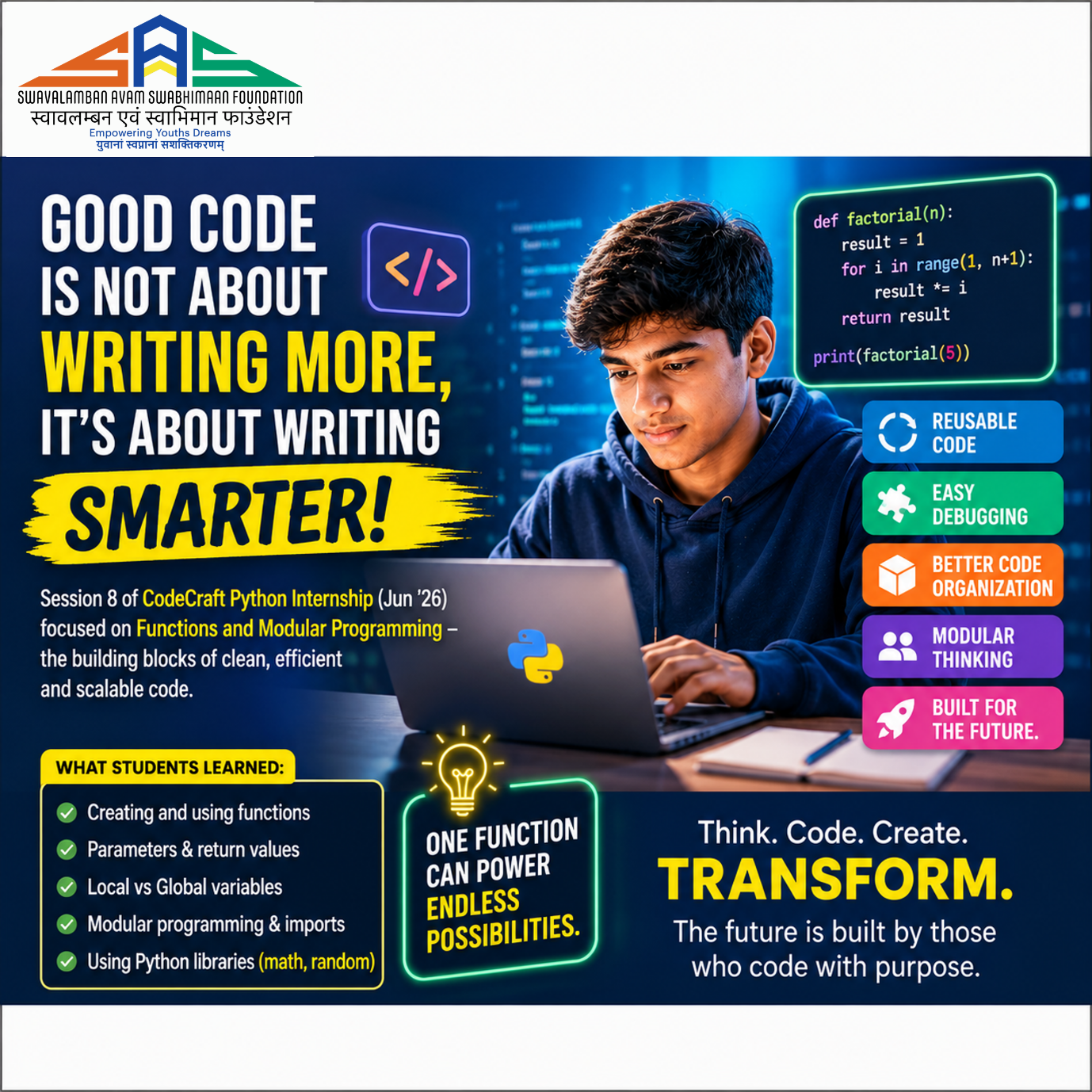
CodeCraft Python Internship (Jun ’26) | Session 8: Functions & Modular Programming
“The true measure of a programmer is not the number of lines of code they write, but the number of problems they solve with elegant simplicity.”
As technology continues to redefine industries, one skill is becoming increasingly valuable—not writing more code, but writing better code.
From Artificial Intelligence and cloud computing to mobile applications and enterprise software, the world’s most impactful digital solutions are built on a simple yet powerful principle: reusability.
This philosophy was at the heart of Session 8 of the CodeCraft Python Internship (Jun ’26), where students explored one of Python’s most transformative concepts—Functions and Modular Programming.
While the session introduced technical concepts such as functions, parameters, return values, variable scope, and Python modules, its real lesson extended far beyond programming. It encouraged participants to adopt a mindset of structured thinking, collaboration, and scalable innovation.
Every Great Innovation Starts with One Reusable Idea
Imagine building a city where every building requires manufacturing new bricks from scratch.
The process would be slow, expensive, and inefficient.
Now imagine having standardized bricks that can be reused to construct schools, hospitals, homes, and skyscrapers.
Software development works exactly the same way.
Functions are the reusable building blocks of programming.
Rather than rewriting the same logic repeatedly, developers define it once and reuse it wherever needed.
This simple concept dramatically improves efficiency, reduces errors, and makes applications easier to maintain.
Students quickly realized that programming is not about producing lengthy code—it is about creating intelligent solutions that can grow with evolving needs.
From Writing Code to Designing Systems
One of the biggest transitions every aspiring programmer must make is shifting from writing instructions to designing systems.
Functions enable this transformation.
Instead of thinking,
“How do I solve this problem again?”
students begin asking,
“Can I create a solution that solves this problem every time?”
This subtle shift represents the difference between coding and software engineering.
During the session, participants learned how a function can receive inputs, process information, and return meaningful outputs that can be reused throughout an application.
Whether calculating marks, validating user information, generating reports, or processing business logic, functions provide consistency and efficiency.
The lesson was simple:
Good programmers write code. Great programmers design reusable solutions.
Built-In Knowledge vs. Human Creativity
An engaging discussion compared Python’s built-in functions with user-defined functions.
Python already provides powerful built-in capabilities such as:
These are trusted tools created by the Python community and available to every programmer.
However, no programming language can predict every business problem.
That is where user-defined functions become powerful.
Students learned how developers create customized functions tailored to unique requirements.
This distinction helped participants understand an important principle:
Technology provides tools.
Innovation comes from people.
Eliminating Redundancy Through Intelligent Design
One of the strongest messages delivered during the session was the importance of avoiding repetitive work.
Imagine maintaining a school management system with thousands of students.
If identical code exists in multiple locations, every update becomes difficult and error-prone.
Functions solve this challenge elegantly.
Update the function once.
Every part of the application automatically benefits.
This is why modern software organizations—from startups to global technology companies—build applications around reusable components.
The same philosophy powers cloud platforms, enterprise software, Artificial Intelligence models, and mobile applications.
Understanding Parameters: Making Programs Dynamic
Participants explored how functions become flexible through parameters.
Rather than creating separate functions for every possible scenario, programmers can pass different values into a single reusable function.
For example, instead of writing individual programs for every student’s marks, one function can calculate results for any student simply by receiving different inputs.
This approach teaches students an invaluable lesson:
Solutions become powerful when they adapt to changing circumstances.
In many ways, this mirrors leadership itself.
Effective leaders don’t solve one problem.
They create systems capable of solving many.
Return Values: Delivering Meaningful Outcomes
The session also introduced return values, allowing functions to send processed information back to the main program.
This concept demonstrates how different parts of a software system collaborate seamlessly.
Every function has a responsibility.
Every output creates value.
Every component contributes to a larger solution.
This modular approach reflects how successful organizations operate—through specialization, collaboration, and clear accountability.
Understanding Scope: Knowing Where Information Belongs
Another important topic covered during the session was variable scope.
Students learned the distinction between local variables, which exist only within a function, and global variables, which are accessible throughout a program.
Although technical in nature, this concept teaches an important design philosophy.
Not every piece of information should be available everywhere.
Well-designed systems protect information, maintain structure, and clearly define responsibilities.
These are principles equally relevant in software engineering, cybersecurity, governance, and organizational leadership.
Modular Programming: Building Software Like Building Cities
As projects grow, managing everything in a single file becomes impractical.
Students explored how modular programming divides applications into multiple independent files containing related functions.
These modules can then be imported whenever needed.
This approach enables:
Large technology companies rarely build applications in one file.
Instead, thousands of developers contribute independent modules that work together to create sophisticated software products.
Understanding modular programming introduces students to professional software development practices used worldwide.
Standing on the Shoulders of Innovation
Participants also explored Python libraries such as math and random, discovering how developers can leverage pre-built capabilities instead of reinventing existing solutions.
This highlighted another valuable lesson.
Innovation is not about building everything from scratch.
It is about combining existing knowledge creatively to solve new challenges.
Every technological breakthrough builds upon the work of previous innovators.
Learning to use libraries effectively prepares students to become contributors to the next generation of technology.
Learning by Building
The session concluded with a practical assignment:
Develop a Python function that calculates the factorial of a number using loops and multiplication logic.
Although simple in appearance, the assignment reinforced multiple concepts simultaneously:
More importantly, it encouraged students to move from passive learning to active creation.
Programming is not mastered by watching.
It is mastered by building.
Empowering Future Technology Leaders
At SAS Foundation, education is viewed as a catalyst for transformation rather than merely knowledge transfer.
The CodeCraft Python Internship has been carefully designed to help young learners develop computational thinking, logical reasoning, creativity, and confidence alongside technical skills.
Each session equips participants not only with programming knowledge but also with habits essential for success in the digital economy:
These qualities will define the next generation of software developers, AI engineers, cybersecurity professionals, entrepreneurs, and technology leaders.
The Road Ahead
The future belongs to individuals who can simplify complexity, create scalable solutions, and collaborate effectively.
Functions and modular programming are far more than Python concepts.
They represent a philosophy of intelligent design.
Every reusable function written today becomes the foundation for tomorrow’s innovation.
Every modular application begins with one thoughtfully designed function.
Every future technology leader begins by learning how to think before learning how to code.
At SAS Foundation, we remain committed to empowering young minds with future-ready digital skills that inspire innovation, foster self-reliance, and build confidence to lead the world of tomorrow.
Because empowering youth with technology is not merely about teaching programming—it is about enabling them to build the future.
Join the Movement
If you believe technology education should empower creativity, innovation, and problem-solving, become a part of the SAS Foundation community.
Together, we can nurture the next generation of digital innovators and create meaningful opportunities for youth to thrive in the rapidly evolving world of technology.
Visit www.sas-foundation.in to learn more about our internships, educational initiatives, volunteer opportunities, membership, and upcoming programs.
Together, let’s empower youth dreams—one line of code, one learner, and one innovation at a time.





Palam, New Delhi · Education · Health · Environment
Answers are AI-generated and may be inaccurate — for official confirmation, contact SAS Foundation directly.