SAS Foundation Assistant
Palam, New Delhi · Education · Health · Environment
Answers are AI-generated and may be inaccurate — for official confirmation, contact SAS Foundation directly.

+91 931 243 9444
+91 965 470 9935

contact@sas-foundation.in

RZ-54/5A, Rajnagar Part 2,
Palam Colony, New Delhi 110077
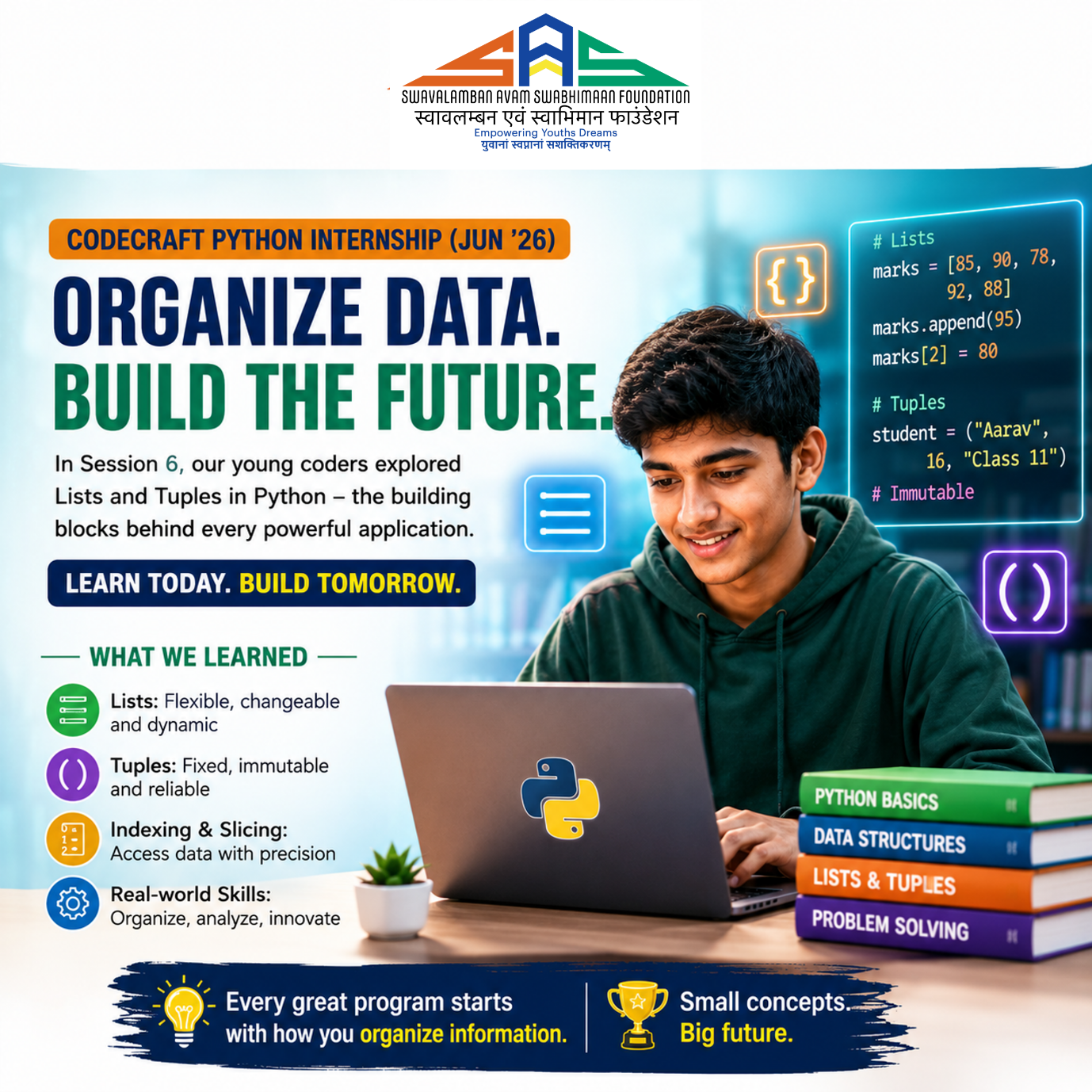
Inside Session 6 of the CodeCraft Python Internship (Jun ’26) by SAS Foundation
“Technology is no longer defined by how much data we generate—it is defined by how intelligently we organize it.”
This simple truth is transforming every industry across the globe.
From Artificial Intelligence recommending your next movie, to banking systems securing millions of transactions, to healthcare platforms analyzing patient records and e-commerce websites delivering personalized shopping experiences—every modern digital solution relies on one invisible foundation: data structures.
Recognizing the importance of this fundamental concept, Session 6 of the CodeCraft Python Internship (Jun ’26), organized by Swavalamban Avam Swabhimaan Foundation (SAS Foundation), introduced participants to one of the most valuable building blocks of computer science—Lists and Tuples in Python.
While these concepts may appear simple at first glance, they represent a significant milestone in every programmer’s journey from writing basic code to designing intelligent software systems.

Every Great Software Application Begins with Organized Information
Imagine trying to manage an entire school’s student records using hundreds of separate variables.
One variable for every student’s name.
Another for every student’s marks.
Another for attendance.
Another for grades.
Very quickly, the program becomes impossible to manage.
Professional developers solve this challenge differently.
They organize related information into meaningful structures.
This is exactly what students explored during Session 6.
Instead of seeing programming as writing commands, participants began understanding software development as organizing knowledge efficiently.
This mindset shift is what separates beginners from future software engineers.
Learning Beyond Syntax: Understanding Data Structures
One of the strongest messages delivered throughout the session was that programming languages are merely tools.
The real skill lies in designing information intelligently.
Students learned that data structures act as organized containers capable of storing multiple related values together.
Rather than scattering information across dozens of variables, programmers create structured collections that are easier to understand, maintain, and scale.
This principle powers virtually every software application in existence.
Whether someone is building:
they all begin by organizing data effectively.
Lists: Built for a Changing World
One of the core concepts explored during the session was the Python List.
Students learned that lists are mutable, meaning their contents can change over time.
This seemingly simple characteristic reflects an important real-world principle.
Most information around us changes constantly.
Student marks improve.
Bank balances fluctuate.
Inventory levels increase and decrease.
Customer orders arrive every minute.
Applications need flexible storage systems capable of adapting to these ongoing changes.
Lists provide exactly that flexibility.
Participants explored how lists allow developers to:
More importantly, they began understanding why software engineers prefer lists for dynamic environments.
Tuples: Protecting Information That Should Never Change
If lists represent flexibility, tuples represent trust.
Students discovered that tuples are immutable, meaning once created, they cannot be modified.
At first this may seem restrictive.
However, professional software systems often require information that should remain permanent.
Examples include:
By preventing accidental modification, tuples help preserve the authenticity and integrity of information.
Students began recognizing that choosing the correct data structure is not simply about programming.
It is about protecting data.
This lesson introduces an important engineering mindset:
Technology is not only about creating systems—it is also about preserving trust within those systems.
Indexing: Teaching Computers Where to Look
Finding information quickly is just as important as storing it.
During the session, participants explored one of Python’s most fundamental concepts—indexing.
Using zero-based indexing, students learned how computers identify the precise location of every element within a collection.
They also explored negative indexing, enabling programmers to retrieve information starting from the end of a collection.
Although this appears technical, the underlying lesson is universal.
Efficient systems always know where their information lives.
This principle extends far beyond Python.
Search engines.
Databases.
Cloud platforms.
Artificial Intelligence.
Every one of these technologies depends upon fast and accurate data access.
Slicing: Extracting Exactly What Matters
Modern organizations rarely need every piece of available information.
Instead, they require meaningful subsets.
This is where slicing becomes powerful.
Participants learned how slicing enables programmers to extract selected portions of lists and tuples without altering the original data.
This mirrors real-world analytics.
A business may analyze only this month’s sales.
A teacher may review only students scoring above 90%.
A hospital may study patients within a particular age group.
The ability to isolate relevant information is one of the most valuable analytical skills in computing.
Why Mutability Matters in the Age of Artificial Intelligence
Artificial Intelligence is often discussed in terms of algorithms.
Yet algorithms are only as effective as the data structures supporting them.
AI systems continuously update learning parameters.
Recommendation engines refresh user preferences.
Navigation systems adjust routes.
Financial platforms process live transactions.
These dynamic environments require flexible data structures like lists.
Meanwhile, security systems, blockchain records, and digital certificates rely upon immutable information similar to tuples.
Through a single classroom session, participants unknowingly encountered concepts that underpin many of today’s most advanced technologies.
Practical Learning That Builds Confidence
Rather than ending with theory, students received a practical assignment:
Create a Python list containing student marks and calculate the average using the built-in sum() and len() functions.
This exercise demonstrates an educational philosophy embraced throughout the CodeCraft Python Internship:
Learning happens through creation, not memorization.
By writing code independently, participants strengthened their understanding of:
Each assignment transforms knowledge into confidence.
Preparing Students for Industry, Not Just Examinations
One particularly valuable discussion during the session focused on why data structures are among the most frequently tested topics during technical interviews.
Modern employers seek professionals capable of solving real-world problems.
That requires more than understanding programming syntax.
It requires structured thinking.
Whether pursuing careers in:
strong knowledge of data structures forms a critical competitive advantage.
By introducing these concepts early, the internship equips learners with industry-relevant foundations that extend well beyond the classroom.
Empowering Youth Through Future-Ready Digital Skills
At SAS Foundation, education is viewed as more than knowledge transfer.
It is about creating opportunities.
Every internship session is designed to nurture curiosity, analytical thinking, creativity, confidence, and practical problem-solving.
The CodeCraft Python Internship reflects the Foundation’s broader vision of Empowering Youths Dreams by making high-quality technology education accessible, engaging, and application-oriented.
As digital transformation accelerates across every sector, empowering young learners with programming and computational thinking is no longer optional—it is essential.
Today’s lesson on Lists and Tuples may seem modest.
Tomorrow, it could become the foundation upon which participants build intelligent applications, innovative startups, breakthrough research, and impactful careers.
The Road Ahead
Every accomplished software engineer once wrote their first list.
Every Artificial Intelligence researcher once learned indexing.
Every technology leader once discovered the importance of organizing information before solving problems.
The journey toward innovation begins with mastering the fundamentals.
At SAS Foundation, we are proud to walk alongside young learners as they take these first steps—transforming curiosity into capability, and capability into meaningful impact.
Because the future belongs not only to those who can use technology, but to those who can design it, improve it, and use it to solve humanity’s greatest challenges.
Join the Movement
If you are a student eager to build future-ready digital skills, a parent looking for meaningful learning opportunities, an educator passionate about technology, or an organization interested in empowering the next generation, we invite you to join the mission.
Become a member of Swavalamban Avam Swabhimaan Foundation (SAS Foundation) and help us create more opportunities for youth through education, technology, innovation, health, environment, and community development.
Together, we can empower today’s learners to become tomorrow’s innovators.