

SAS Foundation Assistant
Palam, New Delhi · Education · Health · Environment
Answers are AI-generated and may be inaccurate — for official confirmation, contact SAS Foundation directly.

+91 931 243 9444
+91 965 470 9935

contact@sas-foundation.in

RZ-54/5A, Rajnagar Part 2,
Palam Colony, New Delhi 110077
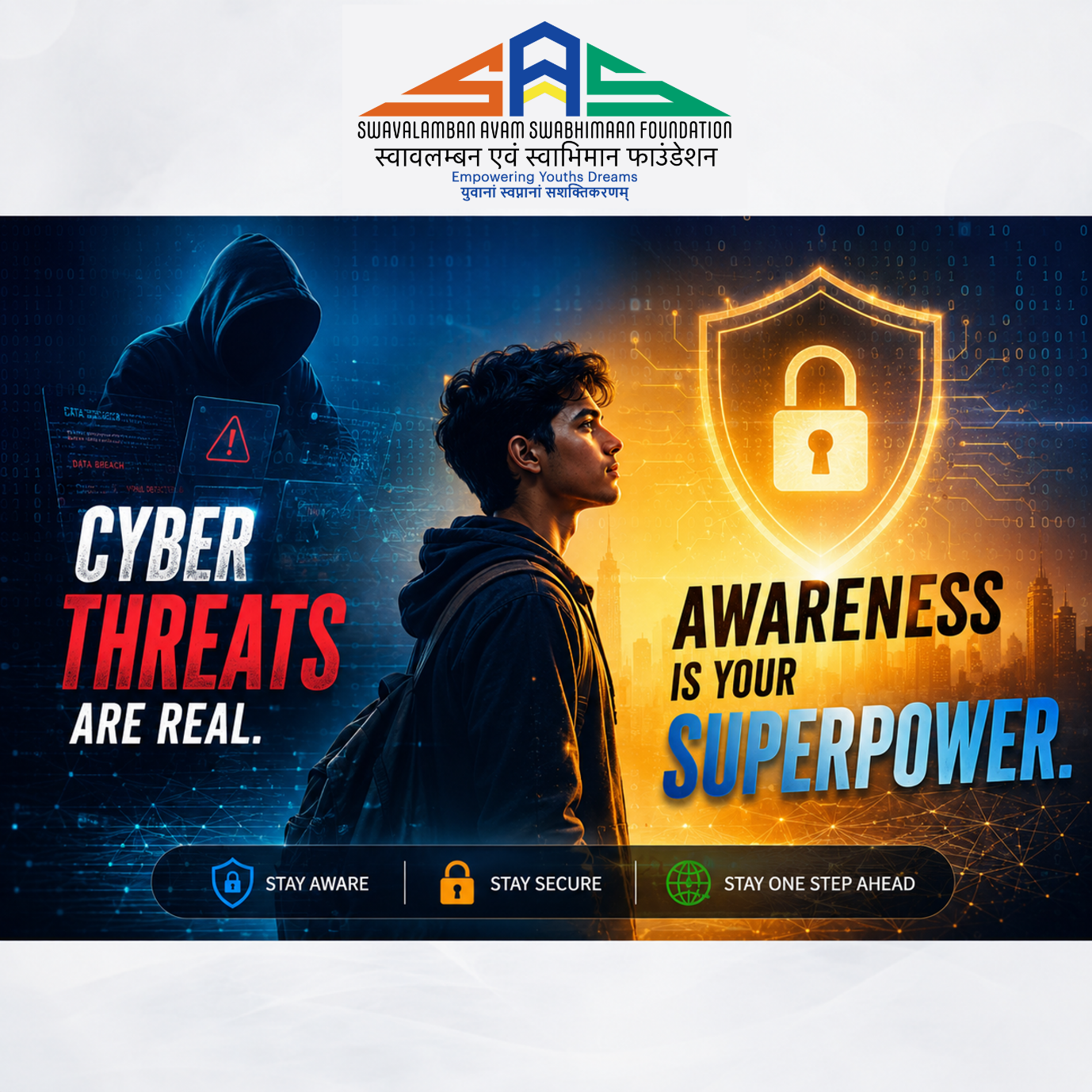
Why Cybersecurity Awareness Must Become a Life Skill for Every Student
Every generation inherits a defining challenge.
For previous generations, it was industrialization, globalization, or digital transformation.
For today’s youth, one of the defining challenges is something far less visible—but equally powerful.
Cybersecurity.
A student today does not merely carry books and notebooks. They carry digital identities, cloud accounts, payment apps, social profiles, passwords, photographs, academic records, and an ever-growing digital footprint.
And yet, while technology education has become mainstream, cyber awareness is still not treated as a foundational life skill.
At SAS Foundation, we believe that this must change.
That belief shaped the launch of our Cybersecurity & Digital Safety Internship Program—designed not just to teach technology, but to develop responsible, aware, and digitally resilient citizens.
The first session of our June 2026 internship batch opened with a simple but powerful realization:
In the digital world, your greatest defense is not software. It is awareness.

Cybersecurity Is No Longer Optional
Cybersecurity is often misunderstood as something relevant only for software engineers, ethical hackers, or large corporations.
The reality is very different.
Every student with:
is already part of the cyber ecosystem.
Which means every student is already a potential target.
Cyber attacks no longer require advanced technical expertise. Modern cyber criminals exploit trust, behavior, emotions, and routine digital habits.
From phishing emails and fake internships to malicious applications and identity theft—today’s attacks increasingly target people before they target technology.
This shift demands a new approach.
Digital literacy alone is not enough.
Digital safety must become a core competency.
Session 1: Building the Foundations of Cyber Awareness
The opening session of the Cybersecurity & Digital Safety Internship focused on helping students understand cybersecurity beyond technical jargon.
Students explored:
What is Cybersecurity?
Cybersecurity is the practice of protecting systems, networks, applications, and digital information from unauthorized access, exploitation, disruption, and attacks.
The discussion emphasized an important truth:
Technology creates opportunities—but it also creates responsibilities.
The CIA Triad: The Three Pillars of Cybersecurity
Students were introduced to one of the most important concepts in information security—the CIA Triad.
1. Confidentiality
Ensuring information remains private and accessible only to authorized individuals.
Examples:
2. Integrity
Ensuring information remains accurate and unaltered.
Examples:
3. Availability
Ensuring information and services remain accessible when needed.
Examples:
Students analyzed how nearly every cyber incident can be understood through these three principles.
Understanding Malware: The Silent Digital Threat
The internship introduced students to six major categories of malware:
Virus
Attaches itself to files and spreads upon execution.
Worm
Replicates independently and spreads rapidly.
Trojan Horse
Disguises malicious code as legitimate software.
Spyware
Monitors activity and collects information.
Ransomware
Encrypts files and demands payment.
Adware
Displays intrusive content and may collect user behavior.
Students discussed how modern attackers increasingly use scalable attack models and automated exploitation methods.
Awareness is becoming more important than ever.
Hackers Are Not All the Same
Popular media often portrays hacking in one dimension.
The session explored distinctions between:
Black Hat Hackers
Attack systems with malicious intent.
White Hat Hackers
Ethical professionals who secure organizations.
Grey Hat Hackers
Operate in legally ambiguous spaces while identifying vulnerabilities.
This distinction helped students understand that cybersecurity is not about breaking systems—it is about protecting people.
Cybercrime Has Become Personal
Cybercrime affects:
Individuals
Identity theft, fraud, cyberbullying.
Businesses
Financial loss, operational disruption.
Governments
Espionage, critical infrastructure attacks.
Students also learned about India’s legal framework under the Information Technology Act, 2000 and the importance of reporting incidents through official mechanisms.
A strong message emerged:
Ignoring cybercrime strengthens attackers. Reporting strengthens society.
Beyond Awareness: Learning Through Action
Learning cybersecurity cannot remain theoretical.
To encourage analytical thinking, students were assigned a real-world application exercise:
A 300-word essay analyzing an actual cyber attack through the lens of the CIA Triad.
The goal is not memorization.
The goal is to develop cyber thinking.
Because future leaders must know not only how technology works—but also how technology fails.
Preparing Youth for a Digital Future
At SAS Foundation, education is not limited to examinations.
We believe in preparing students for realities they will encounter beyond classrooms.
Cybersecurity awareness develops:
These capabilities extend far beyond cybersecurity.
They shape responsible citizens.
The Future Belongs to Digitally Responsible Youth
The next generation will build startups, govern institutions, create technology, and define digital culture.
The question is not whether they will use technology.
The question is whether they will use it safely.
Cybersecurity awareness is no longer an advanced skill.
It is a modern survival skill.
And the earlier we start, the stronger our digital future becomes.
Because cyber threats are real.
But awareness remains our greatest superpower.
Interested in future youth development programs?
Join us in empowering the next generation with skills that matter.