SAS Foundation Assistant
Palam, New Delhi · Education · Health · Environment
Answers are AI-generated and may be inaccurate — for official confirmation, contact SAS Foundation directly.

+91 931 243 9444
+91 965 470 9935

contact@sas-foundation.in

RZ-54/5A, Rajnagar Part 2,
Palam Colony, New Delhi 110077
What happens when environmental conversations move beyond discussion and become collective action?
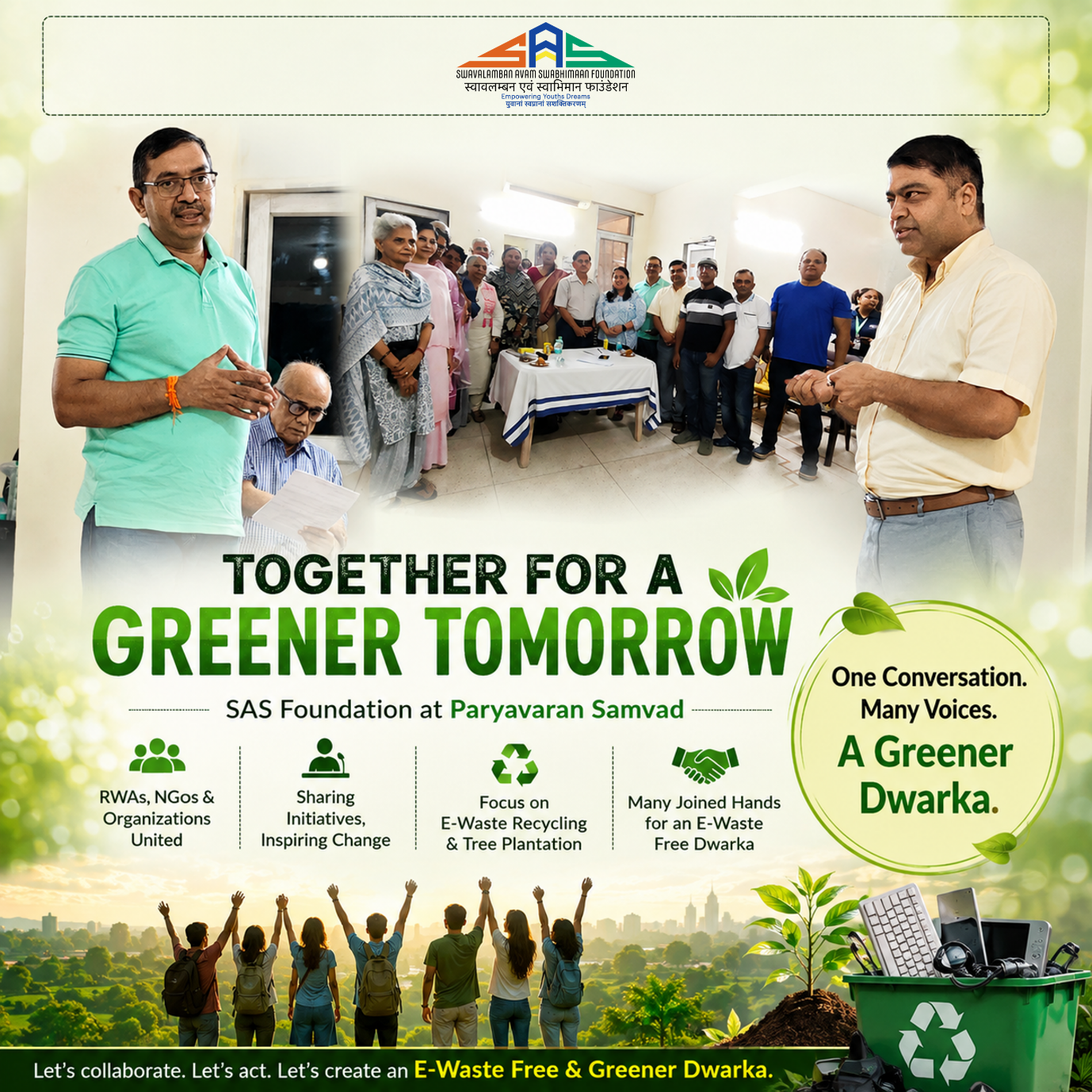
On 25 July 2026, Paryavaran Samvad brought together a diverse group of Resident Welfare Associations (RWAs), NGOs, community representatives and organizations with a shared concern: the future of the environment and the responsibility that communities must assume today.
For SAS Foundation, the Samvad was more than another environmental gathering. It was a reminder that meaningful environmental change rarely comes from one organization, one campaign or one individual. It emerges when people with different experiences, capabilities and networks come together around a common purpose.
The Samvad was chaired by Dr. Madhunita and Anul Kumar, and provided a valuable platform for participating organizations to share the environmental initiatives being undertaken in their respective capacities.
Among the voices at the gathering was SAS Foundation, which presented its work in two important areas of environmental action: e-waste collection and responsible recycling, and tree plantation.
The conversations that followed offered perhaps the most important takeaway of the day—there is a growing willingness within communities to collaborate for a cleaner and more sustainable Dwarka.
From Individual Initiatives to Collective Impact
Environmental challenges are interconnected.
A tree planted today contributes to a greener neighbourhood tomorrow. A discarded electronic device, when channelled into the formal recycling ecosystem, can prevent hazardous materials from being handled irresponsibly while enabling valuable resources to be recovered.
Yet, environmental initiatives often remain fragmented.
One RWA may conduct a cleanliness drive. Another may organize plantation. An NGO may conduct awareness campaigns. A school may encourage students to collect waste. A corporate organization may support recycling. Each effort has value, but the impact can multiply when these initiatives connect.
That is the larger significance of platforms such as Paryavaran Samvad.
They create space for environmental stakeholders to discover one another, exchange ideas and identify opportunities for collaboration.
For SAS Foundation, this philosophy is central to its environmental initiatives. The Foundation believes that sustainability should not remain limited to awareness campaigns or annual observances. It must become a part of everyday community behaviour.
The Growing E-Waste Challenge
Among the environmental issues discussed by SAS Foundation, electronic waste—or e-waste—deserves particular attention.
As technology becomes increasingly integrated into everyday life, electronic devices are being replaced at a rapid pace. Mobile phones, computers, laptops, chargers, printers, televisions, appliances and other electronic equipment eventually reach the end of their useful life.
The question is simple but important:
Where does that device go when it is no longer useful?
If e-waste is discarded along with regular household waste, valuable recyclable materials can be lost and potentially hazardous components may enter inappropriate waste streams.
This is why responsible e-waste collection and recycling are essential elements of sustainable urban development.
Through its environmental initiatives, SAS Foundation has been working to create greater awareness around responsible e-waste disposal and to facilitate structured collection and recycling.
Its message is equally simple:
Do not treat old electronics as ordinary waste. Give them a responsible second destination.
The Vision of an E-Waste-Free Dwarka
The most encouraging development from the 25 July Samvad came after SAS Foundation presented its environmental initiatives.
Several attendees reached out to the Foundation expressing interest in joining hands to create an e-waste-free Dwarka.
This response is significant.
An e-waste-free community cannot be created by simply placing a collection box in one location. It requires an ecosystem.
RWAs can mobilize residents.
Schools can educate students and families.
NGOs can create awareness and community engagement.
Organizations can support collection drives.
Volunteers can become environmental ambassadors.
Recyclers can ensure responsible processing.
And citizens can make the most important decision of all—to dispose of their electronic waste responsibly.
When these individual roles come together, an environmental campaign can evolve into a community movement.
Tree Plantation: From Planting to Stewardship
SAS Foundation also highlighted its tree plantation initiatives at the Samvad.
Tree plantation is one of the most visible forms of environmental action. But true environmental stewardship extends beyond planting a sapling.
The real objective is to nurture green spaces, encourage community participation and build an understanding that trees are long-term community assets.
A sapling planted today may take years to mature. Its environmental benefits, however, can continue for decades.
This makes plantation an exercise in long-term thinking.
It also reflects an important principle of sustainability: the best environmental initiatives are those that create benefits beyond the immediate event.
Why Collaboration Matters
The environmental challenges facing urban communities cannot be addressed in isolation.
Climate concerns, waste management, resource conservation, biodiversity and urban sustainability require participation from multiple stakeholders.
This is where collaboration becomes a force multiplier.
An RWA may have access to hundreds or thousands of households but may not have the technical expertise to manage e-waste recycling.
An NGO may have environmental expertise but require community networks for implementation.
A recycling organization may have the infrastructure for responsible processing but need a reliable collection ecosystem.
A community dialogue can bring these capabilities together.
That is why Paryavaran Samvad represents more than a meeting. It represents the possibility of building an environmental collaboration network for Dwarka.
From Samvad to Sankalp
Every movement begins with an idea.
Every meaningful idea needs people.
And every group of people needs a shared purpose.
The discussions on 25 July created precisely that possibility.
The idea of an e-waste-free Dwarka can become a practical reality if RWAs, NGOs, educational institutions, businesses, resident groups and citizens decide to work together.
SAS Foundation believes that environmental action should be participatory, measurable and sustainable.
The Foundation’s role is not merely to conduct initiatives, but to encourage more stakeholders to become part of the solution.
Because sustainability cannot be outsourced.
It cannot be left only to governments, NGOs or environmental organizations.
Every household, every institution and every community has a role to play.
The Next Chapter Begins With Participation
The 25 July Paryavaran Samvad demonstrated something powerful: communities are ready to engage.
The next step is to transform that willingness into action.
An old laptop lying unused in a cupboard, a box of obsolete mobile phones, discarded chargers, keyboards, printers or other electronic equipment may appear insignificant individually. Collectively, however, they represent an opportunity to create a cleaner and more responsible waste-management culture.
Likewise, every sapling planted and nurtured, every person educated about sustainability and every community brought into an environmental initiative contributes to a larger movement.
The journey towards a greener Dwarka will not be defined by one event.
It will be defined by what communities choose to do after the conversation ends.
Join the Movement for a Greener Dwarka
SAS Foundation invites RWAs, NGOs, schools, colleges, corporates, community organizations, environmental groups and conscious citizens to come forward and collaborate on environmental initiatives, particularly towards building an e-waste-free Dwarka and expanding responsible environmental action.
Organizations interested in conducting e-waste awareness and collection drives, tree plantation initiatives or other community-based environmental programmes can join hands with SAS Foundation.
And individuals who believe that meaningful change begins with participation are invited to become part of the Foundation’s journey by taking membership and supporting its environmental initiatives.
The Samvad has started the conversation. Now, it is time to turn that conversation into collective action.
Together, let us make Dwarka cleaner, greener and more responsible—one community, one initiative and one responsible choice at a time.
Palam, New Delhi · Education · Health · Environment
Answers are AI-generated and may be inaccurate — for official confirmation, contact SAS Foundation directly.