SAS Foundation Assistant
Palam, New Delhi · Education · Health · Environment
Answers are AI-generated and may be inaccurate — for official confirmation, contact SAS Foundation directly.
+91 931 243 9444
+91 965 470 9935

contact@sas-foundation.in

RZ-54/5A, Rajnagar Part 2,
Palam Colony, New Delhi 110077
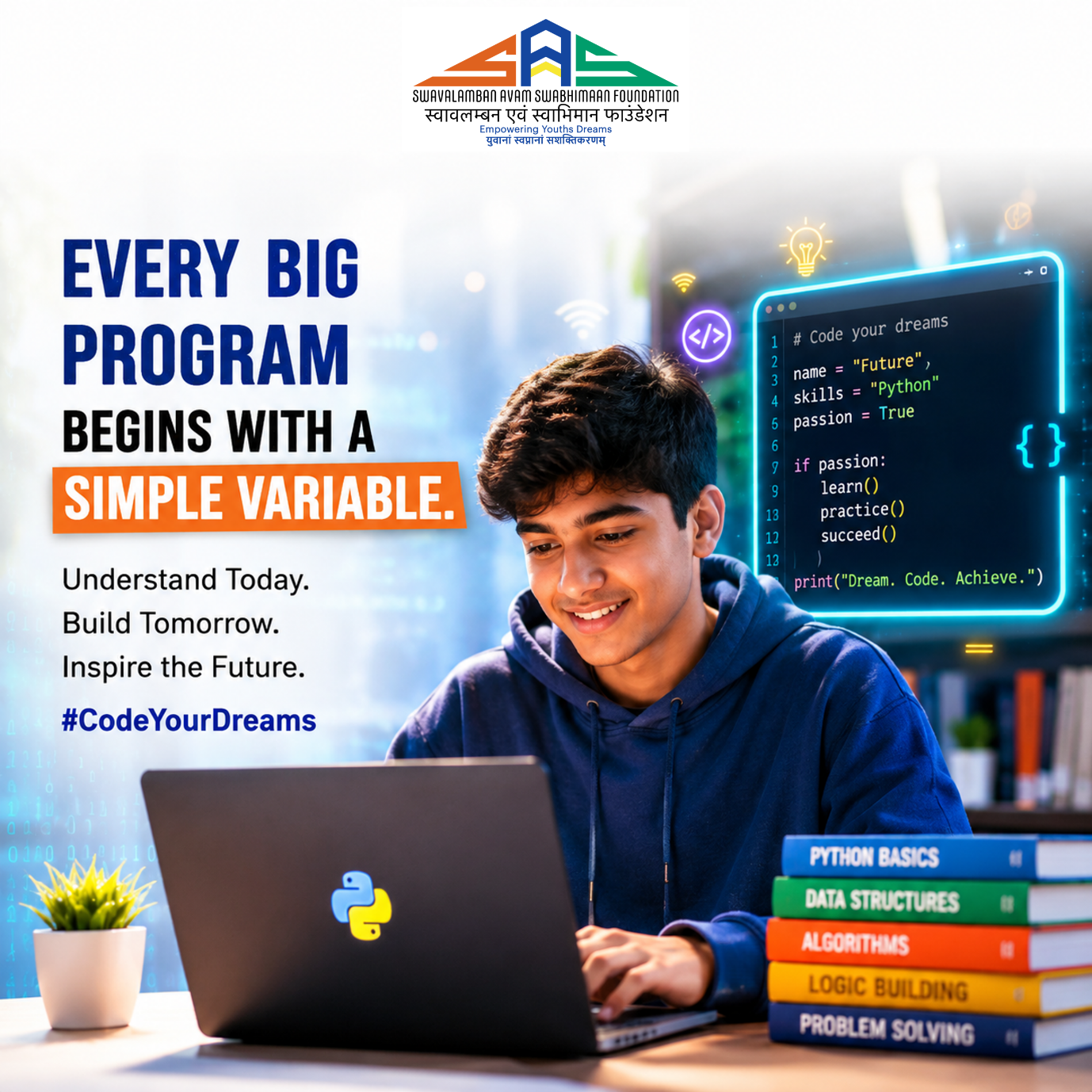
When a Student Writes Their First Variable, Something Bigger Begins
A screen.
A blinking cursor.
One simple line of code.
name = “Future”
At first glance, it appears insignificant.
But hidden inside that single statement is something much larger than programming—it is the beginning of structured thinking, problem solving, creativity, and confidence.
On 14 June 2026, during Session 2 of the CodeCraft Python Internship (Jun ’26) conducted by Swavalamban Avam Swabhimaan Foundation (SAS Foundation), students stepped into one of the most important ideas in technology: understanding how computers think through variables, data, and logic.
The session was not merely about learning syntax.
It was about learning to create.

Technology Does Not Begin With Artificial Intelligence. It Begins With Understanding Data.
Today’s students grow up surrounded by Artificial Intelligence, mobile applications, recommendation engines, digital platforms, and automation.
Yet few pause to ask:
How does a computer remember?
How does software make decisions?
How do applications respond intelligently?
The answer often begins with something surprisingly simple—variables.
Variables are not merely placeholders.
They are containers of possibilities.
They hold information. They shape outcomes. They make logic possible.
When students understand variables, they begin understanding systems.
And when they understand systems, they begin shaping the future.
Session 2: Turning Curiosity Into Computational Thinking
The CodeCraft Python Internship Session 2 introduced participants to foundational programming concepts including:
Python Variables
Students learned how variables act as dynamic containers for information and why developers use them to make software scalable, maintainable, and efficient.
A powerful analogy transformed learning into understanding:
Variables were compared to storage containers—organized, reusable spaces that hold information until it is needed.
From there, students began seeing code not as commands but as organized thought.
Variable Naming: Because Clarity Builds Better Technology
One of the earliest lessons in software engineering is deceptively simple:
Good code is readable code.
Participants explored:
• Rules for naming variables
• Why numbers cannot begin variable names
• Avoiding special characters
• Understanding reserved Python keywords
• Writing meaningful and descriptive identifiers
This lesson went beyond programming.
Students learned that precision, structure, and communication matter in every discipline.
Understanding Data Types: The Language of Digital Systems
Every technology product—from banking apps to healthcare systems—runs on data.
Students explored Python’s built-in data types including:
Integer (int)
Working with whole numbers.
Float (float)
Handling precision and decimal values.
String (str)
Managing text and communication.
Boolean (bool)
Creating logic using True and False.
Students also received exposure to collection structures such as:
• Lists
• Tuples
• Sets
• Dictionaries
The realization was immediate:
Technology is not magic.
Technology is organized information.
Learning to Ask Better Questions Through Operators
One of the most exciting moments of the session came through exploring operators.
Students discovered that operators are not symbols.
They are decision-making tools.
Topics included:
Arithmetic Operators
Performing mathematical computation.
Comparison Operators
Evaluating conditions.
Logical Operators
Building intelligent pathways.
Assignment Operators
Improving efficiency.
Membership Operators
Checking relationships inside datasets.
Identity Operators
Understanding object behavior.
Bitwise Operators
Introducing how computers operate beneath the surface at the binary level.
What looked technical soon became transformational.
Students began seeing how software thinks.
Why This Matters More Than Coding
The future belongs not simply to those who consume technology.
It belongs to those who understand it.
Learning programming is no longer limited to software careers.
Programming develops:
✓ Structured thinking
✓ Analytical reasoning
✓ Creativity
✓ Decision-making
✓ Problem solving
✓ Communication
✓ Confidence
When students learn to code, they learn to think differently.
And that changes everything.
The Assignment That Changed Learning Into Creation
At the end of the session, participants received a challenge:
Build a student information program.
Store:
• Name
• Age
• Class
• Grade
• Percentage
• Marks
Display it creatively using string formatting.
Simple?
Perhaps.
Powerful?
Absolutely.
Because that assignment transformed passive listeners into creators.
It encouraged experimentation.
It invited ownership.
It gave students permission to build.
Empowering Youth Through Digital Education
At SAS Foundation, education is not viewed as information transfer.
Education is viewed as capability creation.
The CodeCraft Python Internship reflects a larger mission:
To equip young learners with future-ready skills and help them become creators of technology—not just users of it.
Every internship session is designed to strengthen:
• Digital literacy
• Emerging technology awareness
• Innovation mindset
• Career readiness
• Confidence through practical learning
Because empowering youth is not only about opportunity.
It is about preparation.
Your First Variable Could Become Your First Startup
Today, a student writes:
marks = 95
Tomorrow, the same student may build:
• An educational platform
• An AI solution
• A social enterprise
• A healthcare innovation
• A climate technology startup
Every breakthrough starts somewhere.
Sometimes, it starts with a single line of code.
Sometimes, it starts with a simple variable.
And sometimes, it starts with believing that young minds can build extraordinary futures.
Join us as we continue empowering youth dreams through education, technology, and opportunity.
Become a member. Participate. Volunteer. Collaborate.
Together, let us create not just coders—but creators.