CodeCraft Python Internship (Jun ’26) | Session 3 Reflection
What separates a machine from intelligence?
It is not speed.
It is not memory.
It is not processing power.
It is the ability to decide.
Every recommendation engine, every navigation application, every intelligent chatbot, every automated system—and even the technologies shaping the future of Artificial Intelligence—depend on one fundamental capability:
The ability to determine what should happen next.
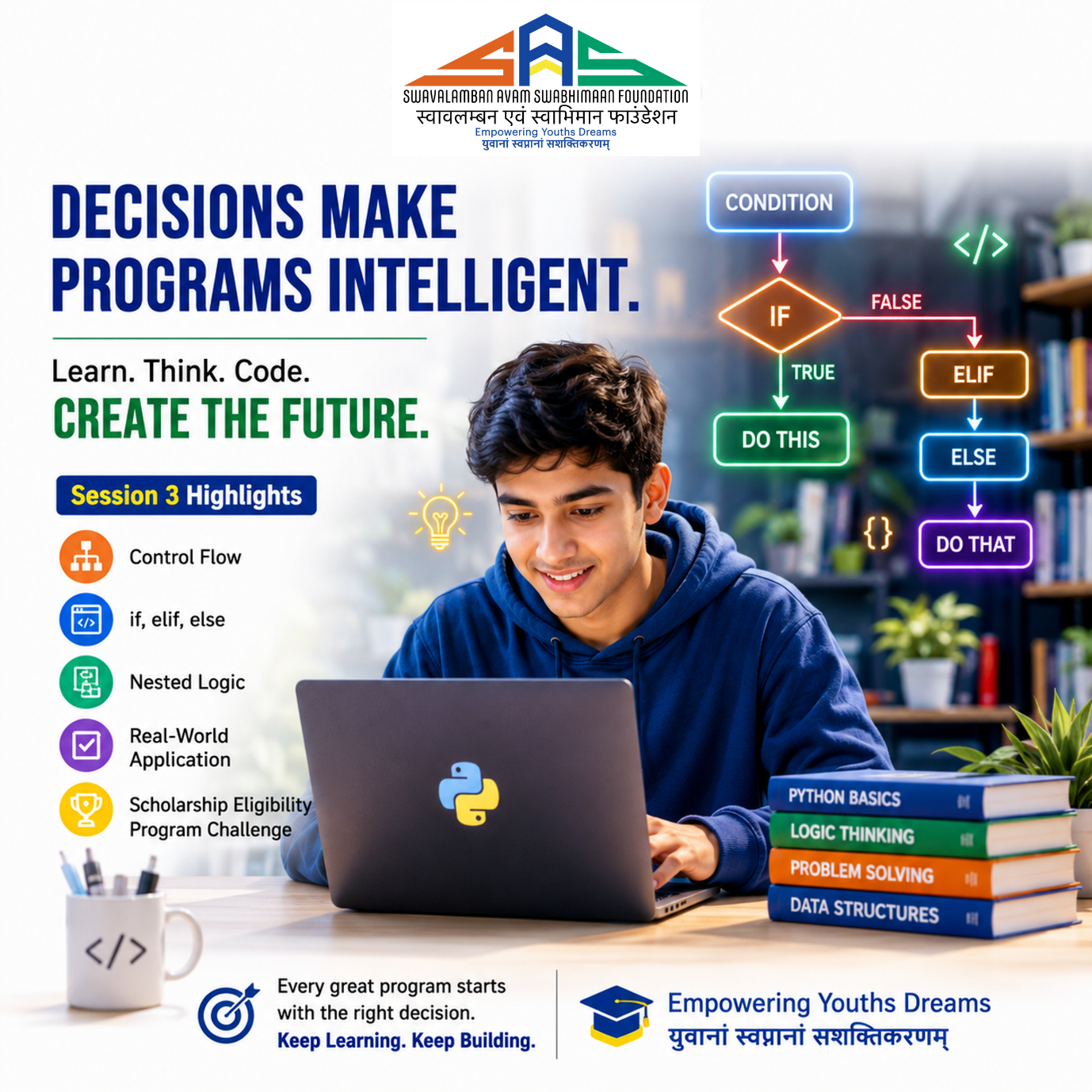
That idea became the foundation of Session 3 of the CodeCraft Python Internship (Jun ’26), where participants explored one of the most transformative concepts in programming—Control Flow and Conditional Statements.
Because programming is not simply writing instructions.
Programming is teaching systems how to think.
Every Intelligent System Begins With a Choice
Human beings make decisions constantly.
If it rains, we carry an umbrella.
If traffic increases, we choose another route.
If opportunities appear, we act.
Computers operate in remarkably similar ways.
But unlike humans, computers require those decisions to be defined clearly.
This is where conditional statements become powerful.
Session 3 introduced students to the logic structures that enable programs to make decisions based on conditions instead of executing every instruction blindly.
Students discovered that software intelligence begins when programs learn to ask:
Should this happen?
Or should something else happen instead?
Moving Beyond Code to Computational Thinking
One of the most valuable outcomes of this session was the shift in perspective.
Participants began realizing that coding is not typing commands.
Coding is structured thinking.
Through interactive examples and real-world analogies, students learned how decision-making frameworks transform static programs into dynamic systems.
The session introduced:
• Control Flow
• Conditional Statements
• if Statements
• else Statements
• elif Statements
• Nested Conditions
• Logical Evaluation
• Indentation Standards
• Edge Case Testing
• Program Readability Practices
What appeared simple on the surface revealed one of programming’s deepest lessons:
Every intelligent outcome starts with intentional logic.
Why Control Flow Changes Everything
Imagine a program that executes every instruction regardless of context.
A scholarship is awarded to everyone.
Passwords are accepted without validation.
Weather alerts appear every day.
Recommendations become meaningless.
Software becomes unusable.
Control flow solves this problem.
Participants explored how conditions allow systems to determine when specific actions should occur and when they should not.
Programs become selective.
Programs become responsive.
Programs become useful.
Students learned that decision-making is what transforms applications into experiences.
Learning the Language of Decisions: If, Elif and Else
At the heart of the session were Python’s decision-making structures.
The Power of “If”
The first breakthrough came with understanding the if statement.
Students explored how a program executes actions only when conditions evaluate to true.
Using practical examples such as student performance evaluation, participants saw how software responds intelligently to changing information.
The lesson extended beyond syntax.
Students began understanding:
Conditions create outcomes.
The Importance of “Else”
What happens when expectations are not met?
This is where else became meaningful.
Participants discovered that programs require alternatives.
Just as life requires contingency planning, software must handle different outcomes gracefully.
Students learned that robust systems do not assume success.
They prepare for possibilities.
The Flexibility of “Elif”
Real life rarely has only two outcomes.
Technology reflects that reality.
Using elif, students explored how software can evaluate multiple conditions sequentially and select the first valid outcome.
This introduced an important lesson:
Complex decisions are often built from simple rules.
Indentation: The Silent Architecture of Python
One of the most practical concepts discussed during the session was indentation.
Unlike many programming languages that rely heavily on symbols and brackets, Python uses spacing to define structure.
Students quickly realized that indentation is not formatting.
Indentation is meaning.
One misplaced space can change how a program behaves.
This lesson introduced a broader principle relevant far beyond programming:
Structure creates clarity.
And clarity creates impact.
Thinking in Layers: Understanding Nested Logic
As confidence grew, students explored nested conditions.
Nested logic introduced the idea that some decisions depend on previous decisions.
A scholarship may depend on marks.
But eligibility may also depend on attendance.
A recommendation may depend on interests.
But also availability.
A login may require credentials.
But also authorization.
Students began seeing how real-world decision systems operate in layers.
Technology became more relatable.
Programming became more human.
The Hidden Skill That Matters Most: Testing Edge Cases
One of the strongest lessons from Session 3 was not about writing code.
It was about questioning assumptions.
Students were encouraged to test:
What happens when marks equal exactly 85?
What happens when attendance equals 90?
What happens with zero?
What happens with unexpected values?
This practice introduced a professional mindset.
Because great developers do not only build systems.
They challenge them.
They anticipate exceptions.
They design reliability.
And they create trust.
Turning Learning into Action: Scholarship Eligibility Challenge
To transform theory into application, participants received a practical assignment:
Create a Python program to evaluate scholarship eligibility.
Criteria:
• Marks greater than or equal to 85
• Attendance greater than or equal to 90%
At first glance, the assignment appeared simple.
But beneath it was something much larger.
Students were learning to:
• Translate requirements into logic
• Build decision structures
• Validate conditions
• Create meaningful outputs
• Think systematically
This is where learning becomes capability.
Preparing Youth for an Intelligent Future
The technologies shaping tomorrow will not simply require users.
They will require builders.
People who understand logic.
People who can design decisions.
People who know how to turn ideas into systems.
Through initiatives like CodeCraft Python Internship, SAS Foundation continues working toward empowering youth with practical, future-ready skills that build confidence, creativity, and problem-solving capability.
Because the future will not belong only to those who consume technology.
It will belong to those who understand how decisions are created.
And every great system begins with one simple question:
What should happen next?
Join us in empowering the next generation of thinkers, creators, and innovators.
Become a member. Build impact. Create the future.