SAS Foundation Assistant
Palam, New Delhi · Education · Health · Environment
Answers are AI-generated and may be inaccurate — for official confirmation, contact SAS Foundation directly.

+91 931 243 9444
+91 965 470 9935

contact@sas-foundation.in

RZ-54/5A, Rajnagar Part 2,
Palam Colony, New Delhi 110077
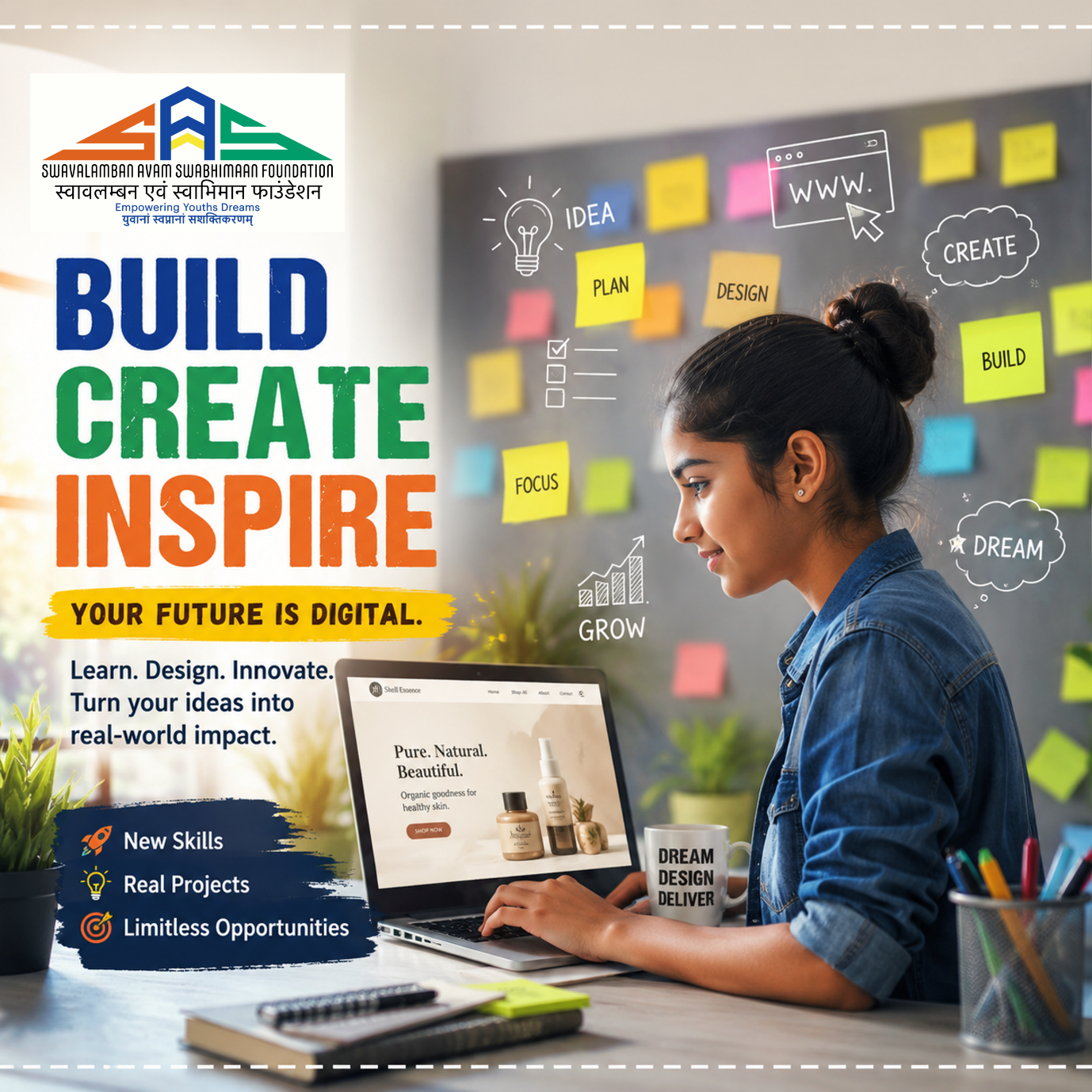
Building Digital Creators, Not Just Website Designers
What if learning to build a website was actually learning to think?
That question quietly unfolded during Session 2 of the Website Design, Development & Maintenance Internship – Webmasters Studio (Jun ’26) conducted by Swavalamban Avam Swabhimaan Foundation (SAS Foundation).
At first glance, the session appeared technical—templates, headers, products, layouts, and media integration. But beneath those clicks and edits was something far more meaningful: young learners discovering how ideas transform into digital experiences.
The future will not belong only to people who use technology.
It will belong to those who know how to create with it.

From Blank Screens to Digital Possibilities
Every website begins with a decision.
Not coding.
Not colors.
Not technology.
A decision.
During this session, participants started with a simple challenge—create a website concept for an organic cosmetics business using WIX.
The objective sounded straightforward.
Choose a template.
Customize a layout.
Add products.
Publish pages.
But what emerged was a much deeper lesson.
Students quickly realized that website creation is not about dragging elements onto a screen—it is about understanding audiences, communicating value, organizing information, and designing experiences.
Through guided exploration and hands-on experimentation, learners transformed ideas into structured digital spaces.
Learning Website Development Through Real Creation
Rather than passively consuming tutorials, participants actively built websites while exploring the WIX ecosystem.
Students learned to:
Create and Configure Website Foundations
The session introduced learners to establishing a website structure using WIX’s website creation capabilities and template-driven design approach.
Students explored:
• Website setup and project initiation
• Template selection strategies
• Brand identity creation
• Website navigation systems
• Homepage structure and hierarchy
By making early design choices, learners began understanding how websites influence first impressions.
Why Templates Matter More Than Most People Think
Templates are often misunderstood.
People assume templates reduce creativity.
In reality, templates accelerate creativity.
Students explored how selecting the right website template can create a strong starting point for user experience, branding consistency, and visual communication.
During customization exercises, participants learned how to:
• Modify headers and navigation menus
• Personalize brand names
• Preview visitor experiences
• Improve visual alignment
• Create cleaner user journeys
These activities introduced one of the most important principles of digital creation:
Constraints often inspire better design.
Product Management: Learning Digital Commerce Fundamentals
One of the most engaging moments of the session came when students explored website inventory and product management.
Instead of accepting default product catalogs, learners asked an important question:
“How do we make this website represent our actual business idea?”
That curiosity opened doors to practical learning.
Participants explored:
Website Product Management
• Managing product inventories
• Adding and deleting products
• Product duplication workflows
• Categorization and organization
• Visibility controls
AI-Assisted Content Creation
Students also explored how AI can support digital publishing by generating:
• Product descriptions
• Content suggestions
• Keyword-based website copy
More importantly, they learned that technology supports creativity—it does not replace it.
Thoughtful human decisions still drive meaningful digital experiences.
The Unexpected Lesson: When Design Constraints Become Innovation Opportunities
Every creator eventually encounters friction.
This session was no different.
While experimenting with backgrounds and embedded media, students discovered that template column structures restricted full-width formatting.
For many beginners, this would feel frustrating.
Instead, it became a moment of learning.
The discussion shifted from:
“How do we fix this?”
to
“Why does this happen?”
That small shift represents real growth.
Students began thinking like problem-solvers.
Website development is not the absence of challenges.
It is the ability to investigate, adapt, and improve.
This challenge naturally created anticipation for upcoming advanced editing sessions.
Bringing Websites to Life Through Content and Media
A website without content is architecture without people.
Students explored practical methods to enrich websites through dynamic content.
Topics included:
Content Elements
• Adding and formatting text
• Typography fundamentals
• Font styling and visual hierarchy
• Visual emphasis techniques
Media Integration
• Uploading local media
• Importing from connected platforms
• Working with images and galleries
• Embedding external videos
Students learned that modern websites are increasingly multimedia experiences—not static pages.
Effective communication now combines:
Words.
Visuals.
Interaction.
Storytelling.
Why Documentation Is a Future Skill
One of the most valuable assignments from the session was surprisingly simple:
Capture progress.
Save screenshots.
Document changes.
This exercise reinforced a professional mindset.
Great creators do not only build.
They track progress.
They review iterations.
They demonstrate growth.
Documentation builds reflection, accountability, and stronger portfolios.
What Students Are Actually Learning Through Webmasters Studio
Although the visible outcome may be a website, participants are developing much broader capabilities:
Technical Skills
• Website Design
• Website Development
• Digital Publishing
• Content Management
Human Skills
• Creativity
• Structured Thinking
• Problem Solving
• Communication
Future Skills
• Digital Entrepreneurship
• Brand Building
• Experience Design
• Technology Confidence
These are not just website skills.
These are life and leadership skills for the digital age.
Creating Builders for Tomorrow
At SAS Foundation, our vision extends beyond delivering sessions.
We aim to create environments where young people gain the confidence to experiment, build, and lead.
When students move from asking:
“How do I use this tool?”
to
“What can I create with this tool?”
real learning begins.
Session 2 was another meaningful milestone in that journey.
The websites are being built.
But more importantly—
so are the creators behind them.
Join the Movement
If you believe students should not only consume digital experiences but also create them—
Join us.
Become a member.
Support youth skill development.
Help build a generation that creates opportunities instead of waiting for them.
Visit: www.sas-foundation.in
Together, let us empower youth dreams.