
SAS Foundation Assistant
Palam, New Delhi · Education · Health · Environment
Answers are AI-generated and may be inaccurate — for official confirmation, contact SAS Foundation directly.

+91 931 243 9444
+91 965 470 9935

contact@sas-foundation.in

RZ-54/5A, Rajnagar Part 2,
Palam Colony, New Delhi 110077
Every Smartphone Tells a Story. The Question Is—Who Else Is Reading It?
A teenager misplaces a smartphone on the way home from school.
Within moments, someone else has access to years of conversations, personal photographs, passwords, location history, social media accounts, online classes, banking applications, and digital identities. The device itself may cost only a few thousand rupees—but the information it contains is priceless.
Today’s cyber threats no longer begin with sophisticated hackers breaking into corporate systems. They often begin with a single careless click, an unnecessary app permission, or an unsecured mobile device.
As smartphones become indispensable companions for learning, communication, entertainment, and financial transactions, mobile security has evolved from being an optional technical skill to an essential life skill.
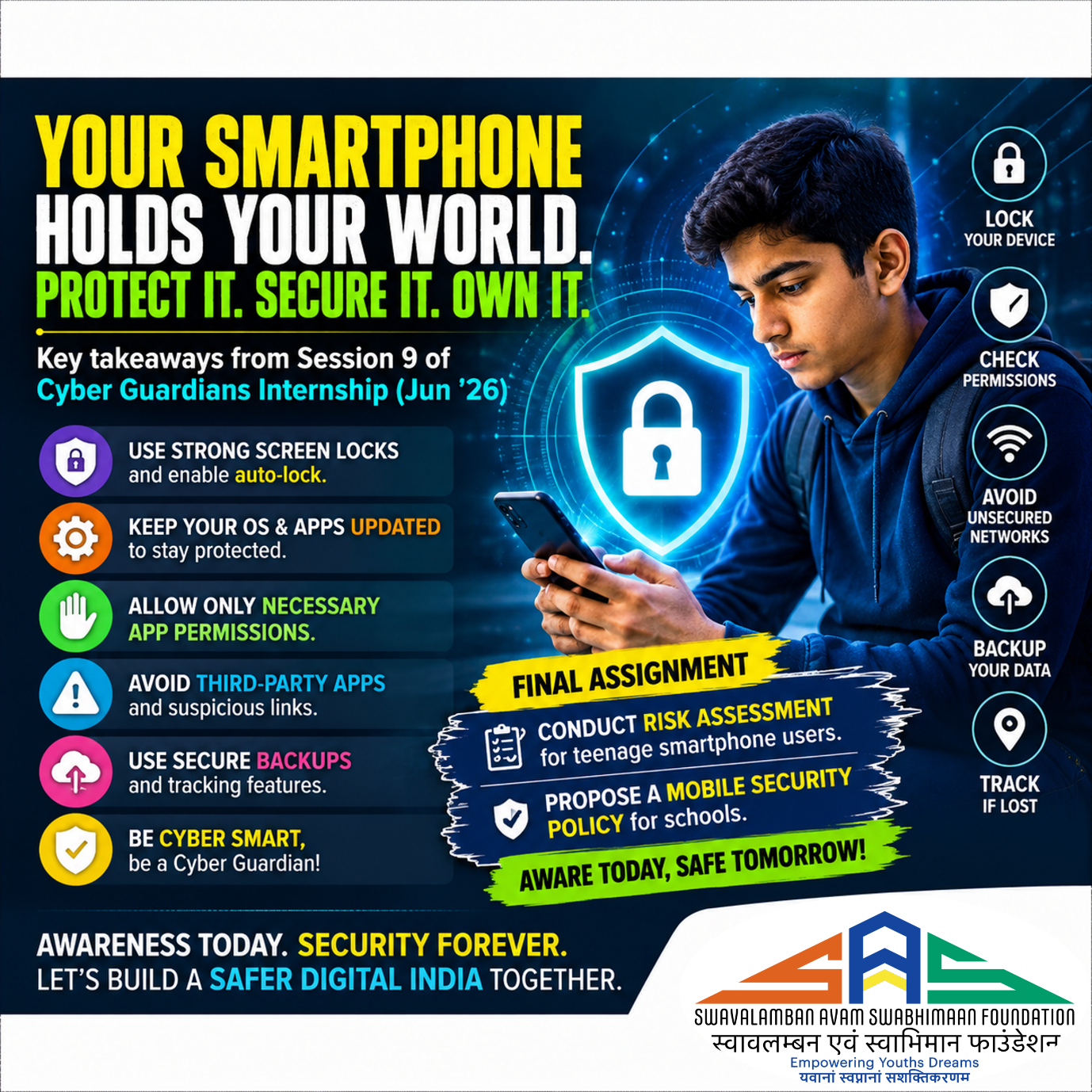
Recognizing this growing need, Swavalamban Avam Swabhimaan Foundation (SAS Foundation) dedicated Session 9 of its Cyber Guardians Internship (Jun ’26) to one of the most relevant challenges facing today’s youth—Mobile Device Security.
The session went far beyond discussing technology. It focused on cultivating a mindset of responsibility, awareness, and digital resilience among young learners.

Smartphones: The Most Valuable Asset We Carry Every Day
For most students, a smartphone is more than a communication device.
It is a classroom.
A library.
A camera.
A wallet.
A diary.
A social network.
A gaming console.
A navigation system.
And increasingly, it is becoming the gateway to their digital identity.
Every application installed, every website visited, every online payment made, and every message exchanged contributes to an ever-expanding digital footprint.
Ironically, while students are becoming more digitally connected than ever before, many remain unaware of the invisible risks surrounding them.
Cybercriminals understand this gap—and they exploit it.
Cyber Threats Have Shifted from Computers to Smartphones
A decade ago, cyber security education focused primarily on desktop computers.
Today, smartphones have become the preferred target.
Why?
Because mobile devices store enormous amounts of sensitive information in one convenient location.
Personal photographs.
School assignments.
Passwords.
Email accounts.
Banking applications.
Digital wallets.
Authentication codes.
Location history.
Health information.
Social media accounts.
Attackers no longer need physical access to steal information. A malicious application, a phishing message, an unsafe Wi-Fi network, or an unnecessary permission can silently compromise an entire device.
This reality makes mobile cyber awareness one of the most important digital competencies for today’s generation.
Security Begins with Awareness, Not Software
One of the most important messages shared during the internship session was simple:
Technology alone cannot keep us safe. Responsible behaviour can.
Many users assume installing antivirus software automatically protects them from every cyber threat.
Unfortunately, that assumption creates a false sense of security.
The strongest cyber defence combines technology with informed decision-making.
Students explored how everyday actions significantly influence their digital safety, including:
Each of these actions appears small individually.
Together, they create powerful layers of digital protection.
Convenience Should Never Replace Security
Modern technology prioritizes convenience.
Automatic Wi-Fi connections.
One-click downloads.
Instant logins.
Location sharing.
Biometric authentication.
Cloud synchronization.
While these features improve user experience, they also introduce new responsibilities.
During the session, participants learned that cyber security is about asking thoughtful questions before accepting digital convenience.
Does this application really need microphone access?
Why is a calculator requesting contact permissions?
Is this Wi-Fi network trustworthy?
Should Bluetooth remain enabled continuously?
Can this message be genuine?
Learning to pause before clicking has become one of the most valuable cyber security habits.
Every Permission Is a Decision
One of the session’s most practical discussions centered around application permissions.
Many users approve every permission request without reading it.
Yet every permission represents access to personal information.
Camera.
Microphone.
Contacts.
Location.
Storage.
Call logs.
Messages.
Granting unnecessary permissions may unintentionally expose sensitive information.
Participants learned that responsible users regularly review application permissions and remove access that is no longer required.
Cyber awareness often begins with understanding what information we voluntarily share.
Public Wi-Fi: Free Internet Can Be Expensive
Public Wi-Fi is available almost everywhere—cafés, airports, shopping malls, educational institutions, railway stations, and public spaces.
While convenient, unsecured networks can expose users to unnecessary risks.
The internship highlighted why students should exercise caution before connecting to unknown networks.
Simple practices such as disabling automatic Wi-Fi connections, avoiding sensitive transactions on public networks, and using trusted security tools can significantly reduce exposure.
The objective is not to create fear.
It is to promote informed digital behaviour.
When a Smartphone Goes Missing
Losing a mobile device is no longer merely an inconvenience.
It can quickly become a cyber security incident.
The session introduced participants to practical response procedures, including:
Preparedness matters.
Many users discover these features only after losing their phones.
Cyber resilience means preparing before an incident occurs—not after.
Students Must Become Digital Leaders
Perhaps the most inspiring aspect of the session was its final assignment.
Rather than memorizing concepts, participants were challenged to:
This transformed students from learners into problem-solvers.
Instead of simply consuming information, they began applying cyber security principles to real-world environments.
This is precisely the kind of experiential learning that develops future leaders.
Why Schools Must Teach Mobile Security
Cyber security education should not begin only in universities or professional training programmes.
It should become part of foundational education.
Students today encounter digital technology before they fully understand its risks.
Schools therefore have an opportunity—and a responsibility—to integrate cyber awareness into everyday learning.
A strong school mobile security policy may include:
Cyber security should be viewed not merely as an IT subject, but as an essential life skill comparable to road safety or financial literacy.
Building Responsible Digital Citizens
Cyber security is often misunderstood as a highly technical discipline reserved for IT professionals.
In reality, it is a shared social responsibility.
Every student who protects personal information…
Every parent who discusses online safety…
Every teacher who promotes responsible technology use…
Every institution that invests in cyber awareness…
…contributes to building a safer digital ecosystem.
Technology continues to evolve.
Artificial Intelligence, connected devices, digital payments, cloud computing, and smart cities will make our dependence on mobile technology even greater.
The future therefore belongs not simply to those who use technology—but to those who use it responsibly.
SAS Foundation’s Vision: Empowering Youth Beyond the Classroom
At SAS Foundation, education is viewed as a catalyst for long-term social transformation.
The Cyber Guardians Internship reflects this philosophy by combining technical awareness with ethical responsibility, critical thinking, and practical problem-solving.
Rather than teaching students to fear technology, the programme encourages them to understand it, question it, and use it responsibly.
This approach aligns with the Foundation’s broader mission of Empowering Youth Dreams through education, innovation, leadership, and community development.
When young people become cyber-aware, they not only protect themselves—they strengthen families, schools, workplaces, and society.
The Road Ahead
The digital world offers extraordinary opportunities.
It connects people, accelerates learning, creates careers, and fuels innovation.
But every opportunity comes with responsibility.
The smartphone in every student’s pocket is far more than a communication device.
It is a repository of identity, trust, relationships, memories, and aspirations.
Protecting it requires awareness—not fear.
Knowledge—not assumptions.
Discipline—not convenience.
As the Cyber Guardians Internship reminds us, cyber security is no longer just about defending devices.
It is about protecting people.
Because the safest smartphone is not the one with the most expensive hardware.
It is the one in the hands of a digitally aware, responsible, and empowered user.
Join SAS Foundation in building a generation of Cyber Guardians who will shape a safer, smarter, and more secure digital future for India and the world. Become a member, volunteer, or partner with us to empower youth through education and digital awareness. Together, we can transform awareness into action and technology into a force for positive change.