SAS Foundation Assistant
Palam, New Delhi · Education · Health · Environment
Answers are AI-generated and may be inaccurate — for official confirmation, contact SAS Foundation directly.

+91 931 243 9444
+91 965 470 9935

contact@sas-foundation.in

RZ-54/5A, Rajnagar Part 2,
Palam Colony, New Delhi 110077
Why Learning Exception Handling Is Teaching Young Minds to Build Resilient Technology—and Resilient Lives
“Success is not the absence of failure; it is the ability to respond intelligently when failure occurs.”
This timeless principle applies as much to life as it does to software engineering.
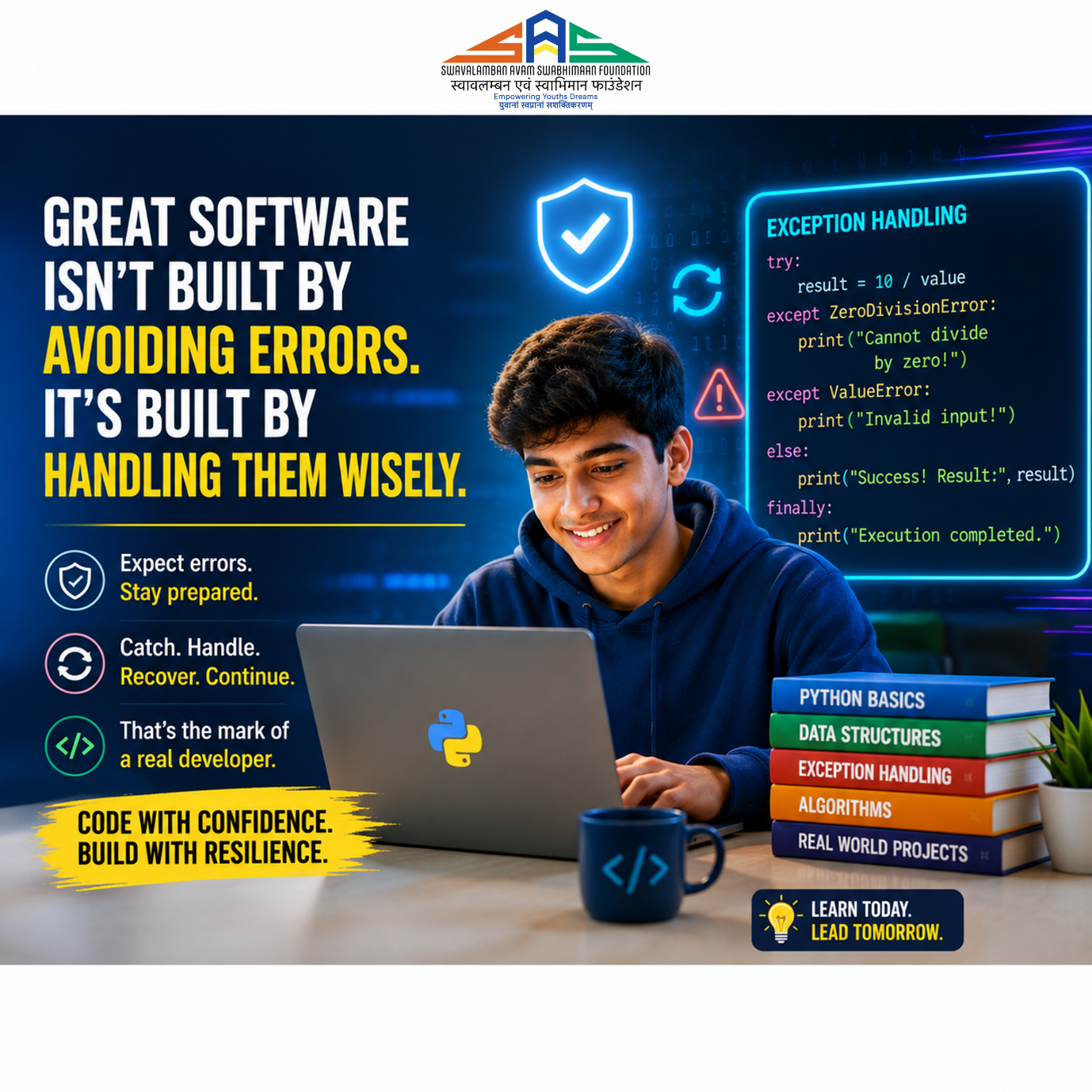
During Session 9 of the CodeCraft Python Internship (Jun ’26) conducted by SAS Foundation, participants explored one of the most important concepts in professional programming—Exception Handling in Python.
While many beginners believe programming is about writing code that always works, experienced software engineers know a different truth:
Great software is defined not by how it behaves when everything goes right, but by how gracefully it responds when something goes wrong.
That mindset formed the foundation of this learning session.

Every Digital Experience Depends on Reliability
Think about the applications you use every day.
Your banking app.
Your online shopping platform.
Your healthcare portal.
Your digital payment application.
Your favourite social media platform.
Millions of users trust these systems because they continue working—even when unexpected situations arise.
Incorrect passwords.
Poor internet connectivity.
Invalid inputs.
Missing data.
Temporary server failures.
Behind every reliable application lies a carefully designed exception handling mechanism.
Students were introduced to this very philosophy—not merely as a Python topic, but as an essential engineering mindset.
Failure Is Inevitable. Crashing Is Optional.
One of the most thought-provoking ideas discussed during the session was simple yet profound:
Errors are unavoidable.
But allowing an entire application to fail because of a single error is a design choice—not a necessity.
This shifted students’ perspective dramatically.
Instead of viewing errors as something to fear, they began understanding them as events that software should anticipate, manage, and recover from.
Just as successful individuals prepare contingency plans for unexpected situations, professional software applications are built with mechanisms that ensure continuity even when problems occur.
This analogy resonated deeply with participants.
Programming suddenly became more than syntax.
It became strategic thinking.
Understanding Exceptions: When Programs Meet Reality
Students learned that an exception is an unexpected event occurring during program execution that interrupts the normal flow of an application.
Examples include:
Without proper handling, these events often cause programs to terminate abruptly.
With exception handling, however, software can:
This is exactly how enterprise-grade software is built.
From “What Went Wrong?” to “What Should We Do Next?”
One of the biggest lessons from the session was that software development is not only about identifying problems.
It is about designing intelligent responses.
Participants explored Python’s powerful exception handling framework using:
Each construct demonstrated a different stage of responsible software behaviour.
The try block attempts normal execution.
The except block provides an alternate path when something unexpected occurs.
The else block executes only when everything succeeds.
The finally block guarantees cleanup regardless of success or failure.
Students realised that well-designed programs always have a recovery strategy.
That principle applies equally to leadership, innovation, and life.
Precision Matters: Why Specific Exception Handling Builds Better Software
Another significant takeaway involved the importance of handling specific exceptions instead of relying on generic error handling.
Rather than treating every problem the same way, professional developers identify the exact issue before responding.
For example:
Each exception communicates a unique problem requiring a unique solution.
Students discovered that precise error handling makes debugging easier, improves software quality, and creates better user experiences.
In many ways, this reflects an important leadership lesson:
Meaningful solutions begin with correctly understanding the problem.
Building Intelligent Systems Through Validation
The session also introduced learners to raising custom exceptions.
Instead of waiting for applications to fail unexpectedly, developers proactively define rules that prevent invalid data from entering the system.
Examples included validating:
Students learned that prevention is often more effective than correction.
By validating inputs before processing them, applications become more secure, reliable, and trustworthy.
This concept extends far beyond programming.
Strong systems are built on strong standards.
Resilience Is a Skill—Not a Feature
Perhaps the most valuable lesson of the session was philosophical rather than technical.
Every developer eventually writes code that fails.
Every entrepreneur experiences setbacks.
Every innovator encounters uncertainty.
The difference lies not in avoiding challenges but in preparing intelligent responses.
Exception handling teaches exactly that.
Instead of stopping when something goes wrong, software evaluates the situation, chooses an alternate path, communicates clearly, and continues operating.
This is resilience in action.
It is equally valuable in technology and in life.
Preparing Students for Industry, Not Just Internships
The CodeCraft Python Internship is designed with a broader vision than simply teaching programming syntax.
Its objective is to cultivate:
Through carefully designed sessions, students gain exposure to concepts widely used across:
Exception handling is one of those concepts that distinguishes hobby programmers from professional developers.
Empowering the Next Generation of Digital Builders
At SAS Foundation, education is viewed not merely as knowledge transfer but as capability building.
The digital economy requires individuals who can think critically, solve problems systematically, and design solutions responsibly.
Every internship session contributes toward that mission.
By introducing students to professional programming practices at an early stage, the Foundation is helping prepare future software engineers, AI innovators, entrepreneurs, and technology leaders who will build reliable digital solutions for society.
Today’s lesson on exception handling may appear technical.
Tomorrow, it may become the reason a critical healthcare platform continues running, a banking application protects millions of transactions, or an AI system makes safe and responsible decisions.
That is the true impact of foundational education.
Looking Ahead
As participants continue progressing through the CodeCraft Python Internship, they are doing much more than learning a programming language.
They are developing resilience.
They are strengthening analytical thinking.
They are learning how technology solves real-world problems.
Most importantly, they are becoming creators of the digital future rather than passive consumers of it.
Because the future belongs not to those who never encounter errors—
It belongs to those who know how to recover, adapt, and keep building.
Join the Movement
If you are passionate about empowering young minds with future-ready digital skills, innovation, and practical technology education, become part of the SAS Foundation community.
Together, we can inspire the next generation of coders, creators, innovators, and changemakers.
Visit: www.sas-foundation.in