
SAS Foundation Assistant
Palam, New Delhi · Education · Health · Environment
Answers are AI-generated and may be inaccurate — for official confirmation, contact SAS Foundation directly.

+91 931 243 9444
+91 965 470 9935

contact@sas-foundation.in

RZ-54/5A, Rajnagar Part 2,
Palam Colony, New Delhi 110077
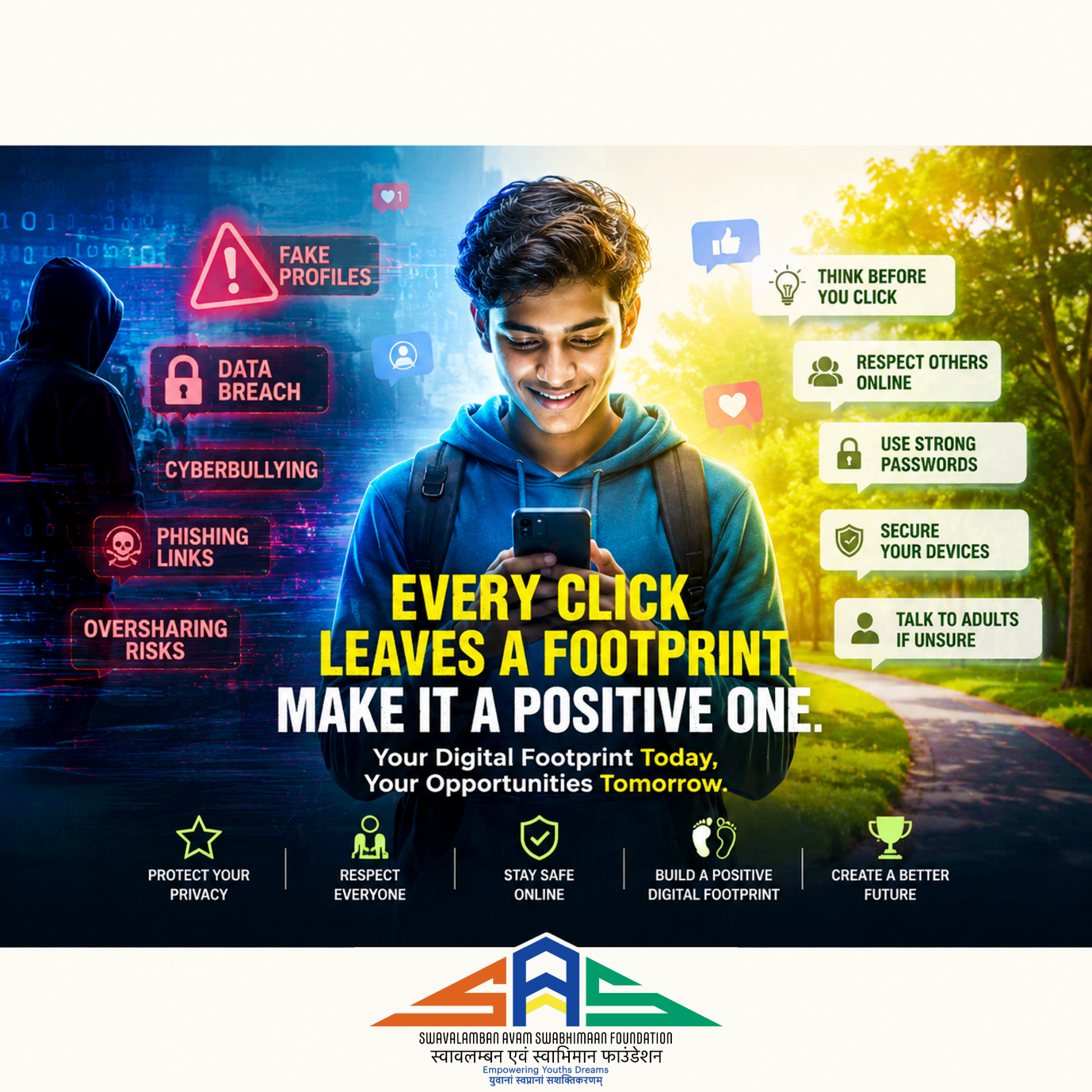
Cyber Guardians Internship (Jun ’26) | Session 2 – Social Networking Safety
A teenager uploads a photograph.
Another accepts a friend request.
Someone forwards a message without verifying it.
None of these actions feel important in the moment.
Yet years later, a university admission panel, an employer, or even a future collaborator may encounter those same digital traces.
That is the paradox of the digital age—moments disappear, but digital footprints often do not.
As part of the Cyber Guardians Internship (Jun ’26), conducted by SAS Foundation under its Educational Initiatives, Session 2 challenged students to look beyond screens and ask a difficult but necessary question:
What story is your online presence telling about you?
This session was not merely about avoiding cyber threats. It was about helping students understand that digital responsibility is becoming one of the defining competencies of the future.

Social Media: The Most Powerful Tool Youth Use—and Misuse
For today’s generation, social networking is not an activity.
It is an environment.
Students connect, learn, create, celebrate, express opinions, build communities, and shape identities online. Platforms have become extensions of classrooms, friendships, aspirations, and opportunities.
But with greater connectivity comes greater responsibility.
The same platform that helps a student discover opportunities can also expose them to misinformation, cyberbullying, impersonation, scams, privacy invasion, and reputation damage.
During the session, participants explored a fundamental truth:
Technology itself is neutral. Human behavior determines outcomes.
The Hidden Cost of Oversharing
Many young users unknowingly exchange privacy for convenience.
Personal details, school information, locations, routines, celebrations, achievements, emotions, and opinions are often shared publicly without understanding the long-term implications.
Session discussions explored how oversharing increases exposure to:
• Social engineering attacks
• Fake profiles and impersonation
• Cyberbullying
• Identity misuse
• Stalking risks
• Data exploitation
• Reputation challenges
Students reflected on a powerful realization:
Not every audience deserves access to your life.
Privacy is not secrecy.
Privacy is thoughtful sharing.
Fake Profiles and Digital Trust
One of the most eye-opening discussions focused on fake accounts and deceptive online identities.
Participants explored how malicious actors create profiles to manipulate trust, collect information, spread misinformation, or exploit emotions.
Young users often assume familiarity based on profile pictures, mutual followers, or attractive content.
But digital trust must be earned—not assumed.
Students learned to pause and ask:
• Do I know this person?
• Is the profile authentic?
• Why is this request arriving?
• What information am I revealing?
Critical thinking is becoming a new form of digital self-defense.
The Trust Rule: A Framework for Responsible Digital Citizenship
A major highlight of the session was introducing students to the Trust Rule—an easy but powerful framework for safer online behavior.
T — Think Before Clicking
Pause before opening links, accepting requests, or sharing content.
R — Respect Others Online
Words leave impact. Digital kindness matters.
U — Use Strong Passwords
Security begins with responsible account habits.
S — Secure Devices
Protection is not optional in a connected world.
T — Talk to Adults if Unsure
Seeking guidance is a strength—not a weakness.
The Trust Rule reframed cyber security from being purely technical into becoming behavioral.
Your Digital Footprint Is Your Silent Resume
Perhaps the strongest takeaway from the session was understanding the idea of a digital footprint.
Every search.
Every comment.
Every upload.
Every reaction.
Every share.
These actions collectively create a lasting online identity.
Students discussed how deleted content may continue to exist through screenshots, archives, reposts, and digital history.
The session encouraged youth to think differently:
Instead of asking,
“What can I post?”
Ask,
“What future does this post create?”
Participants were encouraged to intentionally build positive digital footprints through:
• Volunteering stories
• Project achievements
• Learning experiences
• Educational accomplishments
• Creative expression
• Community participation
Your online identity should become evidence of your values—not accidents of impulse.
Beyond Cyber Safety: Building Responsible Leaders
Cyber awareness is often misunderstood as avoiding danger.
But true cyber awareness creates something much bigger.
It creates:
• Better decision makers
• More responsible citizens
• Stronger communities
• Safer digital environments
• Ethical future leaders
At SAS Foundation, we believe empowering youth means preparing them not only for examinations and careers—but also for responsible participation in a digital society.
The future will increasingly reward trust, authenticity, responsibility, and digital maturity.
Students who understand this early gain an advantage that extends far beyond technology.
Learning by Doing: Assignment for Future Digital Leaders
To transform awareness into action, participants received an experiential assignment:
Conduct a mini survey with 5–10 individuals to understand how teenagers use social media.
Students will:
• Analyze behavior patterns
• Study evolving trends
• Recommend safer practices
• Present evidence-based insights
Because meaningful learning happens when knowledge becomes action.
Final Reflection
A profile is created in seconds.
A reputation is built over years.
One click may seem temporary.
But values reflected through thousands of clicks become identity.
The internet remembers.
The question is—
What do you want it to remember about you?
Join us in creating digitally aware, responsible, and future-ready youth.
Become a member. Join hands with SAS Foundation and support initiatives that empower youth dreams.