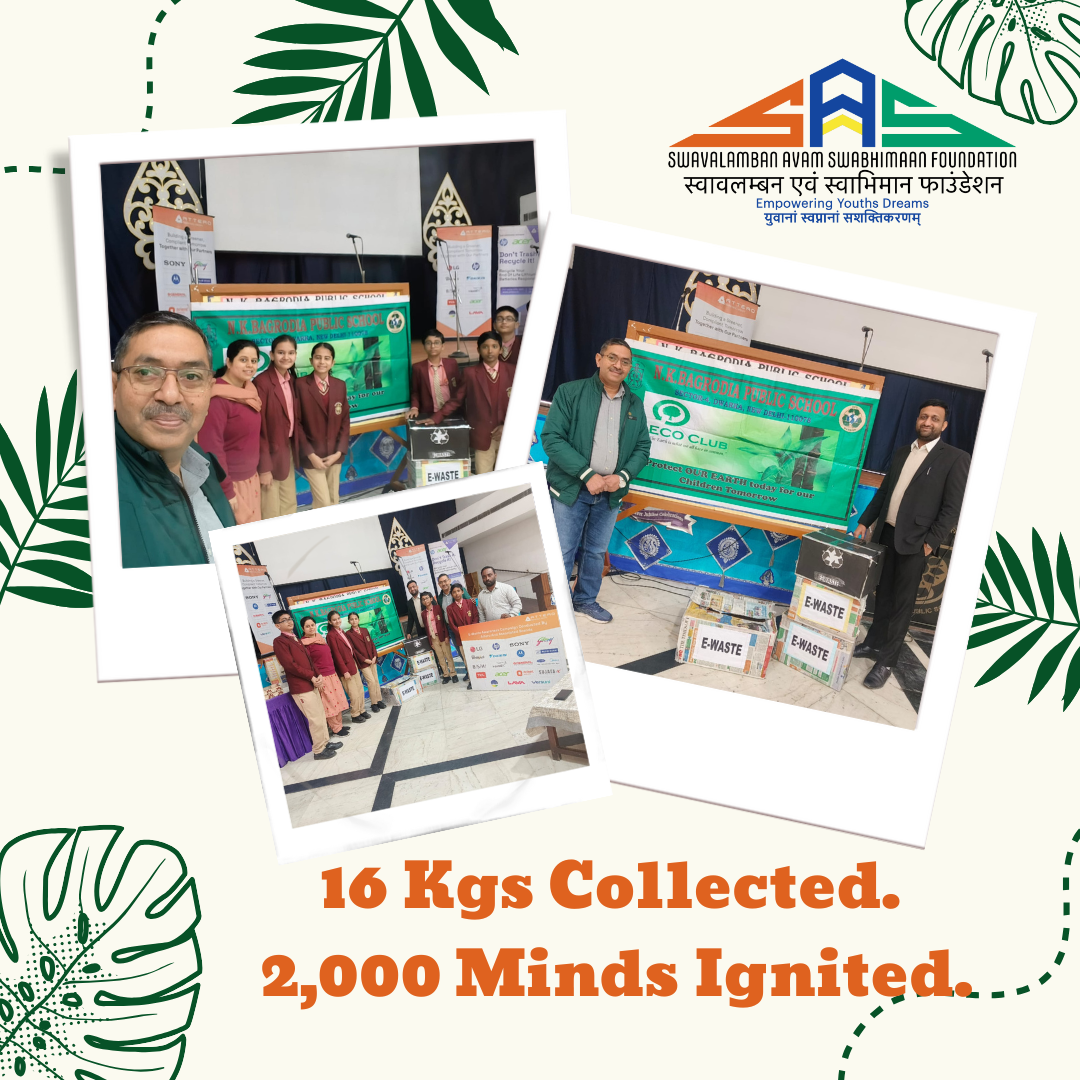
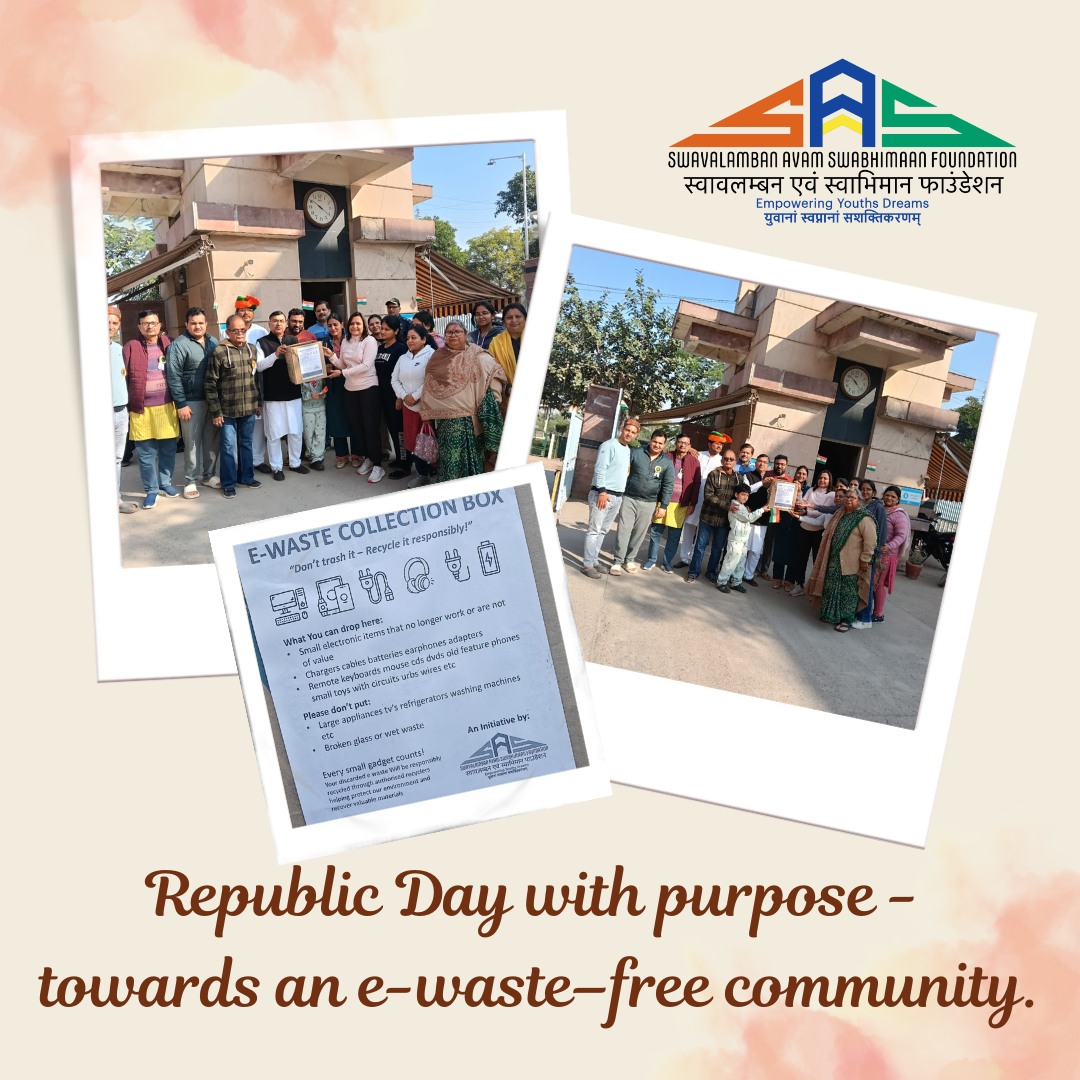
On 2nd February, SAS Foundation, in association with Rotary Club of Delhi Govinda, successfully conducted a comprehensive E-Waste Awareness and Collection Drive at N. K. Bagrodia Global School, Sector-17, Phase-II, Dwarka.
This initiative was not just a collection activity — it was a structured sustainability intervention aimed at embedding environmental responsibility in young minds.
Why E-Waste Awareness in Schools Matters
India is among the fastest-growing generators of electronic waste globally. With increasing digital penetration, smartphones, batteries, chargers, and electronic gadgets are becoming indispensable — but so is the mounting burden of electronic waste (e-waste).
Improper disposal of e-waste leads to:
- Release of toxic heavy metals like lead, mercury, and cadmium
- Soil and groundwater contamination
- Air pollution from informal burning practices
- Serious public health risks
- Loss of recoverable precious metals that could support a circular economy
Addressing this challenge requires more than infrastructure — it requires early environmental education and behavioral change. Schools are powerful catalysts for building long-term sustainability consciousness.
Student-Led Environmental Leadership
What made this drive impactful was the leadership shown by the school’s Eco Club students. Rather than limiting awareness to an assembly session, students went classroom to classroom, educating their peers about:
- The environmental hazards of improper e-waste disposal
- The importance of segregation at source
- Responsible recycling practices
- The concept of a circular economy
- How individual actions contribute to climate resilience
Approximately 2,000 students were sensitized during this exercise, turning awareness into collective responsibility.
This is how sustainability transitions from theory to practice.
Tangible Environmental Impact
The drive resulted in the collection of approximately 16 kilograms of e-waste, comprising:
- Used and damaged batteries
- Charging cables
- Small broken electronic appliances
- Miscellaneous electronic accessories
The collected e-waste was handed over to Attero, India’s leading e-waste recycling company, for scientific and environmentally compliant recycling.
By ensuring responsible downstream processing, this initiative prevented hazardous materials from entering informal waste streams and landfills.
Multi-Stakeholder Collaboration: A Sustainable Model
SAS Foundation believes that environmental challenges demand collaborative solutions.
This drive was executed in partnership with:
- Rotary Club of Delhi Govinda
- N. K. Bagrodia Global School
- Attero (Authorized E-Waste Recycler)
SAS Foundation was represented by Gaurav Agarwal, while Arjun represented Attero during the drive.
Such collaborations reflect a replicable model for urban sustainability:
✔ Schools as awareness hubs
✔ NGOs as implementation partners
✔ Authorized recyclers ensuring compliance
✔ Community participation for scale
Thought Leadership: Building a Circular Mindset in Youth
Environmental sustainability cannot be achieved through policy alone. It must be driven by culture.
When students understand:
- Resource extraction limits
- Environmental externalities of electronics
- Lifecycle thinking
- Responsible consumption patterns
They begin making informed choices — extending device lifecycles, repairing instead of replacing, and ensuring recycling over disposal.
At SAS Foundation, our Environmental Initiatives are aligned with the principles of:
- Sustainable Development Goals (SDGs)
- ESG-driven awareness
- Circular economy frameworks
- Climate-conscious education
By integrating awareness, action, and accountability, we aim to create youth climate leaders who influence families and communities.
The Road Ahead: From Awareness to Movement
A single e-waste drive is not the solution. However, consistent interventions across schools, residential societies, and institutions create cumulative impact.
Our goal is to:
- Scale structured e-waste awareness programs
- Conduct regular collection drives
- Integrate sustainability modules in schools
- Partner with authorized recyclers for compliance
- Promote responsible technology consumption
Because sustainability is not an event — it is a continuous commitment.
Conclusion
The 2nd February drive at N. K. Bagrodia Global School demonstrates that when young minds are empowered, environmental change accelerates.
Sixteen kilograms of e-waste collected.
Two thousand students sensitized.
One powerful message delivered:
The future of India’s environmental sustainability lies in informed youth leadership.
SAS Foundation remains committed to building environmentally responsible communities — one awareness drive at a time.