SAS Foundation Assistant
Palam, New Delhi · Education · Health · Environment
Answers are AI-generated and may be inaccurate — for official confirmation, contact SAS Foundation directly.
+91 931 243 9444
+91 965 470 9935

contact@sas-foundation.in

RZ-54/5A, Rajnagar Part 2,
Palam Colony, New Delhi 110077
From Data to Decisions: How Learning Python Dictionaries and Sets Shapes Tomorrow’s Digital Leaders
The digital world isn’t running out of information.
It is running out of people who know how to organize it.
Every second, billions of pieces of data are created across smartphones, websites, financial systems, hospitals, classrooms, and smart devices. Yet data alone has little value. Its true power emerges only when it is structured, interpreted, and transformed into meaningful insights.
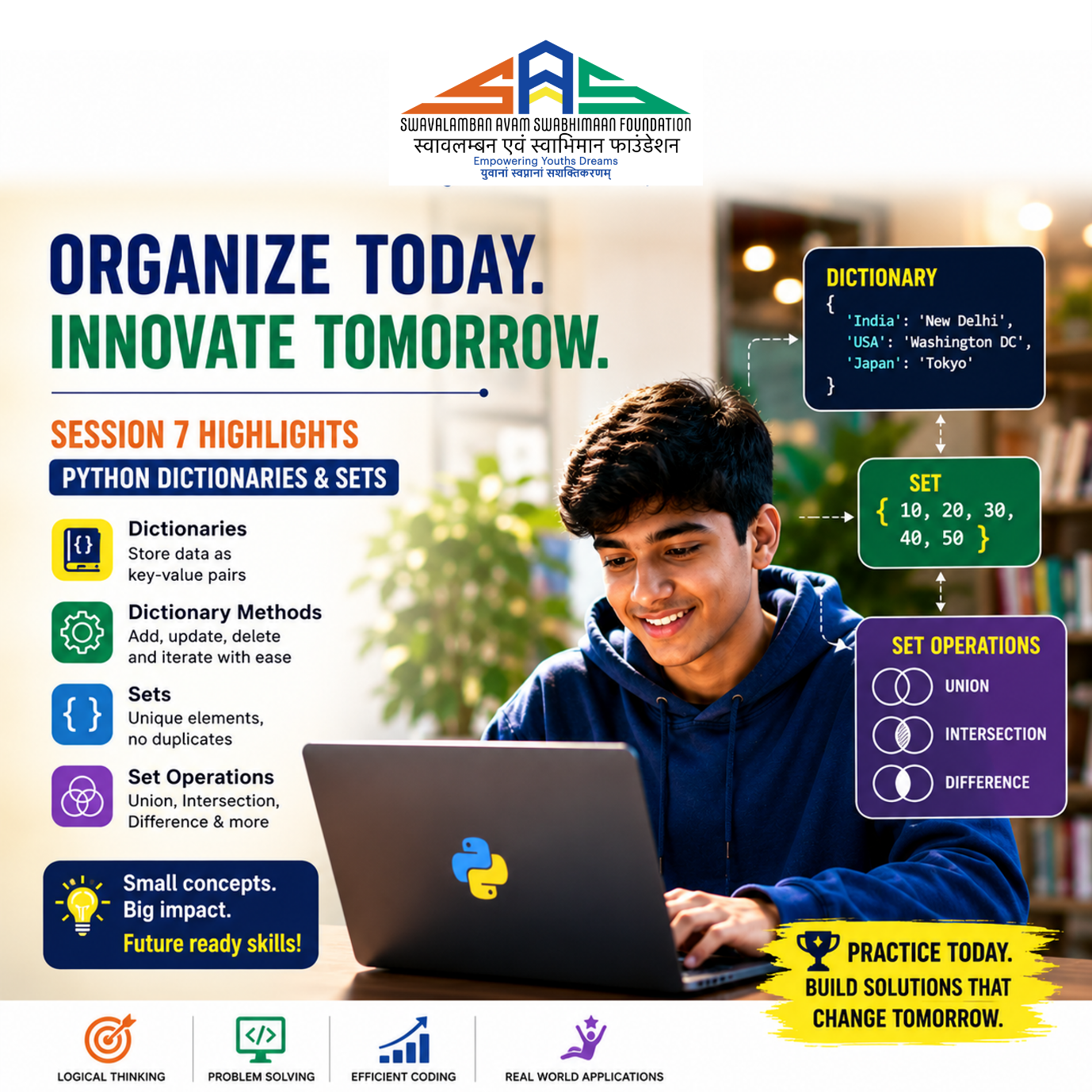
This philosophy formed the foundation of Session 7 of the CodeCraft Python Internship (Jun ’26) conducted by SAS Foundation, where participants explored one of the most practical and impactful concepts in Python programming—Dictionaries and Sets.
While these may appear to be simple programming data structures, they represent something much larger: the ability to organize knowledge efficiently, eliminate redundancy, and solve complex problems intelligently.
In today’s technology-driven economy, these are not merely programming skills—they are future-ready thinking skills.

Beyond Coding: Teaching Students How Technology Thinks
Most people interact with technology every day.
Few understand how it works.
Every search result on Google, every recommendation on YouTube, every banking application, every e-commerce platform, and every AI assistant depends on one critical capability:
Organizing information in a way that computers can understand quickly and accurately.
That is exactly what students learned during this session.
Rather than memorizing syntax, participants explored the logic behind structured information.
They discovered that programming is not simply writing instructions—it is designing systems that think efficiently.
Dictionaries: The Foundation of Intelligent Information Systems
Imagine walking into a library where every book has no title.
Or trying to call someone without knowing their name.
Finding information would become nearly impossible.
This is precisely why dictionaries exist in Python.
A dictionary stores information in key-value pairs, allowing computers to retrieve data instantly using unique identifiers.
During the session, learners explored relatable examples such as:
Students quickly recognized that this same principle powers countless real-world applications.
Whenever you log into a website using your username…
Whenever a hospital retrieves your medical records…
Whenever an online store displays product information…
A structure remarkably similar to a Python dictionary is working behind the scenes.
The session transformed what initially appeared to be a simple coding concept into an appreciation of how modern digital systems organize knowledge.
Why Unique Keys Matter
One of the most valuable lessons from the session was understanding why dictionary keys must remain unique.
Participants compared keys to:
Each identifier represents one unique entity.
Without uniqueness, confusion would become inevitable.
Students began appreciating that programming is fundamentally about precision.
A single well-designed identifier can simplify an entire software system.
Building Reliable Software Through Better Programming Practices
Writing code is one skill.
Writing reliable code is another.
An especially insightful discussion focused on safely accessing dictionary values using Python’s get() method.
Rather than allowing programs to crash when information is missing, students learned how developers anticipate uncertainty and design systems that continue functioning gracefully.
This small programming technique reflects a much larger mindset.
Good programmers don’t merely solve expected problems.
Great programmers prepare for unexpected ones.
This philosophy applies far beyond software development.
It is equally relevant in leadership, innovation, and problem-solving.
Data Changes. Good Systems Adapt.
Technology evolves continuously.
Information changes every second.
Students therefore explored how dictionaries can be:
Through practical demonstrations, learners discovered that flexibility is one of the defining characteristics of successful digital systems.
Applications survive because they adapt.
Developers succeed because they continuously improve.
The same principle applies to lifelong learning.
Sets: Simplicity That Solves Complex Problems
The second half of the session introduced another remarkably powerful concept—Python Sets.
At first glance, sets seem straightforward.
They simply store unique values.
But beneath this simplicity lies tremendous computational power.
Students observed how sets automatically eliminate duplicate entries without additional programming effort.
This capability may appear small, yet it forms the backbone of many real-world applications involving:
The realization was profound.
Sometimes innovation is not about doing more.
It is about removing what is unnecessary.
Mathematics Meets Modern Technology
Many students wonder why mathematics is important in programming.
Session 7 answered that question beautifully.
Using familiar mathematical concepts like:
participants experienced how abstract mathematical ideas become practical programming tools.
These operations enable software to compare datasets efficiently, identify common elements, remove redundancy, and process information at remarkable speed.
Whether recommending friends on social media, filtering search results, or detecting duplicate customer records, these principles quietly power modern technology.
Learning Through Real-World Context
Throughout the session, students were encouraged to connect Python concepts with practical applications.
Examples included:
This approach reinforces an important educational philosophy.
Students remain motivated when they understand why they are learning something—not merely how.
Context transforms information into inspiration.
From Understanding to Application
Every meaningful learning experience should conclude with creation.
To reinforce the concepts, participants received a practical assignment:
Create a dictionary of countries and capitals and display the information neatly using a for loop.
While the assignment appears simple, it integrates several essential programming concepts:
More importantly, it encourages learners to build confidence by applying knowledge independently.
Learning happens when theory becomes practice.
Preparing Youth for an AI-Driven Future
Artificial Intelligence may dominate today’s headlines, but AI itself depends entirely upon well-structured data.
Before an AI model can recognize speech…
Before it can recommend a movie…
Before it can detect fraud…
Someone must first organize information correctly.
Today’s lesson on dictionaries and sets therefore represents far more than another Python class.
It introduces students to the principles that underpin intelligent systems across industries.
These are foundational skills for careers in:
Every advanced technology begins with organized information.
SAS Foundation’s Vision: Empowering Youth Through Digital Education
At SAS Foundation, education is viewed as a catalyst for lasting social transformation.
The CodeCraft Python Internship reflects the Foundation’s commitment to equipping young learners with practical digital competencies that prepare them for tomorrow’s opportunities.
Rather than limiting education to theoretical concepts, the internship emphasizes:
Because empowering youth means enabling them to become creators of technology—not merely consumers.
Final Thoughts
Every breakthrough begins with structure.
Every innovation begins with understanding.
Every intelligent system begins with organized information.
Session 7 reminded us that learning Python is not simply about mastering another programming language.
It is about developing the mindset to solve problems systematically, think logically, and build solutions that create lasting impact.
Today’s dictionaries become tomorrow’s databases.
Today’s sets become tomorrow’s intelligent algorithms.
Today’s students become tomorrow’s innovators.
And every remarkable journey begins with learning how to organize one piece of information at a time.
Join the Movement
If you believe every young person deserves access to future-ready digital education, join SAS Foundation in its mission to empower youth through technology, innovation, and skill development.
Become a member, volunteer, mentor, or partner with us to help shape the next generation of problem-solvers, innovators, and technology leaders.
Together, let’s empower dreams, nurture talent, and build a digitally inclusive future.