In a world where every click shapes our digital identity, the strongest firewall is often not software—it is awareness.
Every day, billions of people log into email accounts, banking portals, social media platforms, educational websites, shopping apps, and cloud services. Behind each login lies something invaluable—our identity, our data, our memories, and our trust.
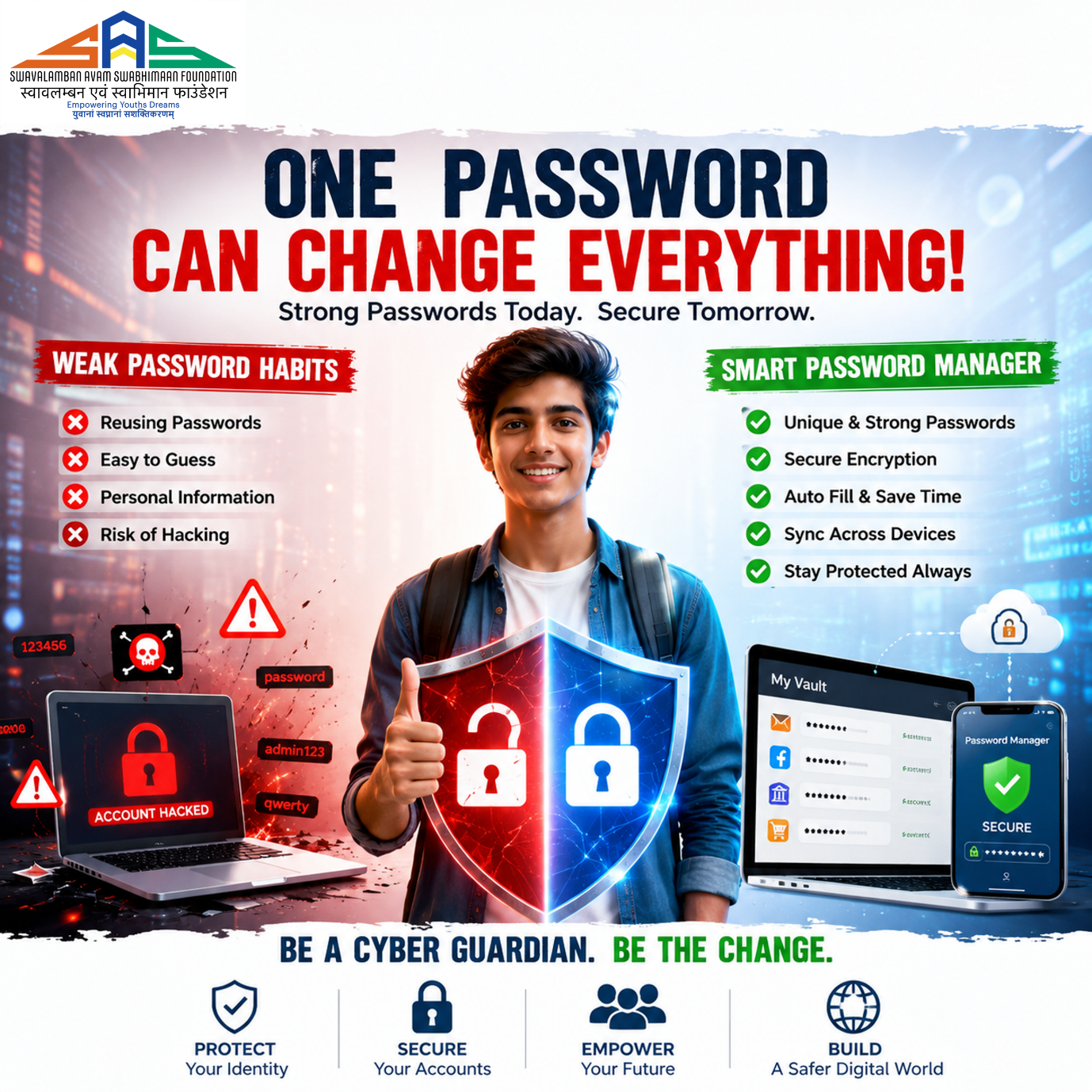
Yet, one of the greatest cyber security risks isn’t sophisticated malware or advanced hacking tools. It’s something far more ordinary: weak and reused passwords.
This was the central message of Session 7 of the Cyber Guardians Internship (Jun ’26), organized by Swavalamban Avam Swabhimaan Foundation (SAS Foundation). The session encouraged students to rethink one of the most overlooked aspects of digital life—how they manage their passwords—and demonstrated how small behavioural changes can significantly improve cyber resilience.
The Hidden Cost of Password Reuse
Many internet users unknowingly use the same password across multiple websites because it is convenient. While this may seem harmless, it creates a dangerous domino effect.
Imagine one website experiences a data breach. If the same password is used for email, social media, online learning platforms, digital wallets, or banking services, attackers can potentially gain access to all of them. A single compromised credential can trigger identity theft, financial fraud, privacy violations, and long-term reputational damage.
Cyber security is no longer only about defending computers—it is about protecting digital identities.
Password Managers: A Smarter Way to Stay Secure
Remembering dozens of strong and unique passwords is nearly impossible for most people. This challenge has given rise to one of the most practical cyber security tools available today: the password manager.
A password manager securely stores credentials in an encrypted vault protected by a single master password. Instead of relying on memory or unsafe practices like writing passwords on paper or saving them in unsecured files, users can generate complex, unique passwords for every account while maintaining convenience.
More importantly, password managers encourage good cyber hygiene by making strong security habits effortless.
Modern password managers offer capabilities such as:
- Automatic generation of strong, unique passwords
- Secure synchronization across computers and mobile devices
- Autofill only on legitimate websites, reducing phishing risks
- Alerts for compromised or weak credentials
- Secure sharing of credentials with trusted family members or teams
- Multi-factor authentication for enhanced protection
- Zero-knowledge architecture, ensuring even the service provider cannot view stored passwords
These capabilities transform password management from a burden into an effective layer of cyber defence.
Why the Master Password Matters
While password managers simplify credential security, they rely on one critical component—the master password.
Students learned that the master password should never be short, predictable, or based on personal information such as birthdays, names, or phone numbers. Instead, long passphrases combining uppercase and lowercase letters, numbers, and symbols provide significantly stronger protection.
A memorable sentence transformed into a complex passphrase is often both secure and easier to remember than random characters.
The master password does not simply unlock an application—it protects an individual’s entire digital life.
Choosing the Right Password Manager
Not every password manager offers the same features. During the session, participants compared leading solutions such as Bitwarden, LastPass, 1Password, and KeePass to understand how different products address varying user needs.
Students explored important evaluation criteria, including:
- End-to-end encryption
- Zero-knowledge security architecture
- Cross-device synchronization
- Multi-factor authentication support
- Password generation capabilities
- Breach monitoring
- Ease of use
- Free versus premium features
Rather than promoting a single product, the session emphasized informed decision-making—a critical digital literacy skill in itself.
Cyber Security Is a Habit, Not a Product
Perhaps the most valuable lesson from the session was that cyber security cannot be purchased—it must be practised.
Even the most advanced security software cannot protect users who repeatedly ignore basic cyber hygiene. Strong passwords, secure browsing, regular software updates, cautious online behaviour, and awareness of phishing attempts collectively create meaningful protection.
Technology provides tools.
People provide resilience.
Building a Generation That Thinks Before It Clicks
Young people today are growing up in an always-connected world. They learn, communicate, collaborate, and create online every day. As digital participation increases, so does the responsibility to protect personal information and contribute to a safer internet ecosystem.
Cyber awareness should therefore become as fundamental as reading, writing, and mathematics.
Teaching students how to evaluate risks, manage credentials responsibly, and protect their digital identities prepares them not only for academic success but also for future workplaces, entrepreneurship, innovation, and responsible citizenship.
Every secure decision made today reduces vulnerabilities tomorrow.
SAS Foundation’s Vision: Empowering Youth Through Digital Responsibility
At Swavalamban Avam Swabhimaan Foundation (SAS Foundation), education extends beyond textbooks. The Foundation believes that empowering youth requires preparing them for the realities of a digital-first society.
The Cyber Guardians Internship reflects this commitment by equipping students with practical cyber security knowledge that they can immediately apply in their everyday lives. Rather than simply teaching technology, the programme develops responsible digital citizens who understand that trust, privacy, ethics, and security are shared responsibilities.
When students understand how to safeguard their digital identities, they become ambassadors of cyber awareness within their families, schools, and communities.
The Road Ahead
The future will belong to digitally confident individuals who combine technical understanding with responsible behaviour.
Strong passwords are not merely combinations of characters.
They are commitments to protecting our identities.
Password managers are not merely convenience tools.
They are enablers of a safer digital future.
And cyber security is not merely an IT function.
It is a life skill that every student, parent, educator, and citizen must embrace.
The journey toward a secure digital India begins with a single decision—to replace convenience with awareness and transform every login into an act of responsibility.
Become a member of SAS Foundation and join us in empowering youth with the knowledge, confidence, and digital skills needed to build a safer, smarter, and more resilient future.