SAS Foundation Assistant
Palam, New Delhi · Education · Health · Environment
Answers are AI-generated and may be inaccurate — for official confirmation, contact SAS Foundation directly.

+91 931 243 9444
+91 965 470 9935

contact@sas-foundation.in

RZ-54/5A, Rajnagar Part 2,
Palam Colony, New Delhi 110077
True environmental leadership is not about saying “yes” to every request. It is about knowing what you can responsibly deliver—and still finding a way to make a difference.
In the world of social impact, organisations are often approached with requests that carry a sense of urgency. A plantation drive is planned. A community event is approaching. Volunteers are ready. And suddenly, there is a need for resources that must be arranged within a very short window.
What should a responsible NGO do?
For Swavalamban Avam Swabhimaan Foundation (SAS Foundation), the answer is simple: never make a promise that may not be fulfilled. But never stop looking for a way to help.
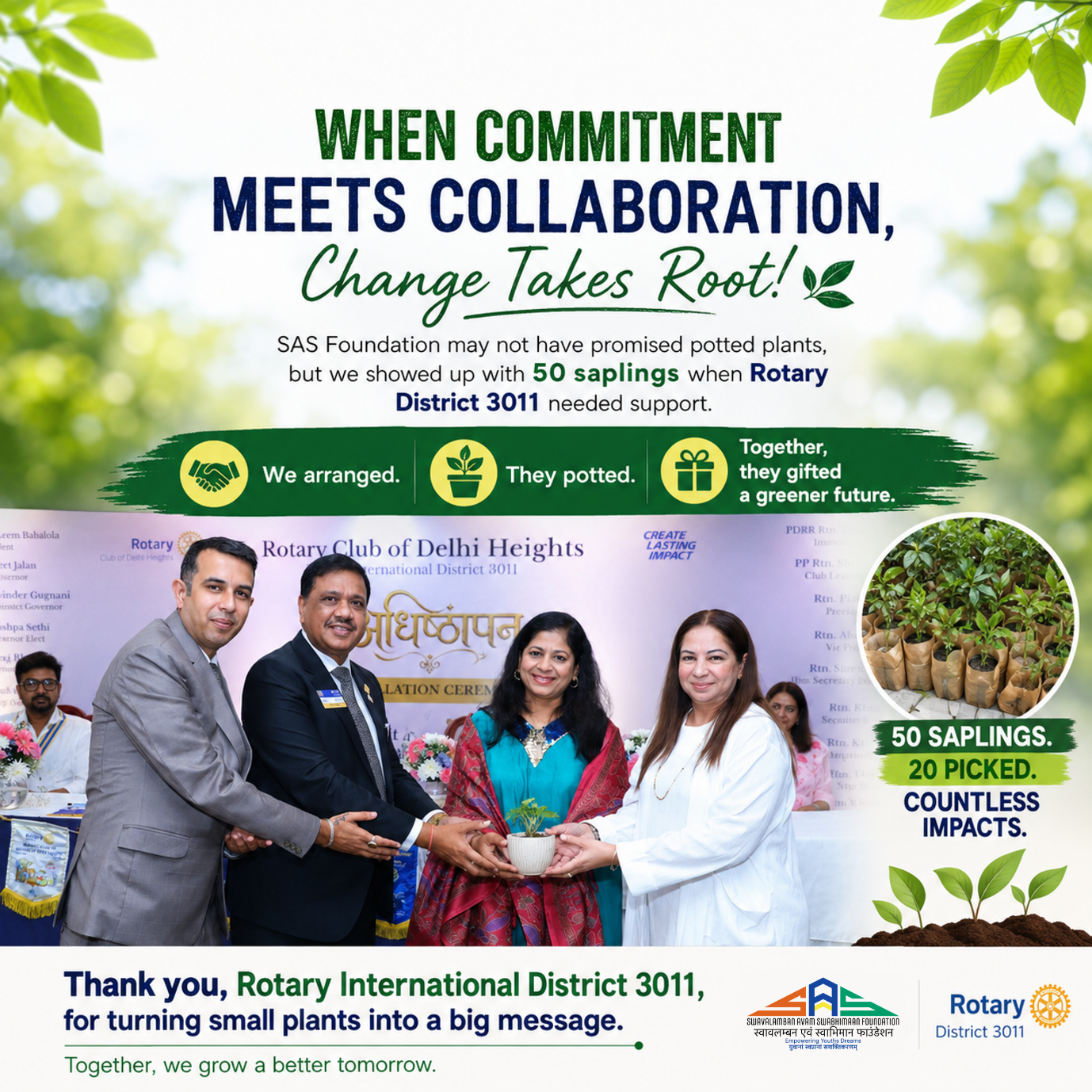
That principle came alive recently when Rotary International District 3011 approached SAS Foundation seeking support for potted plant saplings to be distributed as souvenirs at one of its events.
When “Yes” Is Not the Responsible Answer
SAS Foundation is deeply committed to environmental conservation and regularly supports plantation drives, environmental awareness initiatives, e-waste management campaigns and community-led sustainability efforts. Environment is one of the Foundation’s four core focus areas, alongside education, health and community development.
Naturally, the request from Rotary District 3011 resonated strongly with the Foundation’s environmental mission.
But there was one challenge: time.
The request came very close to the event date. Procuring the required saplings was itself time-sensitive. The additional requirement of suitable pots, their finalisation, procurement and logistics made the timeline even more challenging.
The easy response would have been to say, “Yes, we will arrange everything.”
But responsible impact organisations cannot operate on optimism alone.
A commitment is meaningful only when there is a reasonable ability to honour it.
So SAS Foundation communicated honestly that, given the limited lead time, it might not be possible to fulfil the requirement in full.
That was not a rejection of the cause.
It was a commitment to responsible giving.
But the Story Did Not End There
Rotary District 3011 still needed support.
And when a partner organisation genuinely needs help, sometimes the right question is not “Can we fulfil everything?” but rather:
“What can we realistically do?”
SAS Foundation explored what could be arranged within the available circumstances and helped facilitate 50 plant saplings from a nursery in Delhi Cantt.
The Rotary team then took the next step.
They potted the saplings themselves and used them as environmental souvenirs during their event—turning a simple plant into a meaningful reminder that every celebration can carry a message of sustainability.
What began as a difficult request became a beautiful example of collaborative environmental action.
SAS Foundation did not simply provide plants.
It helped create an opportunity for another organisation to carry the green message forward.
The Bigger Idea: Sustainability Is Also About Responsibility
Environmental sustainability is often discussed in terms of trees, recycling, biodiversity, carbon reduction and conservation.
But there is another dimension that deserves equal attention:
institutional responsibility.
Sustainable impact requires organisations to be realistic about their resources, timelines, commitments and delivery capabilities.
Overpromising may look impressive in the short term. But when commitments cannot be fulfilled, trust suffers.
Responsible organisations understand that credibility is itself a form of social capital.
At SAS Foundation, this philosophy is central to the way partnerships are approached.
The Foundation’s environmental work is designed not merely to create one-day visibility but to encourage sustained environmental consciousness and community participation. Its website specifically invites communities and organisations to come together for plantation drives and other environmental initiatives.
That is why saying “we may not be able to fulfil this request within the available timeline” can sometimes be more responsible than saying “yes” and risking disappointment later.
And yet, responsible leadership should never become an excuse for inaction.
The Rotary collaboration demonstrates the balance:
No false promise.
No unnecessary commitment.
No abandonment of the cause.
Instead—an honest assessment followed by practical support.
From Saplings to Shared Responsibility
There is something particularly powerful about the fact that the Rotary team potted the saplings themselves.
It transformed the support from a simple donation into a collaborative act.
SAS Foundation helped arrange the saplings.
Rotary volunteers added the pots and prepared them for distribution.
The event provided the platform.
And the recipients took home more than a souvenir—they received a living symbol of environmental responsibility.
A plant is different from most souvenirs.
It grows.
It changes.
It needs care.
And, if nurtured properly, it eventually gives back.
That makes a sapling an especially powerful environmental message for young people and communities.
Instead of a souvenir that is eventually forgotten, it can become a daily reminder:
“I was part of something that chose life, growth and a greener future.”
Partnerships That Go Beyond Logos
Meaningful NGO partnerships should not be defined only by logos on event creatives, certificates or social media posts.
They should be defined by what happens on the ground.
The Rotary International District 3011 event was an opportunity to demonstrate precisely that.
Two organisations with a shared commitment to community service found a practical way to collaborate despite operational constraints.
That is what strong partnerships look like.
They are flexible.
They are transparent.
They respect each other’s limitations.
And most importantly, they remain focused on the larger purpose.
For SAS Foundation, that larger purpose is to contribute towards a more sustainable and empowered society while creating opportunities for people—especially young people—to participate in meaningful change.
The Lesson for Organisations, Corporates and Communities
There is an important lesson here for every organisation working in the social-impact ecosystem.
Do not measure commitment by the number of promises you make. Measure it by the promises you keep.
Before committing to a plantation drive, environmental campaign, e-waste collection initiative or community project, organisations should ask:
If the answer is no, it is perfectly responsible to communicate the limitation.
But then ask the next question:
“Is there another way we can contribute?”
That mindset can turn constraints into collaboration.
From “What Can We Give?” to “What Can We Enable?”
The most powerful form of environmental leadership may not always be about doing everything ourselves.
Sometimes, it is about enabling others to act.
The 50 saplings arranged for Rotary District 3011 became more impactful because another team took ownership of potting and distributing them.
This is how environmental movements grow.
One organisation contributes resources.
Another contributes people.
A community contributes participation.
And together, they create impact that none of them could have created alone.
That is the spirit of collective environmental responsibility.
A Greener Future Needs More Than Good Intentions
India does not need more environmental promises that remain on paper.
It needs organisations, institutions, businesses, schools, youth groups and citizens who are willing to convert intentions into action—responsibly and consistently.
A sapling may look small.
But when 50 saplings reach 50 homes, offices or communities, they carry 50 opportunities for care, conversation and environmental awareness.
And when those actions inspire another 50 people to plant, recycle, conserve or participate, the impact multiplies.
That is how change begins.
Not always with a grand gesture.
Sometimes, it begins with one honest commitment, one practical solution and one sapling placed in the right hands.
Join SAS Foundation in Growing the Green Movement
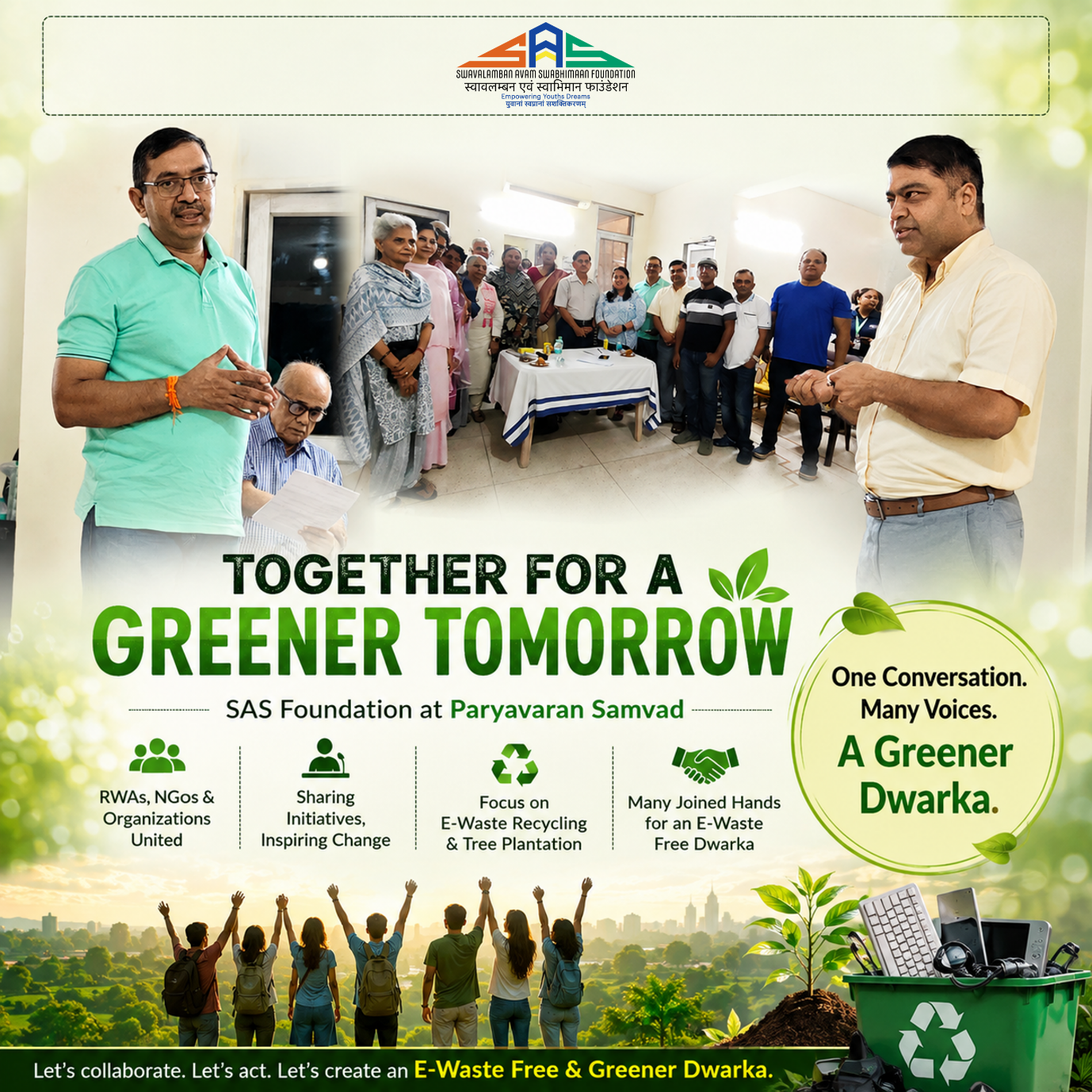
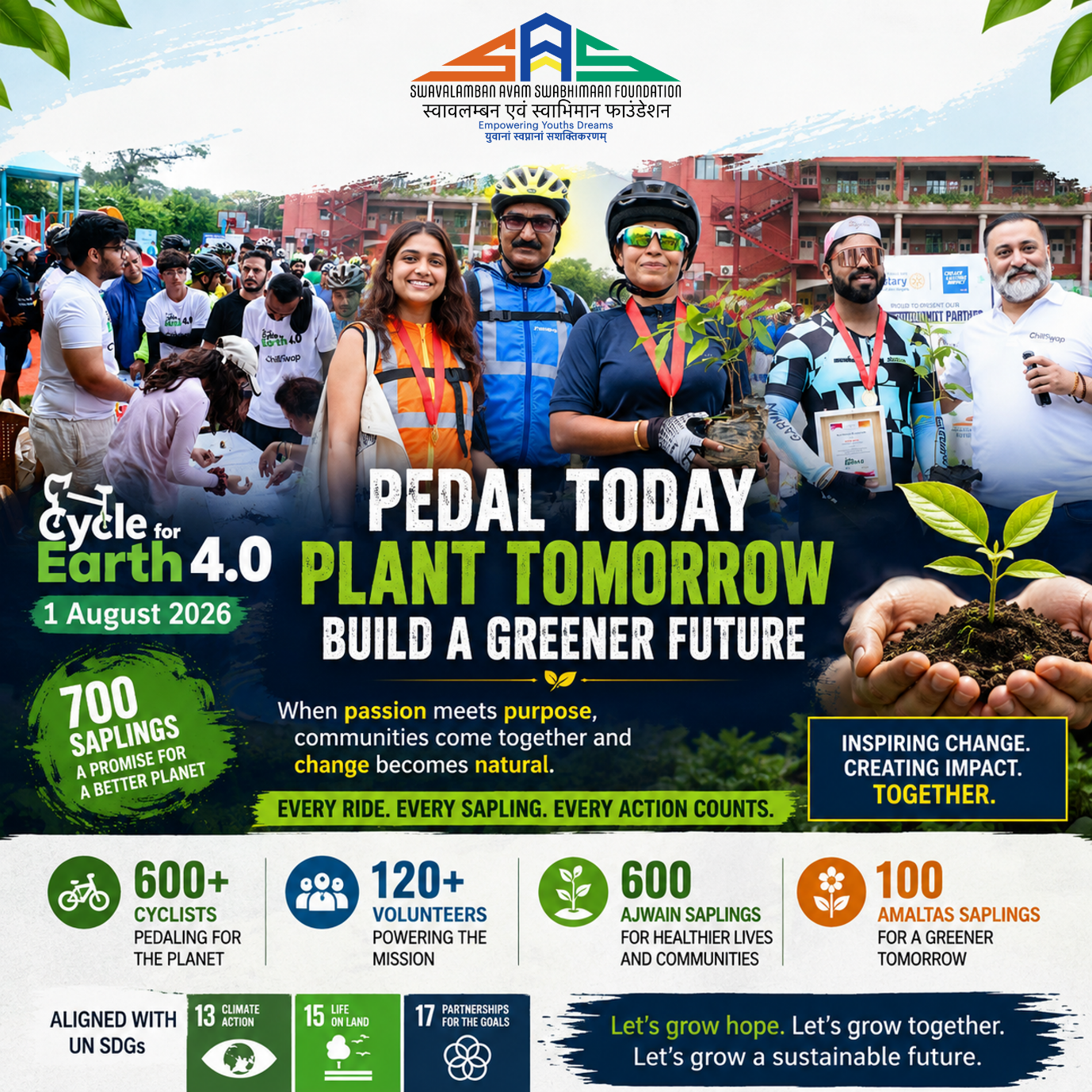
SAS Foundation believes that environmental action becomes stronger when communities work together. Whether it is plantation drives, environmental awareness, e-waste management or other sustainability initiatives, there is always an opportunity to contribute.
If your organisation, institution, school, corporate team, Rotary/Rotaract club or community group is planning an environmental initiative, start the conversation early and let us explore how we can work together.
And if you believe in the mission of creating a more sustainable and empowered society, join SAS Foundation as a member, volunteer, partner or supporter.
Because a greener future will not be built by promises alone.
It will be built by responsible commitments, collective action and people who choose to show up.
Let us plant ideas. Let us nurture action. Let us grow a greener tomorrow—together.


Palam, New Delhi · Education · Health · Environment
Answers are AI-generated and may be inaccurate — for official confirmation, contact SAS Foundation directly.