SAS Foundation Assistant
Palam, New Delhi · Education · Health · Environment
Answers are AI-generated and may be inaccurate — for official confirmation, contact SAS Foundation directly.
+91 931 243 9444
+91 965 470 9935

contact@sas-foundation.in

RZ-54/5A, Rajnagar Part 2,
Palam Colony, New Delhi 110077
What happens when a community decides that old electronics deserve a responsible second life instead of a place in the trash?
Something powerful begins.
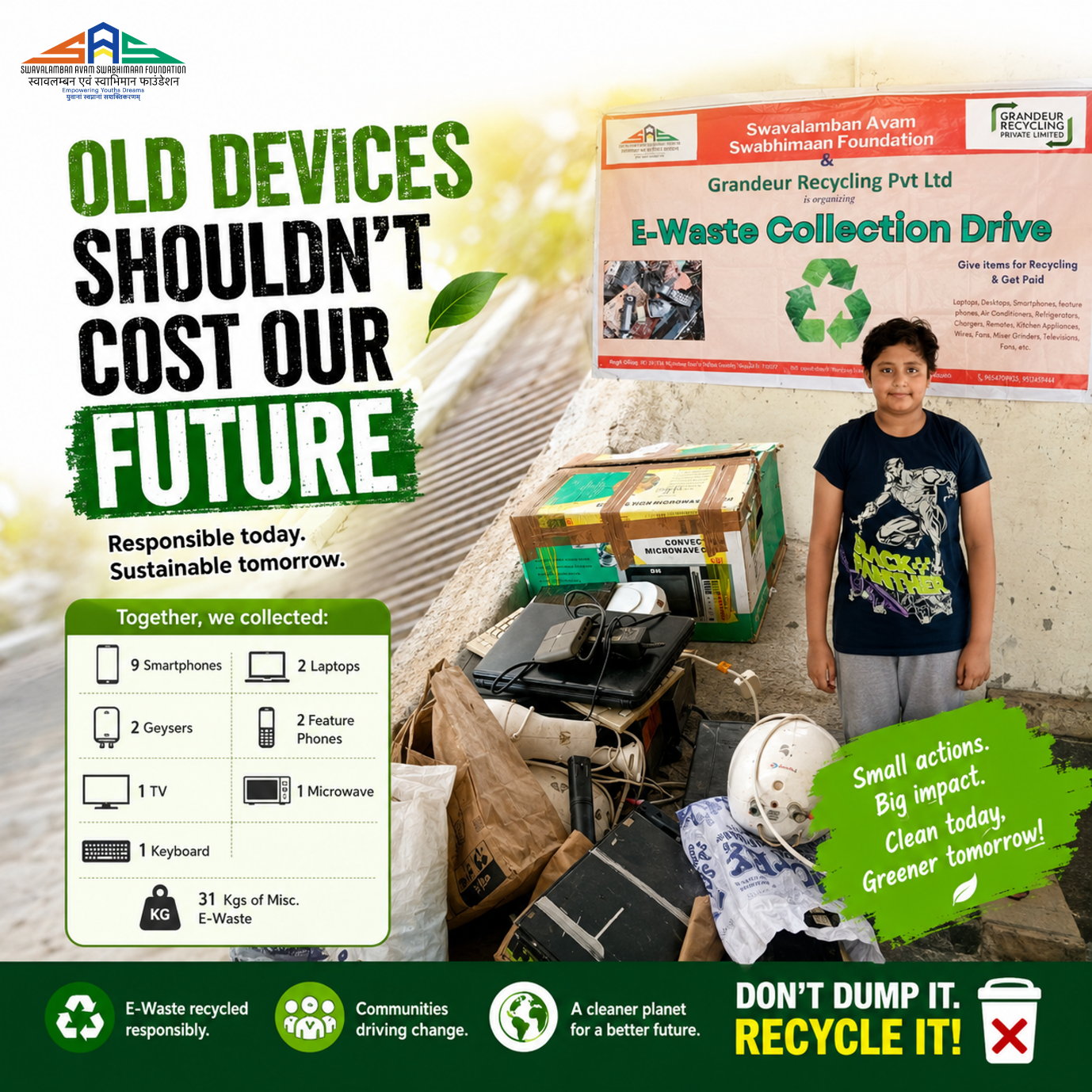
On 26 July 2026, residents of Palm Residency, Sector 76, Faridabad, took an important step towards responsible e-waste management by requesting an e-waste collection drive in their community. In association with Grandeur Recycling Pvt. Ltd., SAS Foundation supported the initiative and helped residents responsibly channel their unwanted electronic items towards recycling.
The drive was not merely about collecting discarded gadgets. It was about creating awareness, encouraging responsible consumption, and demonstrating how collective community action can contribute to a cleaner and more sustainable future.
E-Waste Is Growing. Responsibility Must Grow Faster.
Electronic devices have become an inseparable part of modern life.
Smartphones connect us. Laptops enable education and employment. Televisions entertain us. Microwaves, geysers, stabilizers, UPS systems and countless other electronic products make everyday life more convenient.
But every device eventually reaches the end of its useful life.
The question is: What happens next?
When electronic waste is discarded irresponsibly, valuable materials are lost and potentially hazardous components can enter the environment. Improper disposal can therefore create environmental and resource-management challenges.
This makes responsible e-waste collection and recycling more than an environmental activity. It is a responsibility shared by individuals, residential communities, institutions, businesses and recyclers.
The Palm Residency initiative offered a simple but meaningful answer: start where you live.
A Community That Asked for Change
The most inspiring aspect of this initiative was that the collection drive was requested by the residents themselves.
That matters.
Environmental sustainability becomes significantly more meaningful when communities do not wait for someone else to take the first step.
The residents of Palm Residency recognised that unwanted electronics sitting inside homes could be responsibly channelled into the recycling ecosystem. Their request transformed individual household waste into a collective environmental initiative.
On 26 July, the community came together to contribute their electronic waste for responsible collection.
The result was encouraging.
The collection included:
In total, 18 individual electronic items along with 31 kg of miscellaneous e-waste were collected.
Behind every item was a simple decision: “I will not throw this away irresponsibly.”
That decision is where environmental responsibility begins.
From Household Waste to Collective Impact
One smartphone may appear insignificant.
One old charger may seem too small to matter.
One outdated laptop may simply occupy space in a cupboard.
But when hundreds of households make responsible choices, the collective impact becomes substantial.
This is the fundamental principle behind community-led sustainability: small individual actions can create large collective outcomes.
E-waste collection drives provide communities with a practical mechanism to act on environmental concerns. Instead of asking people to make abstract commitments to sustainability, they create a tangible opportunity to participate.
Residents can identify their unused electronic items, bring them to a designated collection point and ensure that they enter an appropriate recycling channel.
It is simple.
It is practical.
And most importantly, it is repeatable.
The Role of Youth and Volunteers in Environmental Action
Environmental initiatives become stronger when people are willing to move beyond awareness and take responsibility for implementation.
At Palm Residency, SAS Foundation volunteer Shravan Dabi took the lead in conducting the drive.
Shravan was present to address residents’ queries and facilitate the collection of e-waste during the initiative.
This kind of volunteer leadership demonstrates an important principle: environmental change does not always require extraordinary resources; it requires ordinary people willing to take extraordinary responsibility.
For SAS Foundation, supporting youth and community-led environmental action is an important part of its broader commitment to creating a more sustainable future.
Young people, residents and volunteers can become powerful environmental ambassadors when they are given opportunities to participate meaningfully.
Collaboration Makes Sustainability Stronger
The initiative was organised by SAS Foundation in association with Grandeur Recycling Pvt. Ltd., demonstrating the importance of collaboration in building responsible waste-management ecosystems.
No single organisation can solve the e-waste challenge alone.
Communities generate awareness and participate in collection.
Volunteers mobilise and facilitate action.
Organisations build programmes and partnerships.
Recycling partners contribute technical expertise and appropriate recycling channels.
Together, these stakeholders can create a stronger bridge between consumption and responsible resource recovery.
This collaborative approach is particularly important as electronic consumption continues to increase and communities become increasingly dependent on technology.
E-Waste Management Begins at Home
Sustainability does not always require a dramatic lifestyle transformation.
Sometimes, it begins with looking inside a drawer.
That old smartphone.
Those unused charging cables.
The damaged keyboard.
The obsolete UPS.
The non-functional microwave.
The electronics that have been sitting unused for years may still contain materials that can be recovered through appropriate recycling processes.
Instead of allowing them to accumulate indefinitely—or disposing of them with regular household waste—individuals can look for responsible e-waste collection and recycling opportunities.
The next time an electronic device reaches the end of its useful life, the right question is not simply:
“Where can I throw this?”
It should be:
“How can I dispose of this responsibly?”
That shift in mindset is the foundation of a circular economy.
Building a Culture of Responsible Consumption
E-waste management is ultimately about more than waste.
It is about how society consumes resources.
A sustainable future requires us to think about the entire lifecycle of products—from purchase and usage to repair, reuse, collection and recycling.
Communities such as Palm Residency demonstrate that this culture can be built through practical initiatives.
An e-waste collection drive may last only a few hours, but the awareness it creates can last much longer.
A resident who responsibly disposes of one smartphone today may think differently about the next electronic purchase tomorrow.
A child who watches parents participate may grow up understanding that sustainability is not merely a slogan.
A volunteer who leads a community drive may inspire another person to organise one elsewhere.
That is how environmental movements grow—one responsible action at a time.
A Cleaner Future Is a Collective Responsibility
The Palm Residency e-waste collection drive sends a powerful message:
Communities do not have to wait for change. They can create it.
The 18 electronic items and 31 kg of miscellaneous e-waste collected during the drive represent more than numbers. They represent residents choosing responsibility over convenience and action over indifference.
SAS Foundation appreciates the residents of Palm Residency for their initiative and participation, Grandeur Recycling Pvt. Ltd. for its association, and volunteer Shravan Dabi for taking the lead in conducting the drive.
The real success of such an initiative, however, will be measured not only by what was collected on 26 July, but by what happens next.
Will more communities ask for e-waste collection drives?
Will more households separate electronic waste from regular waste?
Will more young people volunteer for environmental initiatives?
Will responsible recycling become a community habit?
The answer can begin with each one of us.
Be Part of the Change
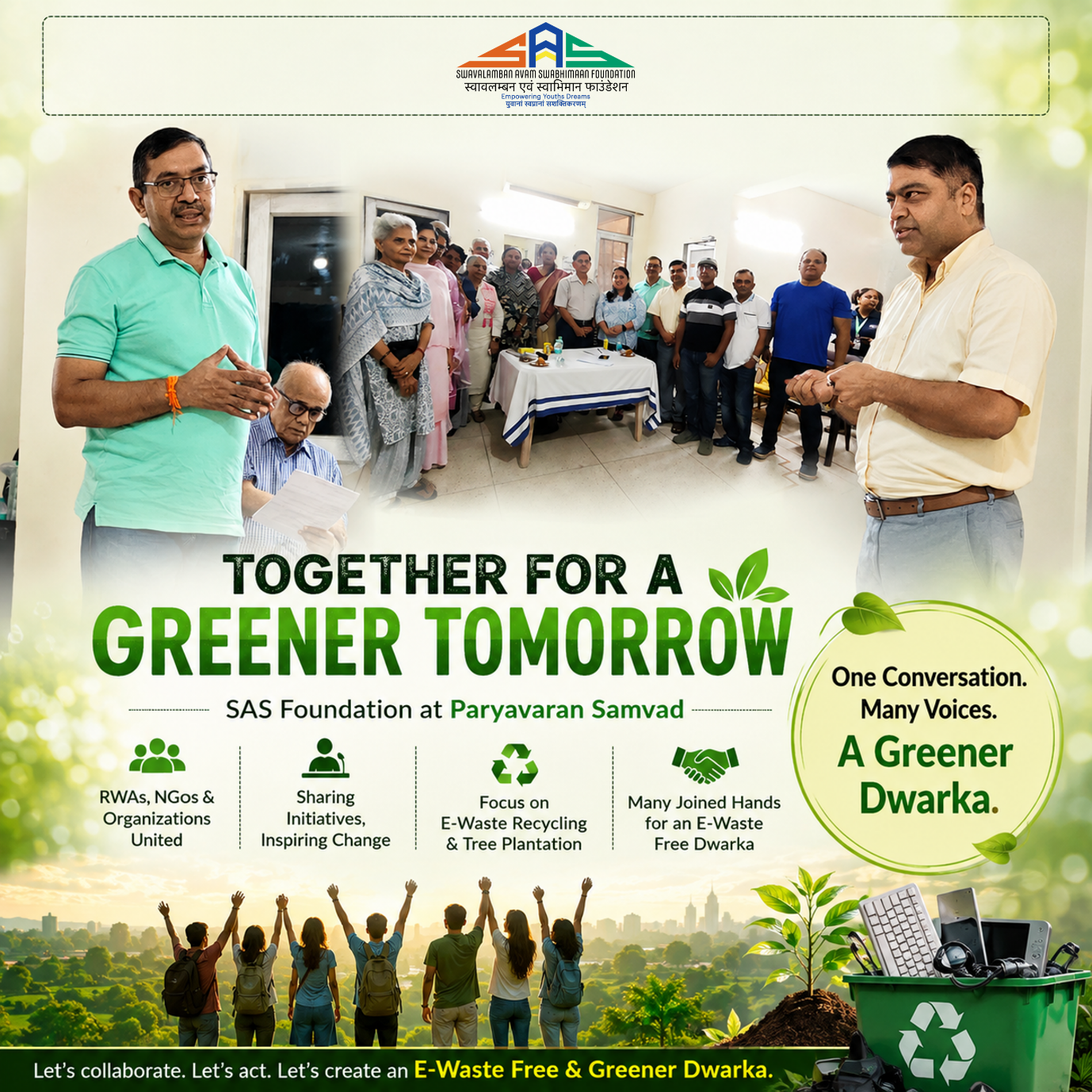
SAS Foundation believes that environmental transformation becomes possible when communities, youth, volunteers, organisations and responsible businesses join hands.
If your residential society, school, college, workplace or community has accumulated e-waste, consider organising a responsible e-waste collection initiative.
If you are a young person looking for an opportunity to contribute to environmental sustainability, step forward as a volunteer.
And if you believe that meaningful change begins with collective action, join SAS Foundation as a member and become part of a growing community working towards a cleaner, greener and more responsible future.
Because the future does not become sustainable by itself. We build it—one responsible choice, one community and one action at a time.
Join SAS Foundation. Become a member. Let us empower communities and youth to create the environmental future we want to live in.

Palam, New Delhi · Education · Health · Environment
Answers are AI-generated and may be inaccurate — for official confirmation, contact SAS Foundation directly.